Why Culture usually wins

Image courtesy of Unsplash
Executive Summary
Organisations often describe culture through values, policies, and leadership statements. Those things can express worthwhile intentions, but they do not determine how people behave. Culture is formed through the conduct that is rewarded, repeated, challenged, or tolerated. It becomes particularly visible when pressure rises and declared principles compete with immediate results. Strategy may set direction and policy may define expectations, but culture determines what people believe will really happen. Sustainable improvement therefore requires more than communication. It requires leaders to align their decisions, responses, and consequences with the behaviour they claim to value.
Why Culture Usually Wins
Most organisations can explain the culture they would like to have. Their websites refer to integrity, collaboration, customer focus, accountability, and continuous improvement. Values appear in induction materials, internal communications, and leadership presentations. Policies explain how people should behave and how decisions should be made. These statements can be sincere and useful. They are not necessarily culture.
Culture is revealed through everyday experience. It develops from what leaders notice, what managers reward, what colleagues repeat, what the organisation challenges and what it quietly allows to continue. That is why culture usually wins.
A strategy can set a new direction. A policy can introduce a new expectation. A project can create a new system. But if established behaviour remains stronger than the formal change, people will usually return to what the organisation has taught them is normal.
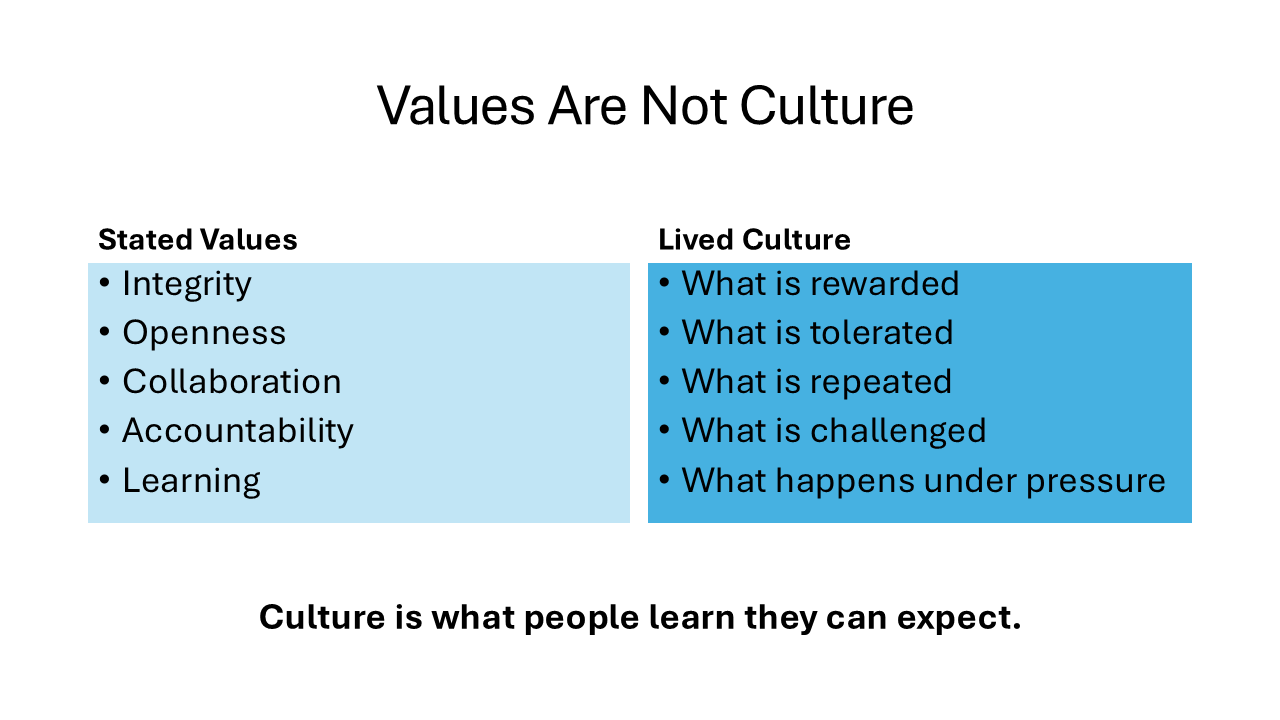
Culture is not the values statement
Values statements describe intention. Culture describes expectation. An organisation may say that it values openness, but employees will judge openness by what happens when somebody raises an uncomfortable concern. It may declare accountability, but people will judge accountability by whether commitments carry consequences. It may promote learning, but employees will notice whether mistakes lead to reflection or blame. The distinction matters because employees learn culture through observation.
They watch which behaviours attract recognition. They notice which concerns receive attention. They see whether rules apply consistently and whether senior people are held to the same standards as everybody else. Over time, these observations create a practical understanding of how the organisation works. That understanding is often more influential than anything written in a handbook.
What is rewarded becomes repeated
Every organisation has a reward system. Some rewards are formal. They include pay, promotion, performance ratings, and access to development opportunities. Others are informal. Attention is a reward. Access to senior leaders is a reward. Being protected from criticism can be a reward. Receiving praise for resolving a crisis, even when the same person helped create it, can reinforce a particular pattern of behaviour. These signals matter because people adapt to them.
If an organisation says that collaboration matters but promotes people solely for individual results, individual competition is likely to survive. If leaders say that risk should be raised early but react badly to unwelcome information, people will learn to delay unwelcome news. If short-term performance is rewarded regardless of how it is achieved, conduct will gradually adjust to that expectation. The written value remains. The rewarded behaviour becomes the culture.
What is tolerated becomes permitted
Culture is shaped not only by what organisations reward, but also by what they tolerate. A missed commitment may appear minor. An exception may seem reasonable. A recurring behaviour may be accepted because the person involved delivers strong results or possesses valuable knowledge. Each decision can be justified in isolation. Together, they create a standard. When poor behaviour carries no meaningful consequence, the organisation quietly communicates that the behaviour is permitted. When responsibility is repeatedly avoided, others learn that accountability is optional. When one team is allowed to ignore a process, the process becomes negotiable for everyone. Tolerance can be particularly damaging because it is rarely announced.
No leadership team formally declares that commitments do not matter. Few organisations intentionally decide that their policies should apply inconsistently. Instead, inconsistency develops through individual moments when challenge feels inconvenient. Culture records those moments even when the official record does not.
““If declared values and rewarded behaviour conflict, rewarded behaviour wins.””
Pressure reveals the real culture
Culture is often easiest to discuss when conditions are calm. The true test arrives when something goes wrong. What happens when a target is missed? What happens when costs rise unexpectedly?
What happens when an employee challenges a senior decision? What happens when somebody admits a mistake? Under pressure, organisations reveal what they value most. Collaboration may disappear as departments protect themselves. Openness may weaken as difficult information is softened. Long-term principles may give way to short-term performance. This does not necessarily mean that the organisation’s values were dishonest. It may mean that those values were never reinforced strongly enough to survive pressure. A value that applies only when convenient is not yet part of the culture. A principle becomes cultural when people expect it to hold even when ignoring it would be easier.
Culture explains why good changes fail
Many organisational improvements fail despite sound design. A new process is introduced, but teams continue using old workarounds. Accountability is clarified, but decisions remain delayed. Leaders ask for greater openness, but employees continue withholding difficult information. These failures may be described as communication problems or resistance to change.
Culture is often the missing explanation. People do not judge a new initiative only by what they are told. They judge it against what they have previously experienced. If earlier initiatives disappeared once leadership attention moved elsewhere, scepticism is rational. If people were previously criticised for raising concerns, a new invitation to speak openly may not immediately feel safe. If deadlines have historically mattered less than relationships or hierarchy, a revised process will not change behaviour on its own. Culture carries organisational memory. It tells people whether the latest message represents a durable change or another temporary priority.
Leadership behaviour carries more weight than leadership language
Leaders influence culture through visible decisions. People notice who receives attention, how conflict is handled, whether difficult news is welcomed and whether leaders admit their own mistakes. They notice whether pressure changes the standards that leaders previously described as non-negotiable. This does not mean leaders must behave perfectly. It means that leadership behaviour should be credible and consistent enough to reinforce the organisation’s stated expectations.
A leader who acknowledges an error can strengthen a culture of openness. A leader who challenges powerful performance achieved through poor conduct can reinforce standards. A leader who asks for unwelcome news early and responds constructively can make early escalation safer. These moments often influence culture more than a formal communications campaign. Leadership messages describe the desired culture. Leadership behaviour demonstrates whether it is real.
Culture cannot be changed through communication alone
Communication is necessary when an organisation wants culture to change. People need to understand what is expected, why it matters and what the organisation is trying to improve. But communication cannot carry the full burden. Posters, presentations, and values workshops do not change culture if the organisation’s decisions continue rewarding the old behaviour. A culture programme may create useful language, but the language will lose credibility if everyday experience contradicts it. Cultural change requires alignment.
The organisation must align:
what leaders say
what leaders do
what managers reinforce
what systems reward
what poor behaviour triggers
what happens when pressure rises.
Without that alignment, the existing culture will absorb the new language and continue unchanged.
Culture is maintained locally
Senior leaders influence culture, but culture is experienced locally. For most employees, the immediate manager, team, and working environment provide the strongest daily signals. Culture becomes real through meetings, workload decisions, performance conversations, responses to mistakes and the way colleagues treat one another. This explains why one organisation can contain several distinct cultures. The formal values may be identical across every department, while local expectations vary significantly. One team may raise concerns early. Another may conceal problems until they become unavoidable. One manager may encourage challenge. Another may treat questions as disloyalty.
Culture therefore needs attention at the level where work occurs. Organisation-wide statements matter. Local behaviour determines whether those statements become normal practice.
The test
A simple test helps reveal an organisation’s real culture:
What behaviour is repeatedly rewarded, protected, or tolerated, particularly when pressure is high?
The answer is likely to describe the culture more accurately than the published values. This is not an argument for abandoning values statements or formal policies. Those tools can provide direction and establish expectations. But they are only credible when everyday behaviour supports them.
Conclusion
Culture is sometimes described as an intangible feature of organisational life. Its consequences are anything but intangible. Culture affects what information reaches leaders, how quickly risks are raised, whether people accept accountability, how customers are treated and whether change becomes established. It influences decisions long after the meeting has ended. That is why culture usually wins. It does not win because strategy, structure or policy are unimportant. It wins because culture shapes how people interpret and apply them in practice. Organisations create stronger cultures when they align words with behaviour, recognition with values and consequences with expectations. They pay attention not only to the conduct they encourage, but also to the conduct they allow. Culture is not what an organisation says about itself. It is what people learn, through repeated experience, they can expect.
Why Good Decisions Still Fail

Image courtesy of Unsplash
Executive Summary
Organisations devote considerable time and effort to making decisions. Strategies are developed, plans are approved, projects are launched, and priorities are established. Yet many organisations still fail to achieve the outcomes they expect.
The challenge is rarely the quality of the decision itself. More often, it is the ability to execute effectively. Successful implementation requires clarity, focus, and commitment to a single overriding priority. While good decisions create the opportunity for success, execution is what converts intention into measurable results.
Too often, organisations mistake alignment for progress, assuming agreement alone will deliver outcomes. Sustained success depends on disciplined execution, consistent follow-through, and the ability to maintain focus over time. The organisations that succeed are not simply those that make the right decisions, but those that consistently act on them.
Why good decisions still fail
Organisations devote considerable effort to making decisions. Meetings are held, options are discussed and evaluated. Recommendations are reviewed, following a discussion around risk and mitigation decisions are approved. This activity is an important part of the process, as solid decisions are crucial to the stability of the organisation.
Yet many organisations experience a frustrating reality. The decision appears sound, but the outcome disappoints. A strategy that seemed convincing produces only limited improvement. A recovery plan gains widespread support but fails to deliver meaningful and sustainable change. A new initiative launches successfully and then gradually loses momentum, on a personal level just reflect on all those new gym memberships in January that are not used beyond March. The immediate temptation is to question the decision itself, sometimes that is appropriate. Often it is not.
Many good decisions fail because execution fails long before the decision does.
A decision creates potential
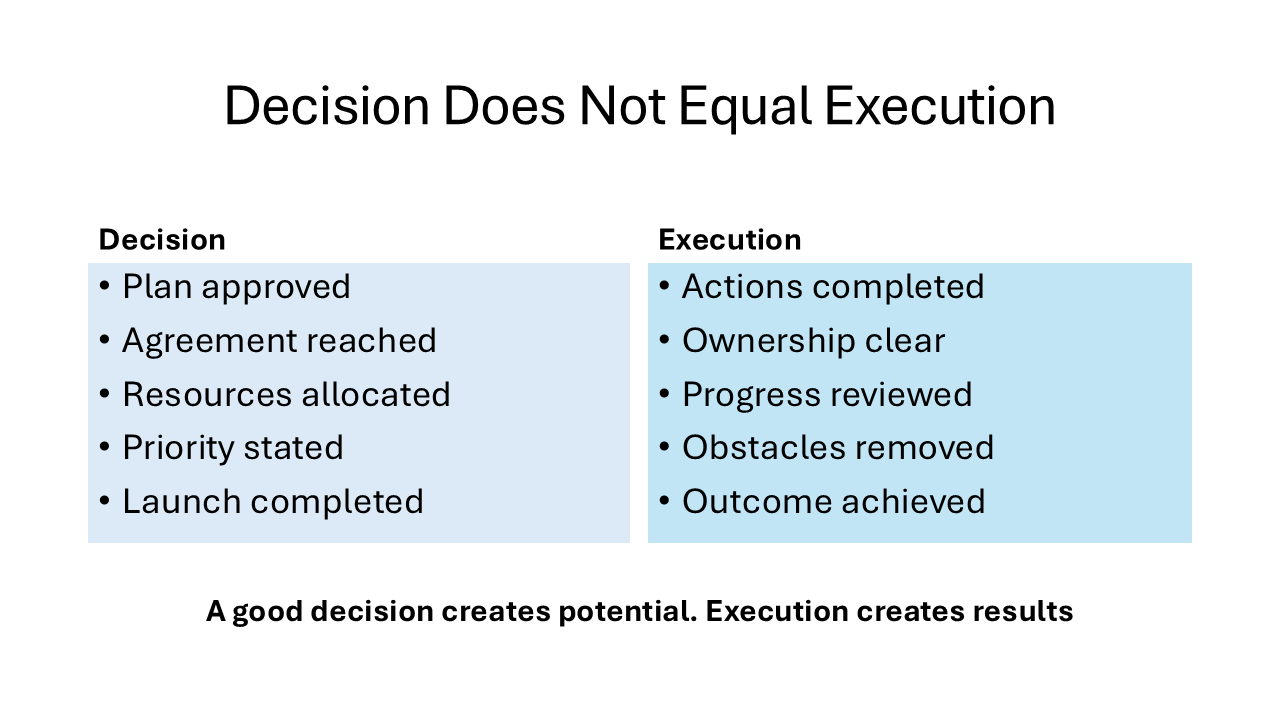
A useful distinction is separating decisions from outcomes. Organisations often treat them as though they are closely linked. In practice, they are only connected by execution. A decision approves a direction. It allocates resources, establishes priorities, and creates the possibility of improvement. What it cannot do is guarantee results. The gap between decision and outcome is where most organisational effort occurs. This gap is frequently underestimated.
A leadership team may spend weeks discussing a decision and then assume implementation will naturally follow. Unfortunately, reality is rarely that the impact of a decision can only be assessed once implementation is complete.
Agreement is not delivery
One of the most common execution traps is confusing agreement with progress. A decision receives support. Stakeholders are aligned behind it, the meeting ends with apparent consensus, everything, and everyone, feels positive. Yet nothing has changed. No customer has received a better service. No risk has reduced. No efficiency has improved. Only agreement has been achieved. Agreement is valuable because it creates a platform for action. It is not action. Many initiatives begin with strong consensus and gradually fade because the organisation mistakes support for delivery.
Why momentum disappears
Most execution failures do not occur at the beginning. They occur after the initial energy fades. Remember those gym memberships? At the start of a new initiative there is often enthusiasm. People are engaged, attention is focused, leadership interest is visible. Then other priorities emerge. New demands appear. Operational pressures return. What was once a visible priority now competes with everything else. The organisation becomes busy again. Momentum weakens as progress slows, which weakens the momentum further, and progress slows. Eventually the initiative survives more as a stated intention than an operational reality. This pattern is remarkably common. It explains why many organisations are better at launching improvements than sustaining them.
“Most execution failures begin after the initial enthusiasm fades.”
Ownership matters more than activity
Strong execution requires ownership. Not a committee, not a discussion group., not a shared aspiration. Ownership. Someone must be accountable for moving the work forward. Someone must remove obstacles, someone must ensure that progress remains visible after attention shifts elsewhere. Without ownership, activities continue but outcomes become uncertain. Tasks may be completed, meetings may occur, reports may be produced. Yet the desired outcome remains no closer. Execution requires accountability linked directly to results rather than simply activity.
Review keeps priorities alive
Another common reason execution weakens is the absence of meaningful review. Organisations often review activity instead of progress. They discuss:
meetings held
work completed
milestones achieved
documents produced.
These measures can be useful. But they do not necessarily indicate movement towards the desired outcome. The stronger question is:
What has improved?
Regular review helps prevent initiatives from becoming background noise. It keeps leadership attention focused on outcomes rather than effort. Most importantly, it creates opportunities to identify obstacles before momentum is lost completely.
Execution depends on consistency
Many organisations search for breakthrough solutions. Execution is usually less dramatic. It depends on consistency. Small actions repeated over time often create greater results than short bursts of intense activity. This is true in organisations and in personal development.
Progress is rarely created by one exceptional week. It is created by sustained follow-through. The same principle applies to strategy, governance, change, learning, and growth. Improvement depends on continued execution long after the original excitement has passed.
The hidden cost of weak execution
Poor execution creates more than disappointing outcomes. It damages confidence. People begin to doubt future initiatives. Scepticism grows. Stakeholders remember previous promises that produced limited results. Future change becomes harder because organisational memory now contains evidence that commitments do not reliably become outcomes. This creates a difficult cycle. Weak execution reduces trust. Reduced trust weakens future execution. Breaking that cycle requires visible delivery rather than additional promises.
The test
A simple test helps distinguish good intentions from execution:
If nobody owns the outcome, the decision has not been executed.
Ownership does not guarantee success, however, the absence of ownership makes success even less likely.
Conclusion
Many organisations assume that success follows naturally from making good decisions. It does not. Good decisions create direction. Only good execution creates results. The gap between the two is where priorities compete, momentum is tested, and accountability matters most. Agreement is valuable planning is essential, strategy is important. But none of them create outcomes on their own. The organisations that succeed consistently are not necessarily those that make the best decisions. They are often the organisations that execute good decisions more reliably than others. Because execution is not what happens after a decision is made. Execution is how the decision becomes real.
Why some organisations improve faster than others

Image Courtesy of Unsplash
Executive Summary
Every organisation encounters problems, setbacks, mistakes, and unexpected challenges. The difference between high-performing organisations and struggling organisations is rarely the absence of problems. More often, it is the speed and consistency with which lessons are turned into action. Many organisations gather feedback, conduct reviews, and identify lessons learned. Far fewer change behaviour as a result. Sustainable improvement comes not from collecting knowledge but from applying it. Organisational learning is not measured by what has been documented. It is measured by what has become normal practice.
Why some organisations improve faster than others
Every organisation wants to improve. Leaders want better performance. Teams want fewer frustrations. Customers want better service. Owners want stronger results. Despite this shared ambition, organisations improve at very different rates.
Some appear to learn quickly. Once problems are identified, changes are made, and performance improves. Others seem trapped in a cycle of recurring issues. The same concerns reappear. The same recommendations resurface. The same surprises continue to cause disruption. This raises an important question:
Why do some organisations improve faster than others?
The answer often lies in the difference between experience and learning.
Experience alone is not enough
Experience is frequently described as a valuable teacher.
In many respects, that is true. Experience exposes weaknesses. It reveals gaps in capability. It creates opportunities to reflect and improve. However, experience does not automatically create learning. An organisation may experience customer complaints, delivery failures, project delays, staff turnover, or governance issues. Those events provide information. They create the opportunity for learning.
The learning itself only occurs if something changes. Without that change, the organisation has merely accumulated a record of the experience. This distinction is important because organisations often assume that awareness and learning are the same thing. They are not. Knowing that a problem exists is different from doing something about it.
Lessons identified are not lessons learned
Many organisations conduct reviews after significant events. Projects hold lessons-learned workshops. Teams discuss what went well and what could improve. Reports are written. Recommendations are captured. All of these activities are worthwhile.
The difficulty is that identifying a lesson and learning a lesson are not the same thing. A lesson is only truly learned when behaviour changes.
If a project identifies the importance of stakeholder engagement but future projects behave in exactly the same way, the lesson was recorded but not learned. If a risk review highlights concentrated dependency on a small number of individuals but no action follows, knowledge has been created without improvement. The lesson exists, but the learning does not.
“A lesson is only truly learned when behaviour changes.”
- Derran Stokes Penyard Project Consultants
Knowledge does not create capability on its own
This challenge becomes more obvious when organisations invest heavily in training. Training can increase knowledge and understanding. It can introduce new tools, concepts, and ways of thinking. But knowledge alone does not guarantee capability. People often know what they should do. Consistent implementation of what should be done is the recurring difficulty.
An organisation may understand the principles of project governance, customer service, operational resilience, or financial management. Yet those principles may still fail to influence everyday decisions. Capability emerges when knowledge becomes routine behaviour. The gap between knowing and doing is where many improvement efforts lose momentum.
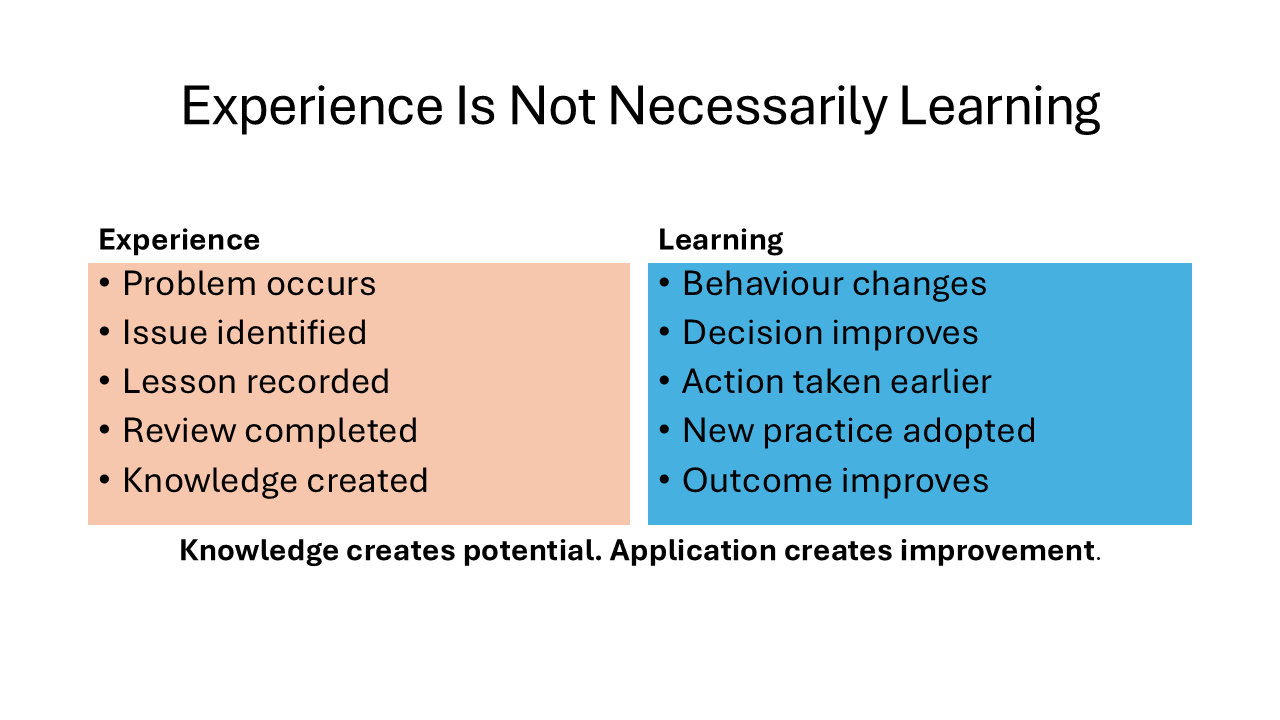
Experience alone does not create learning. Learning happens when behaviour changes
Learning changes decisions
One of the strongest signs that learning is taking place is improved decision-making. A learning organisation does not simply collect insights. It uses them. Leaders ask better questions. Teams recognise problems earlier. Risks are identified before they become issues. Mistakes become less frequent because previous mistakes have altered behaviour. The result is not perfection. Problems still occur. The difference is that organisations become better at responding because prior experience influences current judgement. Learning therefore appears less in documents and more in decisions.
Repeated surprises are warning signs
A useful signal of organisational learning is how often the same surprise occurs. Unexpected events will always happen. Markets change. Circumstances shift. New challenges emerge. The concern arises when familiar events continue to produce the same reaction. A recurring problem should become progressively less surprising. If the same issue creates the same level of disruption year after year, there is a reasonable chance that learning has not been translated into action. Repeated surprise often indicates one of three things:
the lesson was never identified;
the lesson was identified but not applied;
the lesson was applied inconsistently.
In each case, the challenge is not knowledge. The challenge is adoption.
Learning must become normal practice
The most successful organisations are not necessarily those with the best training programmes, the largest knowledge bases, or the most detailed process documentation. They are often the organisations that make learning part of normal practice. When lessons become embedded:
people share knowledge more freely
problems are addressed earlier
improvements become easier to sustain
capability becomes less dependent on individuals.
Learning becomes part of the culture rather than an occasional activity. This creates compounding benefits over time. Each improvement makes future improvement easier.
Why organisations stop learning
Ironically, success can sometimes become a barrier to learning. When performance is acceptable, there is less pressure to challenge assumptions. Existing methods become comfortable. Improvement begins to feel optional. The organisation continues operating successfully, but its ability to adapt gradually weakens. This is one reason why some organisations struggle when circumstances change. Their previous success reduced the urgency to learn. Learning requires curiosity. It also requires the humility to accept that current practice can be improved.
The test
A simple test helps determine whether genuine learning has occurred:
If the same problem creates the same surprise, the learning has not occurred.
This is not a criticism. It is a signal. The organisation may know what happened. The question is whether that knowledge has changed behaviour.
Conclusion
The organisations that improve fastest are not those that avoid mistakes. They are the organisations that convert experience into action more effectively than others. They identify lessons, apply them consistently, and reinforce them until new behaviours become normal practice. Knowledge matters. Training matters. Reviews matter. But none of them create improvement on their own. Improvement occurs when lessons influence behaviour, decisions, and outcomes. Because organisational learning is not measured by what has been documented. It is measured by what people do differently because of it.
Why Organisations struggle with change

Image Courtesy of Unsplash
Executive Summary
Most organisations understand how to announce change. Far fewer understand how to make change stick. New structures, systems, processes, and initiatives are often introduced with good intentions, yet many fail to deliver the expected benefits. The reason is simple: organisations frequently focus on implementing change rather than achieving the behavioural shifts needed to realise value. Successful change is not measured by what has been launched. It is measured by what people do differently once the launch is over.
Why organisations struggle with change
Change has become a permanent feature of organisational life. New systems are introduced. Processes are redesigned. Teams are restructured. Strategies are refreshed. Improvement programmes are launched. For many organisations, change is no longer an occasional event. It has become part of normal operations.
Yet despite the amount of effort invested in change, many organisations continue to experience a similar problem. The change happens, the benefits do not.
This raises an uncomfortable question:
Why is organisational change so often more difficult than expected?
The answer usually has less to do with the quality of the solution and more to do with the way people experience change.
Organisations change quickly. People do not.
A leadership team can approve a change in a meeting. A project team can implement a system in a few months. A process can be redesigned within weeks. Formal change can happen surprisingly quickly. Behavioural change rarely follows the same timetable.
People need time to understand new expectations. Existing habits need to be replaced. New ways of working need to become familiar. Confidence needs to develop. This creates a gap.
The organisation may believe the change is complete because the initiative has been delivered. The people affected by it may still be adapting. This is one reason so many change programmes appear successful on paper while producing disappointing outcomes in practice.
Change is not the objective
One of the most common mistakes is treating change as the goal. It is not.
Few organisations introduce a new process because they enjoy changing processes. Few leadership teams replace systems because they enjoy disruption.
The real objective is always something else:
· Better service
· Greater efficiency
· Lower risk
· Higher quality
· Faster delivery
· Stronger performance
The change is simply the mechanism. When organisations become overly focused on implementation, they can lose sight of the outcome the change was intended to create. As a result, success becomes defined by delivery rather than improvement. The initiative finishes. The desired result remains uncertain.
People experience consequences, not programmes
Leaders often describe change through organisational language. They talk about transformation, operating models, restructuring, technology, efficiency, and strategic priorities. Most employees experience something much simpler. What does this mean for me?
“People rarely resist change itself. They resist uncertainty, loss, or consequences they do not yet understand.”
That question sits at the heart of many change challenges.
People want to understand:
· What will change?
· What remains the same?
· What becomes easier?
· What becomes harder?
· What support will be available?
· How will success be measured?
When these questions remain unanswered, uncertainty grows. Uncertainty often looks like resistance. It is usually a request for clarity.
Resistance is frequently misunderstood
Resistance is commonly described as opposition. A more useful interpretation is that resistance often signals an unresolved concern.
For example:
· The purpose may be unclear.
· The benefit may not be visible.
· The impact may feel one-sided.
· Previous initiatives may have disappointed.
· Accountability may be uncertain.
Treating resistance as a problem to overcome can create conflict. Understanding resistance as information often creates progress. The question becomes:
What concern is preventing commitment?
That question tends to produce much better answers.
Communication is necessary but not sufficient
Communication is often treated as the solution to change resistance. Effective communication matters. Poor communication almost always makes change harder.
However, communication alone does not create commitment. An organisation can communicate frequently and still fail to change behaviour.
No amount of presentation, documentation, or email distribution will replace practical experience.
People begin to believe in change when they see:
· decisions changing
· leaders behaving differently
· processes being used consistently
· benefits becoming visible.
Communication introduces change. Behaviour demonstrates it.
Adoption matters more than launch
Many organisations celebrate launches. A new system goes live. A revised process is introduced. A programme reaches completion. These milestones deserve recognition. The difficulty is that adoption often begins where the project ends. A system only creates value when people use it.
A process only improves performance when it becomes normal practice. A new structure only works when people understand how to operate within it.
This is why implementation and adoption should never be confused. Implementation creates capability. Adoption creates value.
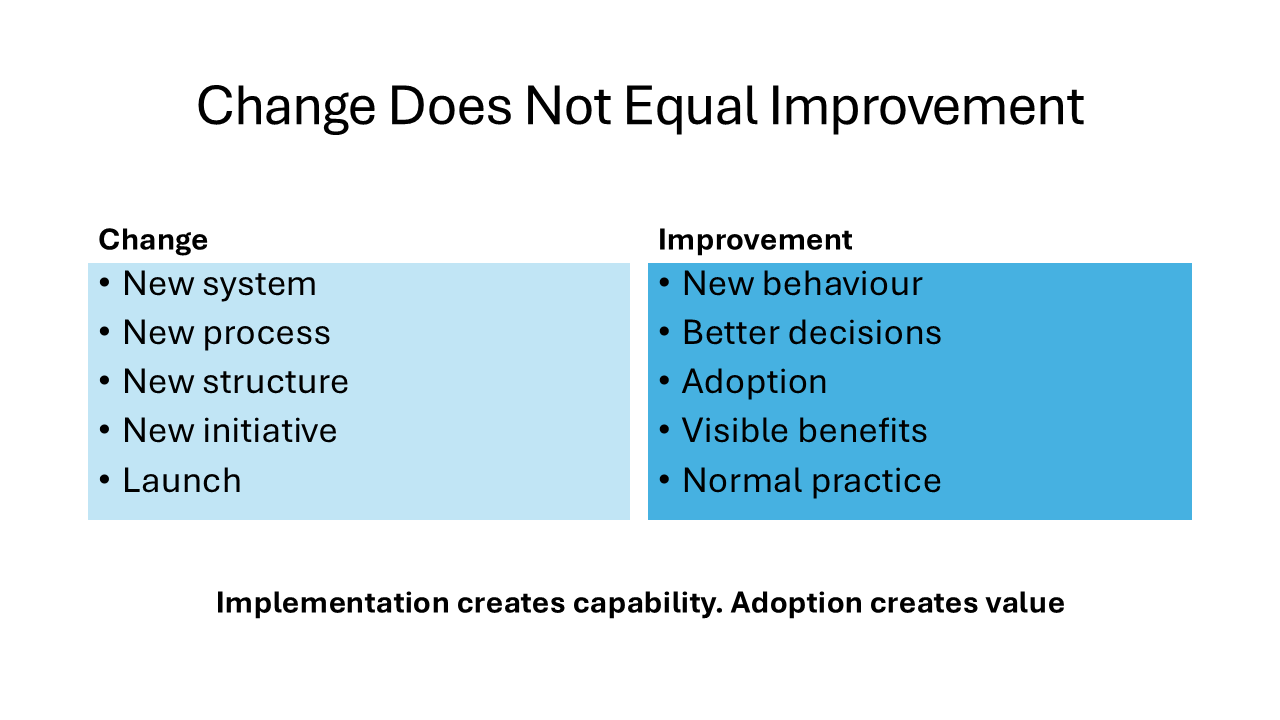
Change Does Not Equal Improvement - Derran Stokes
Behaviour is the real measure
The most reliable indicator of successful change is behavioural evidence. Not whether the initiative was launched. Not whether training was completed. Not whether the programme closed successfully.
The question is:
What are people doing differently?
If decision-making remains unchanged, the change is incomplete. If old workarounds remain dominant, the change is incomplete. If new processes exist but are rarely followed, the change is incomplete. The evidence of successful change appears in practice long before it appears in reports.
The test
A simple test helps distinguish change activity from genuine change:
If behaviour never changes, the change never happened.
Organisations sometimes find this uncomfortable because behavioural change is harder to measure than delivery activity. Nevertheless, it remains the most reliable indicator.
Conclusion
Most organisations can implement change. The greater challenge is ensuring that change becomes part of normal behaviour. This requires more than communication, programme management, or implementation plans. It requires people to understand the purpose of the change, believe the intended outcome is worthwhile, and adjust the way they work as a result.
Change should not be measured by what has been launched. It should be measured by what has become normal.
Because change is not complete when the announcement is made. It is complete when the new behaviour no longer feels new.
What Clients really buy from trusted advisers

Image courtesy of Unsplash
Executive Summary
Clients may initially appoint advisers because of their knowledge, experience, or technical expertise. Those qualities matter, but they are rarely what creates a lasting advisory relationship. Trusted advisers provide something more valuable: clarity when choices are difficult, perspective when the client is too close to the issue, constructive challenge when comfortable assumptions need testing, and judgement when evidence remains incomplete. The strongest advisers do not take decisions away from their clients or create dependency. They help clients understand their choices, consequences, and uncertainties clearly enough to exercise their own judgement with confidence.
Clients rarely need more information
Most organisations are not short of information. Reports are available. Data is collected. Opinions are offered. Internal teams understand the history, personalities, and operational detail surrounding an issue. Yet important decisions can remain unresolved. This is because information and understanding are not the same thing.
A client may possess extensive knowledge of a problem while still being uncertain about what to do next. Several options may appear credible. Different stakeholders may interpret the same evidence differently. The consequences of acting may be visible, while the consequences of delay remain hidden. At moments like these, adding further information does not necessarily help. The client needs clarity. That is where trusted advice begins.
Expertise opens the door
Clients rightly expect advisers to understand their subject. Expertise provides credibility. It allows an adviser to recognise patterns, evaluate evidence, identify risks, and distinguish important details from background noise. Without expertise, advice lacks a sound foundation. But expertise alone does not create trust.
A knowledgeable adviser can still overwhelm a client with detail, make recommendations that ignore practical reality, or become more interested in demonstrating understanding than improving the decision. Technical accuracy is necessary. It is not sufficient.
Clients may appoint an adviser because of expertise. They continue working with that adviser because expertise has been converted into useful judgement.
Trusted advisers create clarity
The central value of trusted advice is often the ability to make a difficult decision easier to understand. That does not mean making the decision itself easy. Some choices remain uncomfortable, uncertain, or expensive even after they have been framed properly. Clarity means that the client understands:
what is actually being decided
which options genuinely deserve consideration
what consequences follow from each choice
what remains uncertain
what must happen next.
This clarity reduces the amount of noise surrounding the decision. Adjacent issues can be separated from immediate ones. Premature options can be deferred. Assumptions can be made explicit. Information that does not alter the judgement can remain available without dominating the discussion. The problem becomes smaller without being oversimplified.
Clients may initially buy expertise. They retain trusted advisers for judgement.
Perspective is difficult to create internally
Clients often understand their organisations better than any external adviser ever could. They know the history, culture, working relationships, previous decisions, and practical constraints. That knowledge is valuable, but it can also make issues harder to see clearly. People inside an organisation may have become accustomed to recurring problems. Temporary workarounds may have become normal practice. Longstanding assumptions may no longer be questioned. Political or personal considerations may make certain conclusions uncomfortable to express.
An external adviser can provide distance. That distance allows familiar circumstances to be viewed afresh. It can reveal that an accepted constraint is actually a choice, that an apparently new problem has developed gradually, or that a discussion about cost is concealing uncertainty about value. The adviser does not possess better organisational knowledge. The adviser provides a different angle from which that knowledge can be examined.
Constructive challenge is part of trust
Trusted advice is not constant agreement. An adviser who supports every proposal, confirms every assumption, and avoids every difficult conversation may be pleasant to work with, but is unlikely to be valuable when decisions become serious. Trust sometimes requires challenge.
That challenge might involve saying:
the evidence does not support the preferred conclusion;
the decision is being taken too early;
an attractive opportunity does not fit the strategy;
apparent savings create greater long-term cost;
ownership remains unclear;
the organisation is monitoring risk rather than controlling it.
This does not require confrontation. Challenge becomes constructive when it focuses on the decision rather than the person making it. The strongest advisers test assumptions calmly, explain consequences plainly, and resist the temptation to dramatise disagreement. The objective is not to prove the client wrong. It is to ensure that the decision is strong enough to survive reality.
Judgement matters most when evidence is incomplete
If every relevant fact were known, many senior decisions would be considerably easier. In practice, leaders often choose while evidence remains incomplete, conditions are changing, and several outcomes are possible. Analysis can reduce uncertainty. It cannot remove it entirely.
This is where judgement becomes valuable. Judgement recognises when the evidence is sufficient to proceed. It distinguishes uncertainty that matters from uncertainty that can be tolerated. It identifies when further analysis will materially improve the decision and when it will merely delay commitment. Trusted advisers do not pretend to know what cannot be known. They express uncertainty honestly, while still helping the client decide. That balance matters. Excessive certainty undermines credibility when events change. Excessive caution leaves the client no clearer than before. Experienced advice sits between the two.
It says, in effect:
This is what the evidence currently indicates, these are the principal uncertainties, and this is the most proportionate decision available.
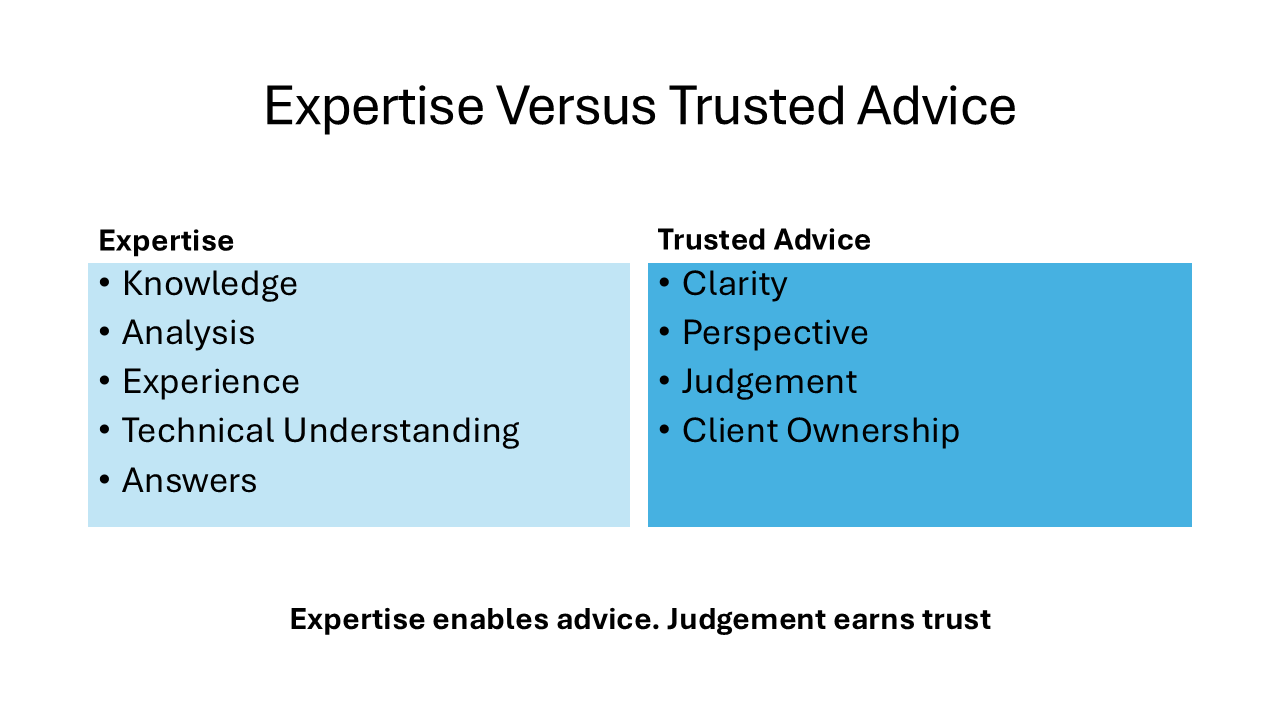
Expertise versus Trusted Advice
Trusted advisers make consequences visible
Senior decisions often become distorted because attention concentrates on the immediate and visible consequences of acting. The financial cost is clear. The disruption is clear. The resources required are clear. The consequences of doing nothing may receive far less attention. A trusted adviser helps the client see both sides.
What happens if action is taken?
What continues if nothing changes?
What risk accumulates during delay?
Which opportunity is lost when resources are committed elsewhere?
What future decision becomes harder if this one is avoided?
This is not persuasion through fear. It is balanced decision-making. A choice cannot be evaluated properly if only the visible cost of action is considered. The cost of inaction, the opportunity cost, and the strategic exposure must also be understood. Making those consequences visible often contributes more value than another round of analysis.
The client must retain ownership
There is an important boundary at the heart of trusted advice. The adviser contributes expertise, analysis, challenge, perspective, and judgement. The client owns the decision. When a client is uncertain, an adviser may be tempted to assume more responsibility. Recommending a course of action can gradually become making the choice on the client’s behalf.
That may feel helpful. It creates a fragile decision. If the client does not understand and own the reasoning, commitment may weaken when circumstances become difficult. The recommendation remains associated with the adviser rather than becoming part of the client’s own judgement. Strong advisers avoid creating this dependency. They help the client reach a decision that can be explained, defended, and implemented without the adviser remaining permanently present. The purpose of advice is not to make the adviser indispensable. It is to make the client’s judgement stronger.
Restraint builds credibility
Trusted advisers also know when to stop. Once the decision, recommendation, evidence, consequences, and uncertainties are clear, additional explanation can reduce rather than increase confidence.
More slides may introduce new distractions. More analysis may reopen settled questions. More talking may imply that the recommendation cannot stand without constant defence. Restraint is therefore part of advisory judgement. It means answering the question asked, making the relevant point, and allowing the client space to consider it.
Silence does not indicate that the adviser has run out of expertise. It can indicate confidence that the necessary judgement has been expressed.
The test
A simple test reveals whether advice is strengthening the client:
If the client becomes dependent on the adviser’s judgement, the adviser has not strengthened the client’s own.
Trusted advice should leave something behind. Not merely a report or recommendation, but a clearer understanding of the decision and a stronger ability to act on it.
Conclusion
Clients may begin by looking for expertise. What they ultimately value is clarity. They value an adviser who can distinguish the important from the merely available. They value perspective that reveals what proximity has hidden. They value constructive challenge that improves decisions without becoming personal. They value judgement that can operate honestly when information remains incomplete. Most importantly, they value advice that helps them make a decision they understand and can own. Trusted advisers do not dominate the room, manufacture certainty, or create dependence.
They clarify. They question. They challenge. They make consequences visible. Then they leave the decision with the person accountable for it. That is the difference between providing information and providing trusted advice.
Expertise may earn the first conversation. Judgement earns the next one.
Why growing a business is easier than strengthening one

Image courtesy of Jake Bluckner on Unsplash.com
Executive Summary
Growth is often treated as an unquestioned sign of success. More customers, more revenue, and more activity can certainly be positive developments. However, growth does not automatically make an organisation stronger. Many businesses become busier, more complex, and more dependent on key individuals without becoming more resilient or sustainable. The most effective organisations focus not only on growth itself, but also on whether that growth strengthens capability, improves resilience, and creates a foundation for long-term success.
Why growing a business is easier than strengthening one
Growth is one of the most celebrated words in business. Businesses aim for growth. Investors look for growth. Leadership teams discuss growth. Success stories are often measured by how quickly an organisation expands. There is good reason for this. Growth can create opportunities, resources, influence, and resilience. A growing organisation may be serving more customers, generating more revenue, and creating more value than before.
The problem is that growth and strength are not the same thing.
Many organisations become larger without becoming stronger. That distinction matters more than most people realise.
Growth is easy to recognise
One reason growth attracts so much attention is that it is visible.
Growth often appears as:
higher revenue
larger teams
additional customers
new products
new services
larger premises
These changes are easy to identify and easy to celebrate. They provide evidence that the organisation is moving forward. At least on the surface.
The difficulty is that visible growth can hide emerging weaknesses. A business may be generating more revenue while becoming increasingly dependent on a small number of people. A team may be growing while communication becomes more difficult. A consultancy may be winning more work while finding less time to improve how it operates. The organisation is growing.
However, the organisation is not necessarily becoming stronger.
Busy is not the same as successful
One of the most common mistakes in growing organisations is confusing demand with strength. More enquiries arrive. More projects begin. More work enters the system. The immediate response is often positive. The organisation appears successful because it is busy. But busy can be misleading.
Many businesses reach a point where every new opportunity creates additional pressure. Leadership attention becomes stretched. Systems struggle to keep pace. Priorities become less clear. Delivery starts relying on personal effort rather than repeatable processes. The organisation remains busy.
Yet the experience of running it becomes harder rather than easier. This is not necessarily a sign of success.
It may be a warning sign.
Growth can create fragility
Growth introduces complexity. New customers create new expectations. Additional services create new delivery requirements. Larger teams create new communication needs. More projects require more coordination.
Complexity itself is not a problem. Every successful organisation becomes more complex over time. The challenge arises when complexity grows faster than capability. Processes that worked for five customers may struggle at fifty. Informal communication that worked for a small team may fail in a larger one. Founder oversight that once ensured quality may become impossible to maintain.
At that point, growth begins to expose weaknesses rather than reinforce strengths. The organisation becomes larger, but also more vulnerable.
“Growth becomes dangerous when complexity grows faster than capability.”
The strongest businesses are selective
A common assumption is that growing businesses should accept every opportunity available to them. In reality, many strong businesses become more selective as they grow. They understand that every new client, service, or project consumes time, attention, and capacity. They recognise that growth carries an opportunity cost. Not every piece of revenue improves the business. Not every customer moves the organisation in the right direction. Not every opportunity is aligned with the chosen direction.
This can feel uncomfortable, particularly for smaller organisations where declining work appears counterintuitive. Yet sustainable growth often depends on choosing what not to pursue. Focus strengthens capability. Constant expansion can weaken it.
Repeatability creates resilience
One characteristic of durable growth is repeatability. Strong organisations develop systems, methods, and ways of working that can be used consistently across multiple situations. This does not eliminate the need for expertise or judgement. It simply reduces the extent to which success depends on constant improvisation.
When growth is built on repeatability:
onboarding becomes easier;
quality becomes more consistent;
improvement becomes possible;
capacity becomes more predictable.
Without repeatability, growth often relies on increasingly heroic effort from increasingly busy people. That approach can succeed for a time. It rarely remains sustainable indefinitely.
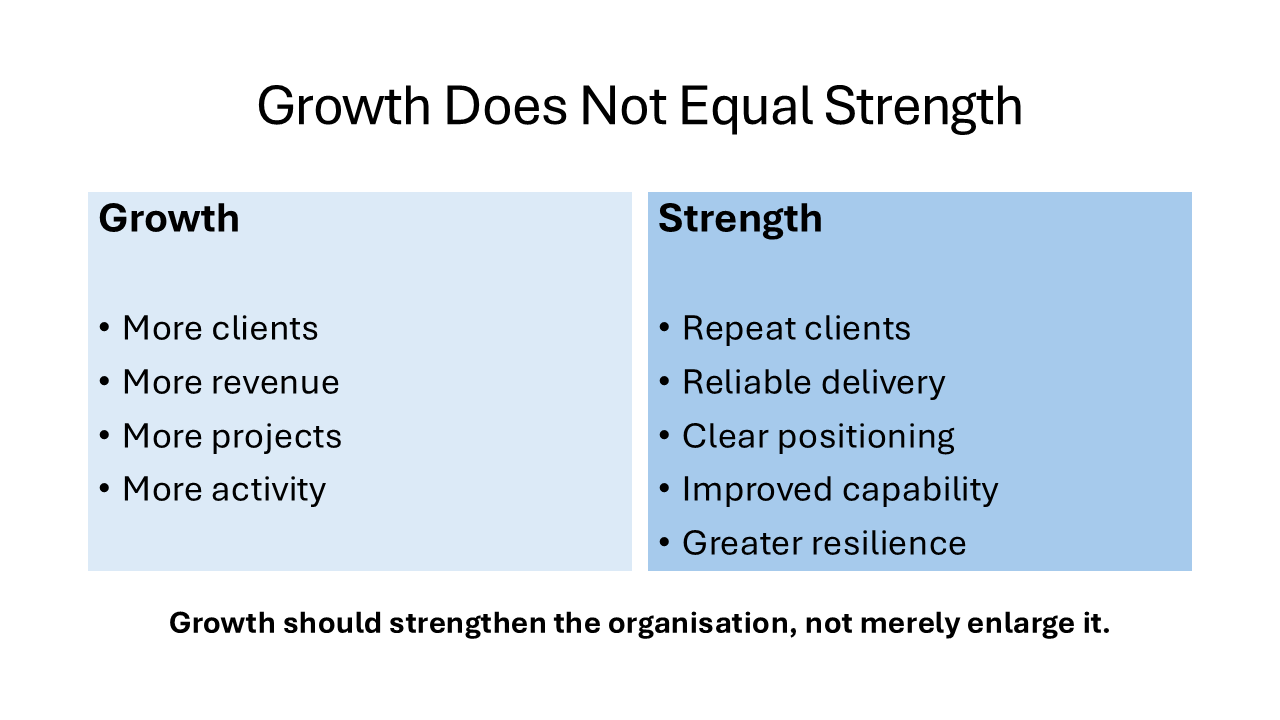
Graphic comparing growth and strength
Revenue is not the only measure
Revenue matters. Without revenue, organisations cannot survive. However, revenue should not be treated as the only indicator of progress.
Other signs often reveal whether growth is strengthening the business:
repeat clients
referral business
delivery consistency
staff retention
operational resilience
customer trust
These signals are less visible than headline revenue figures. They are often better indicators of long-term success. A business that steadily strengthens capability may be building a more valuable future than one that pursues rapid expansion at the expense of stability.
The test
A simple test helps identify the difference between growth and strength:
If growth makes delivery harder every month, the organisation may be becoming larger rather than stronger.
Growth should eventually make future success easier, not more difficult. When every additional customer increases fragility, the organisation is accumulating pressure rather than capability.
Conclusion
Growth is valuable. But growth alone is not enough. The organisations that endure are rarely those that simply become larger. They are the organisations that become stronger as they grow.
That means investing in capability, protecting focus, improving repeatability, and building resilience alongside revenue. Anyone can become busy. Sustainable success comes from becoming stronger. The most effective organisations understand that growth is not the destination. It is the by-product of a business that continues to strengthen over time.
Why senior leaders prefer fewer words

Courtesy of Unsplash.com
Executive Summary
Senior leaders do not usually need less information because they are uninterested in detail. They need information to be selected, ordered and expressed so that the decision becomes clear quickly. Long papers, crowded presentations and extended explanations can obscure sound analysis rather than demonstrate rigour. Effective executive communication begins with the decision, recommendation and consequence, while keeping supporting evidence available for challenge. The objective is not to say the least possible. It is to communicate everything necessary, and nothing that makes the important point harder to see.
Senior attention is a scarce resource
Senior leaders operate in environments where information is abundant and attention is limited.
A typical working day may involve operational performance, financial results, staffing concerns, customer issues, regulatory matters and strategic decisions. Each subject may be important. Each may arrive with reports, presentations, emails and requests for approval. The difficulty is rarely gaining access to information. The difficulty is identifying what matters.
This is where executive communication becomes valuable. Its purpose is not merely to transfer information from one person to another. It is to organise information so that judgement can be exercised efficiently. Yet many papers and presentations do the opposite.
They begin with history, move through context, describe the analysis and explain the methodology. Assumptions and caveats follow. The recommendation may not appear until the final page. The author may believe this demonstrates thoroughness. The reader experiences a search.
Detail is not the same as clarity
Detailed work has an important place. Senior decisions should be supported by sound analysis, credible evidence and clear assumptions. But detail and clarity are not the same thing.
A document can be comprehensive and still leave the reader uncertain about what is required. A presentation can contain accurate information and still fail to communicate its central point. A lengthy explanation can demonstrate effort while obscuring judgement. This happens because writers often organise information in the order in which they discovered it.
They reproduce the analytical journey:
the background;
the investigation;
the evidence;
the alternatives;
the conclusion.
The executive reader usually needs a different sequence:
the decision;
the recommendation;
the reason;
the consequences;
the evidence, where required.
The analysis remains important. Its position changes.
“Clarity is created by making the important thing impossible to miss.”
Why people over-explain
Over-explanation is rarely caused by a lack of knowledge. It is more commonly caused by a lack of confidence in what can safely be omitted. Writers worry that a short document will appear superficial. Advisers fear that a brief answer will not demonstrate sufficient expertise. Teams add background so that nobody can accuse them of overlooking something.
The result is communication designed to defend the author rather than serve the reader. Every additional paragraph may be individually reasonable. Collectively, those paragraphs make the decision harder to identify.
This is especially common when the subject is uncertain. More qualifiers are added. More alternatives remain visible. More analysis is offered in anticipation of every conceivable question. The communication becomes longer, but the underlying judgement does not become stronger.
Brevity does not mean oversimplification
There is a difference between reducing complexity and pretending complexity does not exist. Oversimplification removes something essential. Brevity removes what is not currently necessary.
An executive summary that states the decision, recommendation and principal consequences is not denying the supporting detail. It is placing that detail at the appropriate level.
A concise presentation can still be grounded in substantial work. A one-page brief may sit above days of analysis. A one-sentence recommendation may reflect years of experience.
The reader does not need to see every part of the process to trust the result. The reader needs confidence that the necessary work has been done and that the conclusion can withstand challenge. This is why good executive communicators keep detail available without making all of it visible.
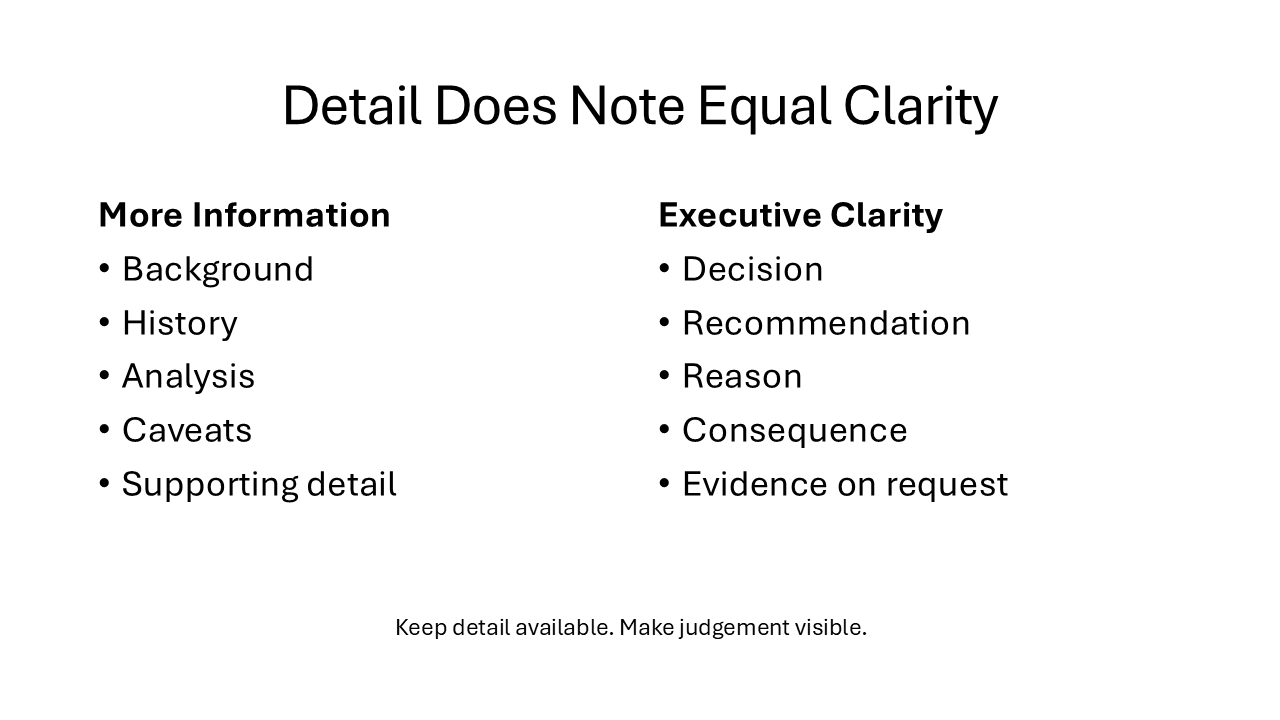
The decision should appear first
The simplest improvement to executive communication is often to state what is being asked for at the beginning.
Consider a leadership team facing deteriorating operational performance, increasing work-in-progress and rising pressure across a service.
A conventional paper might begin by describing the history of the service, recent performance, stakeholder interviews, data limitations and possible causes.
Several pages later, the paper recommends focused discovery. A decision-first opening would instead say:
Approve focused discovery to identify the causes of declining performance before committing to intervention.
The leader immediately knows:
what is being requested;
why the paper exists;
what the proposed next step is.
The supporting information can then explain why that recommendation is reasonable. The difference is not cosmetic. It changes how the document is read.
Once the reader understands the decision, every subsequent point can be interpreted in relation to it. Without that anchor, information competes for attention.
Good communication makes consequences visible
A recommendation rarely stands on its own. Senior leaders also need to understand the consequences of acting and not acting. That does not require an exhaustive catalogue. It requires the few consequences that materially affect the decision.
For example:
performance is continuing to deteriorate;
work-in-progress is increasing;
further delay will reduce available options;
discovery will reduce uncertainty before significant investment.
These points give the decision shape. They explain why it matters now, rather than merely describing why the subject is interesting.
The most effective executive communication connects information to consequence. Facts become relevant because the reader can see what those facts mean for the choice being made.
Headings should carry the argument
Many readers skim before they read carefully. This is not poor behaviour. It is a rational response to information volume. Good headings therefore do more than label sections.
A heading entitled Risks tells the reader the subject.
A heading stating Further delay will increase cost and reduce available options tells the reader the judgement.
If the headings alone communicate the argument, the document is easier to understand. Readers who need more evidence can enter the detail. Readers who need only the senior message can still follow the logic.
This principle applies equally to PowerPoint titles. A slide called Options Analysis identifies its contents. A slide called Focused discovery offers the best balance of speed and certainty communicates its conclusion.
This is not presentational polish. It is decision architecture.
Silence is part of executive communication
The same discipline applies in conversation.
An adviser may give a clear recommendation and then continue speaking because silence feels uncomfortable. Further context is added. Caveats are introduced. The answer becomes less certain as it becomes longer. A concise answer followed by a pause gives the decision-maker space to think and ask for the detail that matters most.
That pause is not disengagement.
It reflects confidence that the answer can stand without immediate defence. Trusted advisers do not conceal detail. They allow demand to determine when detail becomes visible.
The test
A simple test helps distinguish executive communication from information transfer:
If the audience must search for the conclusion, the communication has failed.
The problem may not be weak analysis. The problem may simply be that the analysis has not been converted into a form that supports senior judgement.
Conclusion
Senior leaders do not prefer fewer words merely because they are busy. They prefer communication that respects the purpose of their attention.
They need to understand what is being decided, what is recommended, why it matters and what consequences follow. Supporting evidence remains essential, but it should strengthen the decision rather than hide it. Good executive communication is not the art of making everything short. Some subjects require depth, nuance and extensive examination.
The discipline lies in separating what the reader needs now from what the reader may need later.
State the decision. Make the recommendation clear. Explain the consequence. Keep the evidence ready. The aim is not to say as little as possible. It is to ensure that nothing unnecessary stands between the reader and the judgement required.
Good Advisers Persuade Quietly

Image Courtesy of Upsplash
Executive Summary
Consultants rarely have formal authority over the people they advise, yet their work depends on influencing important decisions. The strongest advisers do not compensate by talking more loudly, presenting more slides, or pushing recommendations harder. They influence by clarifying the decision, exposing its consequences, testing assumptions, and allowing decision-makers to retain ownership. Quiet persuasion is not passive. It is the disciplined use of judgement, questions, evidence, and restraint to help people reach conclusions they understand and can support.
Advice without authority
Consultants are frequently expected to influence decisions they do not have the authority to make.
They may understand the issue, assess the evidence, compare the options, and recommend a course of action. But the final decision usually belongs to a sponsor, board, leadership team, or business owner.
This creates an important tension. The consultant is expected to contribute judgement without taking ownership away from the client. The adviser must influence the outcome while respecting the authority of those accountable for it.
Less experienced consultants can respond to this tension by trying harder to persuade. They add more information, defend their reasoning more forcefully, or repeat the recommendation in increasingly confident language.
Experienced advisers tend to work differently. They persuade quietly.
Authority is not influence
Formal authority allows somebody to approve expenditure, allocate resources, assign responsibilities, or instruct others to act. Influence works differently.
It helps people see the decision more clearly. It changes how the problem is understood. It makes consequences visible and focuses attention on what matters most.
A consultant may have no authority to approve an intervention but may still have considerable influence over whether the decision is properly framed.
That influence can include:
separating the immediate decision from wider concerns
removing options that do not deserve serious consideration
identifying assumptions that need testing
exposing the consequences of delay
asking questions others have avoided.
None of these actions removes ownership from the decision-maker.
They create better conditions for judgement.
Expertise is not persuasion
Subject knowledge matters in consulting. Clients reasonably expect advisers to understand the area in which advice is being offered. But expertise alone rarely persuades.
A technically accurate recommendation can still fail if it does not address the concern preventing commitment. More evidence will not resolve an accountability problem. A detailed financial model will not overcome a lack of trust. A polished presentation will not correct a badly framed decision. This is why influence begins with diagnosis rather than explanation.
When a stakeholder challenges cost, the underlying concern may be value. When additional analysis is requested, the underlying issue may be confidence. When a decision is repeatedly deferred, the real barrier may be ownership or fear of disruption. The words used in the room do not always describe the actual concern. A strong adviser listens for what sits underneath them.
Resistance is not necessarily rejection
Questions and objections can feel like resistance, particularly when a consultant has invested time and professional credibility in a recommendation. But challenge is not necessarily rejection.
It may be an attempt to understand risk. It may expose an assumption that was not made clear. It may show that the consequences of the proposed action have not been compared fairly with the consequences of doing nothing.
Treating every objection as opposition creates defensiveness. The consultant begins protecting the recommendation rather than improving the decision. Quiet persuasion treats challenge as information.
The question becomes:
What concern is this objection revealing?
That creates a more constructive conversation. It allows the adviser to address the decision rather than react to the language in which the concern first appeared.
Clarifying before persuading
Many difficult conversations become easier once the decision is narrowed.
A leadership team may believe it is being asked to approve a large transformation, when the immediate decision is only whether to authorise a focused discovery exercise.
A business owner may believe the choice is between expensive intervention and doing nothing, when a limited diagnostic stage could reduce uncertainty before any major commitment.
If the decision remains broad, persuasion becomes difficult because stakeholders are responding to different interpretations of what is being proposed.
The principal consultant’s first task is therefore not to sell the answer. It is to clarify the question.
Once the decision is precise, concerns become easier to identify, and evidence becomes easier to assess. Clarity does much of the persuasive work.
The strongest advisory influence often comes from making the decision easier to understand, not harder to refuse.
“If the adviser needs to win the argument, the advisory position has probably already weakened.”
Consequences are more persuasive than confidence
Consultants sometimes believe they need to project certainty to be influential.
In practice, excessive certainty can reduce trust. Senior decisions often involve incomplete evidence, competing priorities, and genuine uncertainty. Pretending otherwise rarely strengthens a recommendation.
A calmer approach is to make the consequences visible.
What happens if the organisation acts?
What happens if it waits?
What becomes easier?
What remains unresolved?
What exposure increases if no decision is made?
These questions move the discussion away from the consultant’s confidence and towards the organisation’s reality. The adviser is no longer asking the client to accept an opinion. The adviser is helping the client examine the consequences of available choices.
That is a stronger and more durable form of influence.
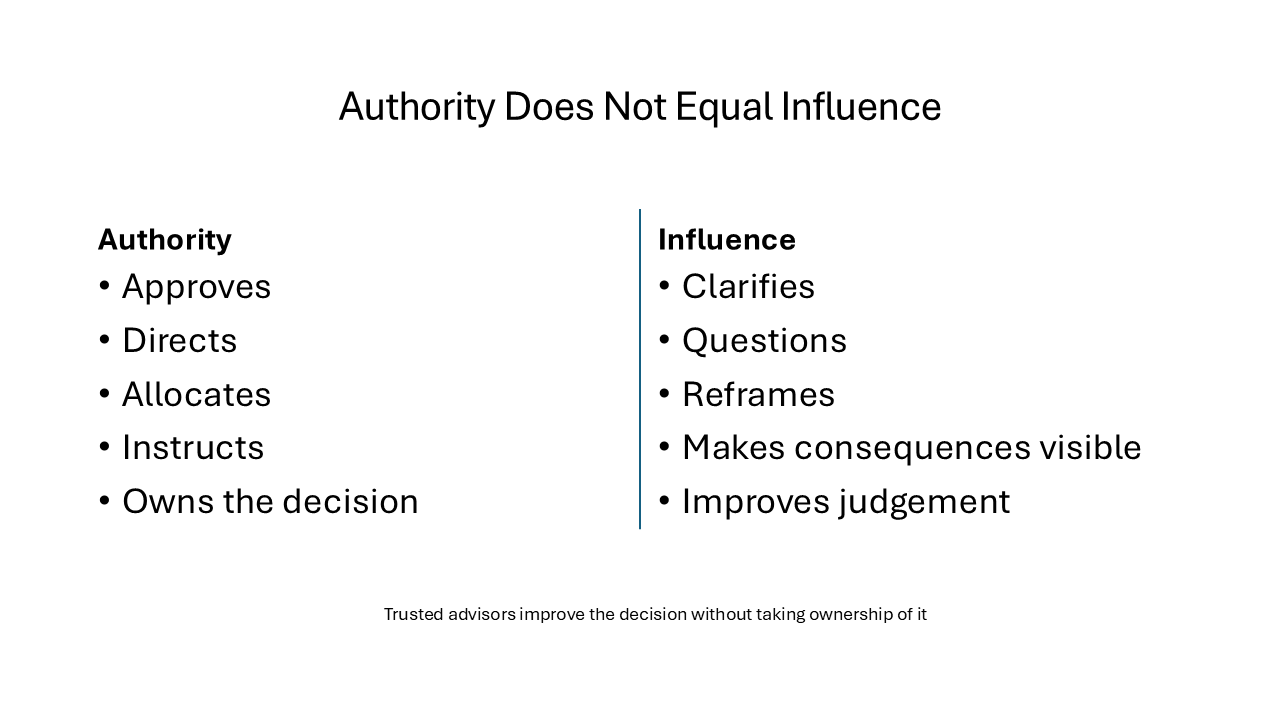
Authority does not equal influence
Questions create ownership
A recommendation can tell somebody what to do. A well-judged question can help somebody understand why the decision matters.
Questions such as the following can change the quality of a senior discussion:
What evidence would materially alter this decision?
What concern is preventing commitment?
What would need to be true for this option to succeed?
What happens if nothing changes?
Who will answer for the outcome once the decision is made?
These questions do not manipulate the decision-maker towards a predetermined conclusion. They expose the conditions required for a sound decision. When people articulate those conditions themselves, they are more likely to understand and own the resulting choice.
That ownership matters after the meeting. A decision accepted because somebody argued forcefully for it may weaken once that person leaves. A decision reached through clear reasoning is more likely to endure.
Restraint strengthens influence
Influence is easily weakened by over-explanation.
Once the decision, recommendation, and consequences are clear, additional words can begin to introduce doubt. Repeating an argument may suggest the adviser does not trust it to stand. Adding further evidence can reopen questions that were already sufficiently resolved.
This is particularly relevant when silence follows a recommendation.
The urge to keep speaking can be strong. Silence may feel like loss of control or lack of engagement.
Often it is simply the moment when the decision-maker is thinking. Experienced advisers allow that space to exist. They answer the question asked, state the judgement clearly, and stop. If more detail is required, it can be requested. If a concern remains, it can be explored directly.
Restraint shows confidence in both the advice and the client’s ability to consider it.
The adviser must not own the client’s decision
There is a boundary at the heart of trusted advice. The consultant contributes analysis, judgement, challenge, and clarity. The client owns the decision.
Crossing that boundary may appear helpful in the short term, particularly when stakeholders are reluctant to commit. But it creates dependency and weakens accountability.
A decision-maker who adopts a recommendation without understanding or owning it may later distance themselves when circumstances change. The adviser then becomes associated not only with the analysis, but with a decision that never properly belonged to the client. Strong advisers resist that temptation.
They make the decision clear enough to own. They do not take ownership on the client’s behalf.
The test
A simple test helps distinguish advisory influence from forceful persuasion:
If the adviser needs to win the argument, the advisory position has probably already weakened.
Trusted advice is not measured by whether the consultant dominates the conversation.
It is measured by whether the client reaches a clearer, better-owned decision.
Conclusion
The strongest advisers are rarely the loudest people in the room. They do not rely on authority they do not possess. They do not overwhelm challenge with information or treat every objection as opposition.
They clarify the decision. They listen for the concern beneath the question. They make consequences visible. They ask questions that improve judgement and then allow the decision-maker enough space to think. This is not passive consulting. It requires confidence, restraint, and the willingness to leave ownership where it belongs.
Good advisers bring expertise. Trusted advisers help other people use their own judgement more effectively. That is why the most persuasive advice often feels less like persuasion and more like clarity.
Why organisations are rarely surprised by failure

Image courtesy of Unsplash.com
Executive Summary
Organisational failure is often described as unexpected, but serious problems rarely arrive without warning. Falling performance, recurring exceptions, staff turnover, customer complaints, and increasing dependence on a small number of people usually appear well before failure becomes visible. The problem is not always that organisations fail to identify risk. More often, they recognise individual warning signs but tolerate the combined exposure for too long. Effective strategic-risk management means distinguishing current issues from future risks, understanding where the organisation is most vulnerable, and acting before repeated signals become accepted as normal.
Failure rarely begins with a single dramatic event
When an organisation experiences a serious failure, the event is often described as sudden.
A major customer leaves. A critical service breaks down. Costs rise sharply. Delivery becomes unreliable. Key employees resign, taking important knowledge with them. From the outside, this can look like an unexpected crisis. Inside the organisation, the story is often different.
Warning signs may have been visible for months. Staff turnover was increasing. Customer complaints were recurring. Exceptions were becoming routine. Managers were spending more time managing immediate problems and less time addressing their causes.
The final failure may be sudden. The conditions that created the failure usually are not.
Risk is not the same as an issue
One reason organisations struggle with strategic risk is that risks and issues are frequently treated as though they are the same thing.
An issue is happening now. A risk is an uncertain future event or consequence.
If staff turnover is already increasing, that is an issue. The associated risk may be that service resilience falls, remaining staff become overloaded, customer relationships weaken, or essential knowledge leaves the organisation.
The distinction matters because an organisation can manage a current issue without adequately addressing the future exposure it creates.
Recruitment may replace some departing staff. Temporary cover may protect service levels. Overtime may keep work moving. These actions may control the immediate issue.
They do not necessarily reduce the strategic risk.
Identifying a risk does not mean controlling it
Most organisations can identify risks.
Risks appear in reports, meeting papers, project documents, and risk registers. They are assigned ratings, owners, and review dates. This can create confidence that the risk is being managed.
But visibility is not control.
A risk can remain clearly documented while the organisation’s exposure continues to rise. The same concern may be reviewed repeatedly without a meaningful change in behaviour.
The language may become familiar:
Recruitment remains difficult.
Customer complaints continue to be monitored.
Operational pressure remains high.
Management capacity is constrained.
Mitigating actions are in progress.
Each statement may be accurate.
Together, they may describe an organisation moving steadily towards failure.
The danger is that familiarity reduces urgency. A risk discussed every month without becoming a crisis can begin to feel stable, even while the underlying position is deteriorating.
Failure is rarely unexpected. It is usually preceded by warning signs the organisation has learned to tolerate.
Exposure matters more than the risk description
A broadly worded risk tells leaders what might happen. Exposure tells leaders how badly the organisation could be affected and how little margin remains.
Consider a customer service function experiencing rising staff turnover. The immediate problem is clear, but the strategic exposure depends on several additional factors.
Is important knowledge concentrated among a small number of experienced employees? Are operating procedures sufficiently documented? Can other teams provide cover? How long does recruitment take? How quickly can new staff become effective?
Two organisations may appear to face the same risk while having very different levels of exposure.
One may have experienced staff, documented procedures, strong recruitment, and spare capacity.
The other may depend on a few individuals, have limited cover, and require several months to recruit and train replacements.
The headline risk is the same.
The vulnerability is not.
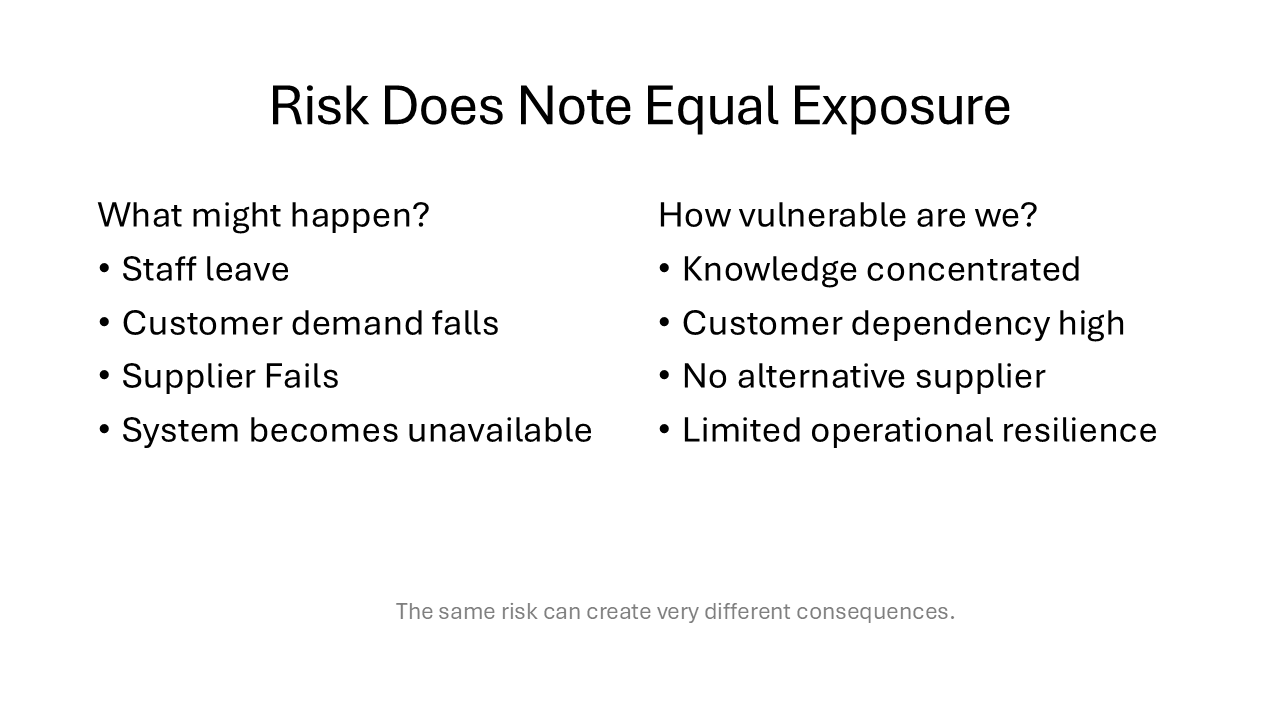
The same risk can create very different consequences
Concentration makes ordinary problems dangerous
Many strategic failures begin with excessive concentration.
Knowledge may be concentrated in one person. Revenue may be concentrated among a small number of customers. A service may depend on one supplier, one system, or one operational site.
Concentration can make an organisation efficient when conditions are stable. It can also make ordinary disruption disproportionately damaging.
The departure of one employee should not threaten an important service. The loss of one customer should not destabilise the entire business. The failure of one supplier should not stop all delivery.
Where that is possible, the organisation has more than a routine operational risk. It has a strategic exposure.
The absence of previous failure does not prove resilience. It may simply mean the concentration has not yet been tested.
Repeated exceptions are warning signs
Weak signals often appear as exceptions.
A deadline is missed because of unusual demand. A customer complaint is attributed to an isolated mistake. Overtime is approved to cover temporary absence. A workaround is introduced until the underlying problem can be addressed.
Each decision may be reasonable in isolation.
The strategic risk appears when exceptions repeat.
Repeated exceptions indicate that the system is no longer coping within its normal design. The temporary workaround becomes routine. Managers spend increasing amounts of time holding performance together manually.
At this point, the organisation may still appear functional. But resilience is declining.
Why organisations wait
Leaders rarely ignore warning signs deliberately.
More often, immediate demands take priority. Intervention carries cost, disruption, or political difficulty. The organisation hopes that recruitment will improve, demand will settle, or the next reporting period will show recovery.
Waiting can feel proportionate when no single signal appears decisive.
The problem is that strategic vulnerability develops through accumulation.
Staff turnover alone may be manageable. Rising complaints alone may be manageable. Increasing overtime alone may be manageable.
Together, they may be evidence of a system approaching its limit.
This is where principal judgement matters. The question is not whether any individual symptom proves failure is imminent. The question is whether the combined pattern has changed the organisation’s exposure.
Strategic risk requires intervention triggers
A risk should not remain a subject of indefinite observation.
There must be a point at which the organisation acts differently.
That point might be reached when complaints exceed an agreed tolerance, when turnover continues for successive periods, when essential knowledge becomes concentrated among too few people, or when temporary arrangements become routine.
Without an intervention trigger, risk management becomes passive reporting.
The organisation remains informed but not protected.
A useful test is:
If the same risk is discussed repeatedly but behaviour never changes, the organisation is monitoring exposure rather than managing it.
Conclusion
Organisations are rarely surprised by failure because no warning signs existed.
They are surprised because the warning signs were considered individually, explained away, or tolerated for too long.
Strategic risk is not controlled simply because it appears in a register or is reviewed regularly. Control begins when leaders understand the organisation’s exposure, recognise concentration and dependency, and define the point at which observation must become intervention.
The final failure may arrive suddenly. The path towards it usually does not.
Strong organisations do not wait for one decisive warning. They recognise when several smaller signals are telling the same story.
That is the difference between knowing a risk exists and acting before it becomes a crisis.
Why organisations confuse activity with progress

Why organisations confuse activity with progress
Executive Summary
Many organisations are extremely busy. Meetings are held, projects are launched, reports are produced, and initiatives are announced. Yet despite all this activity, meaningful progress remains elusive. Activity creates the appearance of movement, but movement alone does not guarantee improvement. The most effective organisations understand the difference. They focus less on how much is happening and more on whether what is happening is advancing a clear objective. Progress requires direction. Activity alone does not.
Why organisations confuse activity with progress
Most organisations are not short of activity. Calendars are full. Meetings are well attended. Projects are underway. Reports are produced. Action plans are updated. Emails circulate. Dashboards are reviewed. New initiatives are regularly launched.
From the outside, this often looks impressive. The organisation appears energetic, engaged, and productive. Yet a simple question frequently exposes a different reality:
What has actually improved?
The answer is often less clear than expected. This is because activity and progress are not the same thing. Many organisations generate large amounts of the first while achieving surprisingly little of the second.
Activity is visible
One reason activity is so attractive is that it is easy to see. People can point to:
meetings held
reports completed
projects started
workshops delivered
actions assigned
These things create evidence that work is happening. They provide reassurance. They create momentum. They allow people to feel as though something is being done.
None of this is inherently bad. The problem begins when activity becomes a substitute for progress. It is entirely possible for an organisation to be extremely busy while remaining largely stationary.
Movement is not direction
Imagine somebody walking quickly around in circles. There is movement. There is effort. There may even be urgency. What there is not necessarily is progress. Progress requires direction.
Organisations experience exactly the same problem. Teams can work extremely hard while moving in different directions. Departments can pursue competing priorities. Projects can consume resources without advancing the organisation's most important objectives. The organisation appears busy because many things are happening.
What becomes less clear is whether those things are collectively moving the organisation towards a better position.
This distinction sits at the heart of effective leadership.
The comfort of activity
Activity often feels safer than judgement. Starting a new initiative feels productive. Creating another report feels responsible. Holding another meeting feels engaged. As a result, organisations naturally drift towards things that can be counted, scheduled, and demonstrated. The risk is that effort becomes the measure of success. When that happens, a subtle shift occurs. People begin asking:
"What are we doing?"
instead of:
"What difference is it making?"
Those questions sound similar. They are not. One measures effort. The other measures outcome.
“If nothing has been excluded, there is probably no strategy”
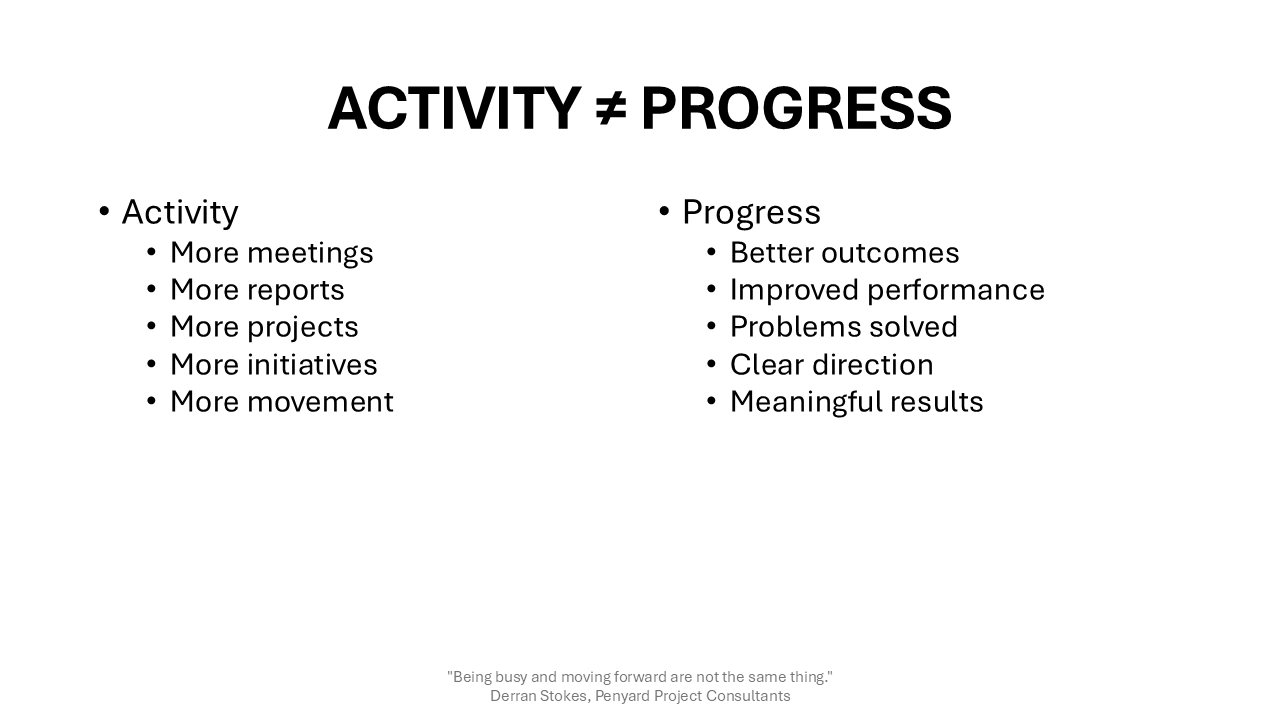
Comparison showing the difference between activity and progress
Why priorities become diluted
A common cause of excessive activity is the belief that everything matters. A new customer initiative appears important. A new compliance requirement appears important.
A technology improvement appears important. A recruitment challenge appears important. A process review appears important. Individually, they may all be justified. Collectively, they often overwhelm the organisation.
When everything becomes a priority, nothing receives the focus required to make meaningful progress. The result is predictable:
more meetings
more reporting
more projects
more pressure
but not necessarily better outcomes. The organisation becomes occupied rather than effective.
Progress requires choice
One of the least glamorous aspects of leadership is deciding what will not receive attention. Many organisations spend significant energy deciding what to start. Far fewer spend equal energy deciding what to stop. Yet stopping activities is often where progress begins. Every meeting consumes time. Every initiative consumes attention. Every project consumes resources. The question is not whether these activities have value.
The question is whether they contribute sufficiently to justify the resources consumed.
Effective leaders are willing to ask uncomfortable questions:
Why are we doing this?
What happens if we stop?
What outcome is this intended to achieve?
How will we know if it has worked?
These questions often reveal that some activity survives largely because it has always existed.
Progress is usually quieter than activity
Activity attracts attention. Progress often does not.
Progress can look like:
fewer customer complaints
shorter turnaround times
reduced rework
better decision-making
improved staff retention
stronger financial performance
These outcomes are often less visible than the work that created them. Because of this, organisations sometimes celebrate activity and overlook progress. The dashboard fills with indicators of effort while the underlying outcomes receive less attention.
Over time this creates a strange situation:
The organisation becomes highly informed about what it is doing while remaining less certain about whether it is succeeding.
The Principal Question
One question cuts through much of this confusion:
If we stopped doing this tomorrow, would anybody notice a meaningful difference?
Not because an activity disappeared. Because an outcome deteriorated. That distinction matters. If nobody notices a difference, the activity may not be contributing as much value as assumed. If outcomes immediately worsen, the activity is probably serving a genuine purpose. This is often a more useful test than discussing effort, commitment, or historical practice.
Conclusion
Most organisations do not struggle because people are lazy. They struggle because people are busy. There is a difference.
Activity creates movement, visibility, and reassurance. Progress creates improvement.
The challenge for leaders is recognising that the two are not interchangeable. A full calendar is not a strategy. A long action list is not progress. A growing number of initiatives is not evidence of success. Real progress occurs when activity is connected to a clear direction and produces measurable improvement.
That requires focus. It requires judgement.
And sometimes it requires the courage to stop doing things that create movement without creating value.
A useful test remains:
If activity disappeared tomorrow, what outcome would change?
Because organisations do not become successful by doing more things. They become successful by doing the right things, consistently, for long enough to matter.
Why Strategy is mostly about saying no

Image from Unsplash
Executive Summary
Strategy is often misunderstood as a plan for growth, a list of priorities, or a collection of ambitions. In reality, effective strategy is about making choices. Every organisation has more opportunities than it can pursue, which means success depends as much on deciding what not to do as deciding what to do. Strong strategies create focus by identifying priorities, making trade-offs visible, and deliberately excluding activities that do not support the chosen direction. Without these exclusions, organisations risk becoming busy rather than effective.
When people hear the word strategy, they often think about growth plans, ambitious goals, and exciting opportunities. They imagine a vision of the future and a detailed plan for getting there. While those things can be important, they are not what makes a strategy a strategy.
In reality, strategy is usually much simpler than that.
Strategy is deciding what not to do. This is one of the most overlooked ideas in business, and one of the most valuable.
The problem with trying to do everything
Most people and organisations do not suffer from a lack of ideas. The opposite is usually true.
There are always more opportunities than there is time, money, attention, and energy available to pursue them. New projects appear. Existing work expands. Customers ask for additional services. New markets emerge. New technologies promise improvements.
Every opportunity can appear worthwhile when viewed on its own. The challenge arrives when they are viewed together. At that point, reality becomes unavoidable. There are limits.
There is only so much time available in a day. There is only so much money available to invest. There is only so much attention leadership can give before focus begins to fragment.
This is where strategy becomes important.
Without strategy, organisations try to do everything. When that happens, priorities blur, resources become stretched, and progress slows.
Activity increases.
Direction weakens.
Objectives are not strategy
Many organisations mistake objectives for strategy. An objective is an outcome you would like to achieve.
Examples might include:
Increase sales
Grow the business
Improve customer satisfaction
Reduce costs
Expand into new markets
All of these are perfectly reasonable objectives. None of them are strategy. An objective describes where you want to go. Strategy describes how you intend to get there.
This distinction matters because many organisations can describe their objectives clearly while remaining uncertain about the choices required to achieve them.
Saying, "We want to grow" is not strategic.
Deciding where growth will come from, what opportunities will be ignored, and which resources will be focused on that growth is where strategy begins.
Every strategy requires exclusion
A useful test of any strategy is whether it includes things that have been deliberately excluded.
If everything remains possible, strategy has not yet happened.
Consider a small consulting business.
It might be possible to offer:
project management
business coaching
recruitment services
software implementation
training
governance advice
marketing support
change management
There is nothing inherently wrong with any of those services. The challenge is trying to pursue all of them at the same time.
The wider the range of services becomes, the harder it is for customers to understand what the business actually stands for. Expertise becomes diluted. Resources become scattered.
Eventually, the business becomes busy but difficult to define. A stronger strategy might involve deliberately choosing a smaller number of areas and declining opportunities outside them.
At first glance, this can feel restrictive.
In practice, it usually creates clarity.
The organisation becomes easier to understand, easier to position, and easier to grow.
What remains after the exclusions often forms the basis of a genuine strategy.
Why saying no feels difficult
Most people find exclusion uncomfortable. Opportunities create optimism. Saying yes feels positive. Saying no can feel like giving something up. This is why weak strategy often emerges disguised as flexibility.
Organisations tell themselves they are keeping options open. They describe their approach as adaptable. They remain receptive to every opportunity that appears.
For a while, this can feel sensible. The difficulty is that every additional commitment consumes resources. The organisation becomes increasingly reactive. Decisions are made one opportunity at a time rather than against a clear direction.
Eventually, the organisation finds itself working very hard without moving decisively towards anything. The absence of exclusion is often mistaken for freedom. In reality, it frequently produces confusion.
The hidden cost of every decision
Every important decision creates a trade-off. Choosing one direction means choosing against another. This is true for organisations and individuals alike. A business that invests heavily in one service area may have less capacity to develop another. A leader who focuses on one strategic initiative has less time available for something else. A team that commits resources to one project cannot use those same resources elsewhere. These trade-offs exist whether they are acknowledged or not.
Strong strategy makes them visible. Weak strategy ignores them.
The value of strategic thinking lies in recognising that every decision has consequences beyond the decision itself. Resources are finite. Choices matter precisely because not everything can be done.
Strategy creates focus
One of the greatest benefits of strategy is focus. When people know what matters most, decision-making becomes easier. Opportunities can be assessed against a clear direction. Projects can be evaluated more effectively. Resources can be allocated more deliberately. Without focus, everything appears equally important. With focus, priorities become visible.
This is why some organisations achieve more with fewer resources than their competitors. They are not necessarily more talented. They are often more focused. They know what they are trying to achieve and, equally importantly, what they are not trying to achieve. That clarity compounds over time.
Good strategy looks surprisingly simple
Many people expect strategy to be complicated. They expect large documents, complex diagrams, and specialised language. The strongest strategies are often much simpler than that. A good strategy can usually be described in plain language.
It explains:
the direction being pursued
the choices that support that direction
the opportunities that have been excluded
It does not need extensive jargon. In fact, complexity often hides uncertainty rather than clarity. If a strategy cannot be explained clearly, it may not yet be clear enough. Simplicity is not a sign of weakness.
It is often a sign that hard choices have already been made.
Why strategy matters
The purpose of strategy is not to predict the future. Nor is it to eliminate uncertainty. Its purpose is to provide direction when opportunities, challenges, and distractions compete for attention.
Every day, organisations are presented with new possibilities. Some are attractive. Some are profitable. Some appear urgent. The role of strategy is not to say yes to all of them. It is to determine which opportunities deserve attention and which do not.
Without that discipline, organisations drift. With it, they move deliberately.
The test
A simple test can reveal whether a strategy is genuinely strategic:
If nothing has been excluded, there is probably no strategy.
Real strategy requires choice.
Choice requires trade-offs.
Trade-offs require saying no.
Conclusion
Many people think strategy is about deciding what to pursue. That is only part of the story. The harder and more important task is deciding what to leave behind.
Every organisation has more opportunities than it has the resources to pursue. Time, money, expertise, leadership attention, and organisational focus are all finite. Attempting to do everything rarely creates better results. More often, it creates confusion, competing priorities, and fragmented effort.
Effective strategy acknowledges these realities. It creates clarity by identifying what matters most and by making deliberate choices about what will not be pursued. Those choices may sometimes feel uncomfortable, particularly when attractive opportunities must be declined, but they are essential if resources are to be used effectively.
The organisations that achieve sustained success are not necessarily those with the most opportunities. They are often the organisations that understand their direction clearly enough to resist distraction.
A useful test remains:
If nothing has been excluded, there is probably no strategy.
Real strategy requires choice.
Choice requires trade-offs.
Trade-offs require saying no.
Ultimately, strategy is not defined by everything an organisation hopes to do. It is defined by what remains after it has decided what not to do.
The best financial conversations are rarely about money.

Why the best financial conversations are rarely about money
Many people assume that financial conversations are primarily about numbers.
Budgets, forecasts, costs, margins, cash flow, and return on investment all appear to support that view. As soon as finance enters a discussion, attention often shifts towards spreadsheets, calculations, and affordability.
Yet the most productive financial conversations I have seen rarely begin with numbers. They begin with consequences.
This may sound surprising. After all, finance is often presented as the language of measurement. But in practice, senior leaders are rarely making decisions because of numbers alone. They are making decisions because of what those numbers represent.
A cost represents a choice. A budget represents a priority. An investment represents an expectation. A financial discussion only becomes valuable when it helps people understand the consequences of those choices more clearly. That is why the strongest financial conversations tend to feel less like accounting and more like judgement.
Cost is rarely the real question
One of the most common responses to a proposed initiative is:
"Isn't that expensive?"
On the surface, this appears to be a financial challenge. Often, it is not.
In many cases, the question is expressing something else entirely:
uncertainty about value
concern about risk
discomfort with timing
lack of confidence in the outcome
competing priorities
The cost becomes the visible focus because it is easy to identify and easy to discuss. The underlying concern is often more important.
This is why organisations sometimes find themselves trapped in circular discussions about affordability. The conversation is still stuck on price because the real issue has not been made explicit.
A useful financial conversation does not simply debate the number. It seeks to understand what the number represents.
The difference between challenge and opposition
Another misconception is that financial challenge means resistance. It does not. Experienced leaders learn that financial questions are often signs of engagement, not rejection.
When someone asks:
"Can we justify this investment?", they are not necessarily opposing the decision. They may simply be testing the strength of the reasoning. The same applies to questions about risk, return, timing, and affordability. A challenge can improve a decision; a challenge can expose assumptions. A challenge can reveal weaknesses that need attention. The mistake is to respond defensively.
Many organisations react to financial challenge by producing more information, more analysis, and more detail. They attempt to defend the proposal through volume. The result is often the opposite of what was intended. Clarity decreases. The conversation becomes more complex. The core issue becomes harder to see. Good financial conversations rarely require more detail. They usually require clearer thinking.
Value should arrive before cost
One of the most reliable patterns in business is this:
When value is unclear, cost becomes dominant. The organisation begins to focus on what the initiative will consume rather than what it will create. Discussion shifts towards budgets, constraints, and expenditure. This is understandable.
Cost is visible. Value often is not.
Value often appears later in the form of:
improved reliability
reduced waste
better customer experience
increased capacity
stronger performance
Those outcomes can be harder to quantify and harder to connect directly to a decision. As a result, the conversation naturally gravitates towards the more visible side of the equation. The antidote is not more financial modelling. The antidote is explaining value clearly enough that cost can be judged in context. When value leads the discussion, financial conversations tend to become calmer and more productive.
The hidden cost of doing nothing
One of the most important financial questions in any decision is rarely asked.
Most discussions focus on, what will this cost?
Far fewer ask:
What will it cost if we do nothing?
This is where many poor decisions originate. The cost of action is usually visible. The cost of inaction is often hidden. Inefficiencies continue. Bottlenecks remain. Opportunities are missed. Rework accumulates. Customers experience the same frustrations. The business continues paying, even though no visible expenditure occurs.
This is why delay is rarely neutral. Waiting is not the absence of a decision. Waiting is a decision with consequences.
Once leaders learn to compare the cost of action with the cost of inaction, many decisions become much easier to understand.
Every financial decision is an allocation decision
Another useful perspective is recognising that money is only one of the resources being allocated. Leadership attention is a resource. Organisational focus is a resource. Operational capacity is a resource. Expertise is a resource.
Every significant decision directs these resources towards one objective and away from another.
This means financial discussions are often less about affordability and more about priorities.
The question is rarely:
Can we afford this?
The question is often:
Is this the best use of the resources available?
That is a fundamentally different conversation.
It moves the discussion away from spending and towards judgement.
Why realised value matters more than approved value
A further trap appears once decisions have been approved. Many organisations celebrate the completion of a project and assume the value will follow automatically. Sometimes it does. Often it does not. Projects create capability. People create value. Until behaviour changes, benefits remain theoretical.
This is why strong financial conversations continue long after approval has been granted. The real question is not whether the investment was approved.
The real question is whether the expected value materialised. That distinction separates financial activity from financial effectiveness.
Financial maturity is really decision maturity
One lesson becomes increasingly clear with experience. Financial maturity has less to do with technical expertise than most people assume. Of course, analysis matters. Financial controls matter. Accurate information matters. But the quality of financial decision-making is usually decided by something simpler.
The ability to:
identify consequences
recognise trade-offs
understand value
expose hidden costs
remain calm under challenge
These are not accounting skills. They are decision-making skills. The strongest financial conversations create understanding. They make choices clearer. They expose assumptions that might otherwise remain hidden. Most importantly, they improve the quality of judgement.
The test
A simple test helps reveal whether a financial conversation is productive:
If the discussion stays focused on cost, the value is probably unclear.
Cost is important. But cost alone rarely decides whether a decision is good.
A decision should be evaluated in the context of its consequences, the value it creates, the capabilities it strengthens, and the costs it avoids. When that perspective is missing, financial conversations become arguments. When it is present, they become opportunities for better decision-making.
Conclusion
The best financial conversations are rarely about money. They are about understanding consequences.
They help organisations see the trade-offs hidden inside decisions. They make the cost of inaction visible. They connect investment to value. They expose assumptions before those assumptions become expensive.
Numbers are important. They always will be. But numbers are not the point. The point is understanding what happens because of the choices we make.
That is where good financial judgement begins. And that is why the best financial conversations are rarely about money at all.
every decision is a capital allocation decision

Image courtesy of unsplash
Most business decisions are not constrained by ideas. They are constrained by resources.
Time, money, management attention, operational capacity, expertise, and focus are all finite. Every organisation has more opportunities than it can realistically pursue. As a result, the quality of leadership is often reflected not in what gets approved, but in what is deliberately left undone.
This is where many decision discussions become misleading.
Teams frequently ask: "Can we do this?" The more important question is often: "What are we choosing not to do if we do?"
That question shifts the discussion from affordability to allocation.
At senior level, that distinction matters.
The hidden reality behind most decisions
Many decisions appear to be independent. A business is considering investing in training. A new software platform is proposed. Marketing activity is expanded. Additional staff are requested. A process improvement initiative is launched.
Each proposal is usually assessed on its own merits.
The difficulty is that organisations do not make one decision at a time. They operate portfolios of decisions that compete for the same pool of resources.
Approving one initiative rarely creates additional capacity. It consumes some.
The money allocated to one project is unavailable for another. The time committed by leadership cannot be spent elsewhere. The attention given to one priority is attention withheld from another.
This means every significant decision contains a second, often invisible, decision.
The decision not taken.
Capital is more than cash
When people hear the term capital, they often think only about money. Money is important, but it is rarely the only resource being allocated. Leadership attention is capital. Operational capacity is capital. Specialist expertise is capital. Organisational focus is capital.
These resources are both valuable and limited.
A business may have sufficient cash to pursue several initiatives simultaneously yet still fail because management attention becomes fragmented. Projects compete with one another. Priorities become blurred. Teams become overwhelmed.
The organisation appears well funded while remaining poorly allocated.
This is one reason growing organisations sometimes struggle despite having strong opportunities available to them.
The challenge is not access to resources. It is deciding where those resources will create the greatest impact.
Every yes creates a no
One of the most useful disciplines in senior decision-making is recognising that every approval creates an implicit rejection elsewhere. This does not always feel obvious.
When an initiative appears valuable, attention naturally focuses on its potential benefits. The organisation begins to discuss how it might be implemented rather than what alternatives are being displaced.
But resources do not become unlimited simply because an opportunity appears attractive. If leadership commits significant time to implementing a new customer platform, that time is no longer available for operational improvement.
If capital is allocated to expansion, it cannot simultaneously be used to strengthen resilience. If a decision is made to increase the headcount, other forms of investment may be postponed.
None of these outcomes imply the original decision is wrong. They simply make something visible that often remains hidden:
Every yes creates a no.
The quality of the allocation depends on whether the organisation understands both sides of that equation.
Comparing projects is often the wrong approach
A common mistake is to compare initiatives directly. A software investment is compared with a training programme. A recruitment proposal is compared with a marketing campaign. A process redesign is compared with a technology upgrade.
This can quickly become unhelpful because the activities themselves are different.
A better question is: What outcome are we trying to create? Training may increase capability. Technology may improve automation. Recruitment may increase capacity. Marketing may accelerate growth.
The activities differ, but the outcomes can be compared.
This shifts the dialogue from: Which project do we prefer? To: Which outcome creates the greatest value?
That is a much more useful conversation.
Opportunity cost is usually ignored
One of the least discussed concepts in business is also one of the most important. Opportunity cost.
Put simply, opportunity cost is the value of what cannot be pursued because another decision has been made.
Most business cases focus heavily on the benefits of the proposed initiative. Far fewer explain the opportunities that will be delayed, reduced, or abandoned as a result. This creates an incomplete picture.
A leadership team may approve a major investment because the projected return appears attractive. That may be entirely reasonable.
However, the quality of the decision can only be understood when viewed alongside the opportunities that have been displaced. Sometimes the best decision is not the one with the highest apparent return.
Sometimes it is the one that creates the strongest long-term capability, resilience, or strategic position. Without recognising opportunity cost, organisations risk becoming overly focused on visible benefits while overlooking what they are sacrificing elsewhere.
The difference between spending and investing
Another useful distinction is the difference between expenditure and investment. An expense often helps maintain current performance. An investment is intended to improve future performance.
The distinction is not always obvious.
Training can be seen as an expense because it consumes budget. It can also be seen as an investment because it creates capability. Technology can appear expensive in the short term while generating efficiency over many years.
Similarly, cost reduction initiatives can sometimes weaken future performance even while improving short-term financial results.
This is why effective leaders look beyond immediate spend. They ask whether resources are being used to preserve today's performance or create tomorrow's capability.
Both matter. The challenge is knowing when each is appropriate.
Why allocation matters more than spending
Many organisations become focused on how much they are spending. The more useful question is often whether those resources are being allocated effectively. Large budgets do not guarantee good outcomes. Small budgets do not prevent them.
What matters is whether resources are directed towards activities that genuinely improve performance, strengthen capability, or create future value.
Businesses frequently assume growth comes from doing more. Sometimes it comes from doing fewer things better. In those situations, better allocation is more valuable than higher expenditure.
The goal is not to maximise spending. The goal is to maximise the value created by the resources available.
The test
A simple test helps expose weak allocation decisions:
If every option can be funded, prioritisation has not occurred. Resources are finite. Choices matter precisely because not everything can be done at once.
Good allocation requires the willingness to choose.
Conclusion
Every organisation operates within constraints. There is never enough money, time, focus, expertise, or capacity to pursue every worthwhile opportunity. That reality is not a problem. It is the reason leadership exists.
The purpose of capital allocation is not simply to decide what can be afforded. It is to determine where scarce resources will create the greatest value. That requires more than budget management. It requires judgement.
Because every significant decision is ultimately an allocation decision. The question is never simply whether something is worth doing. The question is whether it is the best use of the resources available. And that is one of the most important decisions any leader can make.
why completed projects often fail to deliver value

Most organisations are good at delivering projects. Many are much less effective at realising the value those projects intended to create. This distinction matters more than it first appears.
Many are much less effective at realising the value those projects were intended to create.
This distinction matters more than it first appears.
A project can be delivered on time, within budget, and exactly to specification. The agreed output can be produced. The final report can be completed. The project team can be congratulated and disbanded. And yet, months later, the organisation may still be asking a simple question:
And yet, months later, the organisation may still be asking a simple question:
What actually improved?
This is an uncomfortable question because it challenges a widely held assumption that successful delivery automatically leads to successful outcomes.
In practice, it rarely does.
The completion illusion
Most organisations place significant emphasis on delivery. Delivery is visible. Progress can be measured, milestones can be tracked, budgets can be monitored. Governance can be applied. Success can be formally declared. All of this is important.
The difficulty begins when delivery becomes a proxy for value. A new system is implemented; a training programme is completed. A process is redesigned. A project reaches its planned conclusion.
The organisation sees evidence of activity and assumes value will naturally follow. Sometimes it does, but often it does not.
The project may have created capability, but capability alone does not guarantee benefit.
The gap between capability and value is where many organisations quietly lose the return they expected from their investment.
Delivery creates capability
One of the most useful distinctions senior leaders can make is understanding that projects generally create capability, not value. A project delivers the ability to do something differently. It does not automatically ensure that different behaviour occurs. A new customer relationship management (CRM) system, for example, creates the capability for improved customer management. A training programme creates the capability for improved performance. A redesigned process creates the capability for greater efficiency.
None of these outcomes are guaranteed. The project creates the possibility of improvement. The organisation must still turn that possibility into a reality. This is where value is either realised or lost.
Behaviour is the bridge
There is a simple relationship that sits behind success change initiatives. Capability leads to behaviour, which in turn, leads to value. The capability may already exist. The challenge is whether people behave differently because of it. An organisation may invest in extensive training to remove operational bottlenecks. The project can be delivered exactly as planned. Staff can attend sessions. Materials can be completed. Competency assessments can be passed. Delivery is achieved.
But if teams continue working in the same way, making the same decisions, and following the same habits, the bottlenecks remain. The capability exists, however, the value does not. The missing link is behaviour.
This is one reason that realised value often arrives much later than delivery. Behavioural change takes time. Habits need to adapt. Processes need to stabilise. New ways of working need to become normal rather than exceptional.
Without this transition, successful delivery simply creates unused potential.
Why value disappears
Most value does not disappear through major failure. It leaks away. Small assumptions accumulate. Accountability becomes unclear. Attention moves elsewhere. Benefits are assumed rather than verified. The project concludes and everyone moves on to the next priority.
Meanwhile, the expected value remains largely undecided. This happens because project structures are usually designed to deliver outputs rather than project benefits. The project team is accountable for producing something.
Very few people are accountable for ensuring the organisation obtains the value that justified the investment in the first place. This creates a predictable gap. The work is completed. The benefit remains unowned.
Project ownership is not benefit ownership
One of the most overlooked questions in any initiative is: Who owns the benefit?
Many organisations can immediately identify the project owner. They know who approved the work, who managed delivery, who controlled the budget, and who reported progress.
Far fewer can identify who owns the outcome. This matters because ownership often ends too early. The project manager delivers the work. The sponsor signs off the completion. The project team celebrates success. The expected benefit is left to emerge on its own. Sometimes it does. Frequently it does not. At principal level, this distinction is critical. The project owner is not the benefit owner.
The person accountable for delivering the project is not the person accountable for the value of the project. Until someone owns the benefit, value remains a vulnerability.
Measuring the wrong thing
Another common source of value loss is measurement. Organisations naturally track what is easily seen. Training sessions delivered, system users onboarded, processes completed, the number of projects closed.
These measurements are useful, but they are measurements of activity. They do not necessarily indicate whether value has been realised.
For example, the training delivered does not prove that throughput has improved. System implementation does not prove that the customer experience has improved. Process redesign does not prove efficiency improvement.
These activity measures tell us whether something happened, they do not tell us whether the original objective was achieved. The distinction is subtle but important.
Value emerges when the organisation behaves differently and obtains a different result. Anything less is evidence of activity, not evidence of activity, not evidence of benefit.
Why organisations celebrate too early
One reason value is often overlooked is that delivery creates a visible moment of completion. Humans naturally prefer closure. Projects provide exactly that. A clear finish line, a clear report, a clear success declaration. Benefits rarely behave in the same way.
Value tends to emerge gradually. It develops through improved decisions, better behaviours, stronger performance, and reduced waste over time.
This means value is quieter than delivery. And because it is quieter, it often attracts less attention.
The organisation celebrates the completion of the work while paying little attention to whether the promised outcome materialises.
That creates a dangerous gap between effort and result.
The practical test
A simple test exposes whether value is genuinely being realised:
A benefit is not real until the organisation behaves differently because of it.
This shifts the conversation immediately.
Instead of asking:
· Was the project delivered?
· Was the budget controlled?
· Were the milestones achieved?
The organisation asks:
· What is being done differently?
· What has measurably improved?
· What problem has been reduced?
· What value is now visible that was not visible before?
These questions move attention away from completion and towards consequence.
That is where value lives.
The role of leadership
Senior leaders often assume value appears automatically once delivery is complete. In reality, value usually requires active attention. It requires benefit ownership, it requires monitoring of outcomes rather than activity, it requires a willingness to revisit assumptions and confirm that expected improvements are emerging. Most importantly, it requires recognising that projects do not create value directly. Projects create capability. People create value through the way that capability is used.
Conclusion
Many organisations are highly effective at delivering projects. Far fewer are equally effective at realising benefits. The difference often comes down to one simple misunderstanding. Completion is treated as success. It is not. Successful delivery creates the opportunity for value. Value only emerges when behaviour changes and outcomes improve. That is why completed projects can still fail economically. The project may be finished. The work may be complete. The capability may exist. But until the organisation behaves differently because of it, the value remains unrealised.
Projects create capability.
People create value.
Why waiting is rarely free

Most organisations understand the cost of action.
Far fewer understand the cost of waiting.
When a significant decision is proposed, the costs are usually visible immediately. There may be financial investment, disruption, management attention, implementation effort, or short-term risk. These costs can be identified, discussed, challenged, and measured.
Because they are visible, they become the focus of the conversation.
Waiting, by contrast, often appears cost-free.
Nothing changes. No money leaves the organisation. No difficult implementation begins. No commitment has to be made. The problem remains where it is, and the decision can be revisited later.
At least, that is how it appears.
In reality, waiting is rarely free. It simply presents its costs differently.
The absence of action is still a decision. Like every decision, it creates consequences.
Why delay feels responsible
One reason delay is so common in senior environments is that it often feels prudent.
Leaders are expected to be careful. They are expected to avoid unnecessary risk and challenge assumptions before committing resources. There is genuine value in thoughtful decision-making, particularly when the consequences are significant.
The difficulty arises when caution becomes comfortable.
A decision that is delayed for legitimate reasons can be sensible. A decision that is delayed because nobody wants to commit is something else entirely.
The distinction is rarely obvious at the time.
Additional analysis feels responsible. Waiting for more information feels sensible. Deferring a decision until the next budget cycle appears disciplined.
Each of these reasons may be valid.
The problem is that delay itself is rarely neutral.
While a decision is being postponed, the conditions that created the need for the decision continue to exist. Problems do not pause while organisations think about them.
They continue to generate cost.
The hidden costs organisations overlook
Most delay costs are not recorded in obvious places.
They appear indirectly.
Operational inefficiencies remain embedded. Bottlenecks continue to restrict flow. Work-in-progress accumulates. Customers experience the same service problems. Rework continues. Teams create workarounds.
Because these costs arrive gradually, they are often accepted as normal.
The organisation becomes familiar with them.
This familiarity creates a dangerous illusion. Costs that are experienced every day stop attracting attention. They disappear into the background while the proposed solution receives intense scrutiny.
The visible cost is challenged.
The existing cost is tolerated.
Over time, this reverses the way decisions should be evaluated.
The proposed action appears expensive because it is new, visible, and measurable.
The cost of doing nothing appears cheap because it is familiar.
Neither perception is necessarily accurate.
A familiar example
Consider an organisation experiencing recurring operational bottlenecks.
Work accumulates. Delivery dates are becoming less predictable. Staff spend increasing amounts of time managing exceptions rather than improving flow. Customers are becoming frustrated.
A proposal is made to invest in training.
The cost is immediately visible:
investment in training delivery
time away from productive work
management effort
short-term disruption
These costs become the focus of discussion.
Questions quickly emerge:
Can the training wait?
Is there a cheaper option?
Should we revisit this next quarter?
Do we really need to act now?
All reasonable questions.
What is often missing is an equivalent examination of the alternative.
What happens while the decision waits?
The bottleneck remains.
Work-in-progress continues to grow.
Delivery uncertainty persists.
Customer confidence weakens.
Staff continue operating in an inefficient environment.
In other words, the organisation continues paying.
It is simply paying in a form that is less visible than a training budget.
Why leaders underestimate the cost of delay
Human beings tend to give greater weight to immediate, visible costs than to future or distributed ones.
Organisations are no different.
A £50,000 investment attracts attention because it appears in a budget.
The cumulative impact of reduced productivity, avoidable rework, and delayed delivery rarely receives the same scrutiny, even when the total effect is greater.
This is one reason why some organisations become trapped in cycles of recurring problems.
Each proposed intervention appears expensive in isolation.
Each delay appears harmless in isolation.
Over time, however, the organisation repeatedly chooses the cost of waiting.
The total becomes significant, even though none of the individual decisions looked particularly consequential.
The result is a business that feels busy, works hard, and remains stuck.
Delay is a decision
One of the most useful shifts in commercial judgement is recognising that delay is not the absence of a decision.
Delay is a decision.
It has an owner.
It has consequences.
It creates winners and losers.
It changes outcomes.
When viewed in that way, delaying an important choice becomes something that must be justified in exactly the same way as taking action.
This does not mean every decision must be accelerated.
Some delays are entirely legitimate.
Information may genuinely be incomplete. Dependencies may need to be resolved first. Timing may make implementation unrealistic.
The key point is that delay should be evaluated with the same discipline as action.
Both create consequences.
Both carry risk.
Both consume resources.
The cost of waiting is often the real business case
Many business cases focus heavily on the benefits of action.
They describe efficiency gains, reduced risk, higher revenue, improved customer experience, or stronger operational performance.
All of these are relevant.
But experienced leaders often look for something else.
They ask:
What happens if we do nothing?
This is frequently where the real business case emerges.
Not because the proposed solution becomes more attractive, but because the current situation becomes easier to understand.
The true comparison is rarely:
Cost versus no cost.
More often it is:
Cost of action versus cost of inaction.
Once that comparison becomes visible, many decisions become clearer.
Why this matters for non-finance leaders
Many non-finance leaders assume that financial thinking requires detailed models, forecasts, and spreadsheets.
Sometimes those things are necessary.
Often they are not.
The most important financial question is frequently much simpler:
What is the economic consequence of waiting?
Answering that question requires curiosity more than technical knowledge.
Where is money being trapped?
What inefficiencies are persisting?
What opportunities are being missed?
Which risks are increasing?
What becomes harder if we wait another month?
These are commercial questions, not accounting questions.
And they are often the difference between a decision that appears expensive and one that is clearly worthwhile.
The test
A simple test makes delay visible:
If waiting has no meaningful consequence, it is probably not an important decision.
The reverse is also true.
If waiting creates increasing cost, increasing complexity, or increasing risk, then delay is already affecting the outcome.
Whether the organisation recognises it or not.
Conclusion
Many organisations are highly disciplined when evaluating the cost of action.
Fewer apply the same discipline to the cost of waiting.
That imbalance creates predictable behaviour. Visible costs are challenged. Hidden costs accumulate. Important decisions remain unresolved while the underlying problem continues to generate consequences.
The reality is straightforward.
Waiting is not the absence of a decision.
Waiting is a decision with consequences.
The cost of delay is still a cost.
And in many cases, it is far larger than people realise.
finance is not about numbers. it is about consequences

Finance is often treated as a specialist language.
For many non‑finance leaders, it can feel like a world of accounts, spreadsheets, ratios, models, forecasts, and terminology that belongs somewhere else. Finance becomes something to consult after the decision has been shaped, or something that arrives late in the process to challenge, constrain, or approve.
That separation is understandable. It is also expensive.
At senior level, finance is not just about numbers. It is about understanding the economic consequences of decisions.
A decision may be operational, commercial, strategic, or organisational. But once it is made, it will almost always have financial consequences. It will affect cost, revenue, cash, capacity, risk, or the way resources are tied up in the business.
The question is not whether a decision is “financial”.
The question is whether its financial meaning has been understood.
Finance translates decisions into consequence
It begins with a simpler question:
What happens economically if we do this — and what happens if we do not?
That question changes the conversation.
A decision to invest in training, for example, may not look financial at first. It may be described as an operational decision, a capability decision, or a people decision. But if the purpose of the training is to remove bottlenecks, improve throughput, reduce work‑in‑progress, and make delivery more predictable, then the financial implications are immediate.
Better throughput can improve revenue stability.
Lower work‑in‑progress can reduce cash tied up in the system.
Less rework can reduce cost.
More predictable delivery can improve customer confidence.
The decision is still operational in form.
But its consequences are financial.
This is the first shift non‑finance leaders need to make. Finance is not separate from the decision. It is one way of understanding what the decision will actually do.
Good financial thinking does not need to begin with a spreadsheet.
It begins with a simple question:
Finance is not about numbers. It is about consequences.
Finance is often treated as a specialist language.
For many non‑finance leaders, it can feel like a world of accounts, spreadsheets, ratios, models, forecasts, and terminology that belongs somewhere else. Finance becomes something to consult after the decision has been shaped, or something that arrives late in the process to challenge, constrain, or approve.
That separation is understandable. It is also expensive.
At senior level, finance is not just about numbers. It is about understanding the economic consequences of decisions.
A decision may be operational, commercial, strategic, or organisational. But once it is made, it will almost always have financial consequences. It will affect cost, revenue, cash, capacity, risk, or the way resources are tied up in the business.
The question is not whether a decision is “financial”.
The question is whether its financial meaning has been understood.
What happens economically if we do this — and what happens if we do not?
That question changes the conversation.
A decision to invest in training, for example, may not look financial at first. It may be described as an operational decision, a capability decision, or a people decision. But if the purpose of the training is to remove bottlenecks, improve throughput, reduce work‑in‑progress, and make delivery more predictable, then the financial implications are immediate.
Better throughput can improve revenue stability.
Lower work‑in‑progress can reduce cash tied up in the system.
Less rework can reduce cost.
More predictable delivery can improve customer confidence.
The decision is still operational in form.
But its consequences are financial.
This is the first shift non‑finance leaders need to make. Finance is not separate from the decision. It is one way of understanding what the decision will actually do.
The three lenses that matter
There are many ways to describe financial performance, but senior decision‑making often begins with three simple lenses:
· profit
· cash
· capital
These are not accounting abstractions. They are practical ways of seeing whether a decision strengthens or weakens the business.
Profit asks whether the decision improves the relationship between revenue and cost.
Cash asks when money moves, and whether the decision releases or traps it.
Capital asks where resources are tied up, and whether they are being used well.
A bottleneck in production, for example, is not only an operational inconvenience. It may mean work sits unfinished for longer. That work may consume labour, materials, management attention, and cash before it creates value. The business may still be busy, but money is trapped inside the system.
Seen through an operational lens, this is a flow problem.
Seen through a financial lens, it is also a capital efficiency problem.
Both views are true. The financial view simply makes the consequence clearer.
Cost is visible. Impact is often hidden.
One reason financial conversations become distorted is that cost is usually visible before value is.
Cost appears quickly. It has a number. It can be approved, challenged, reduced, delayed, or rejected.
Impact is different.
Impact often emerges over time. It may appear to be higher reliability, fewer mistakes, shorter lead times, better customer retention, less rework, or more stable workload. These effects matter, but they are less immediately visible than the cost of acting.
That imbalance creates predictable behaviour.
When the cost is clear, but value is not, the decision will be challenged.
The challenge may sound like financial discipline:
· “Isn’t this expensive?”
· “Can we delay it?”
· “Is there a cheaper option?”
· “Can we do less for now?”
Those are legitimate questions. But they become dangerous when they are asked before the value has been framed properly.
A decision cannot be judged only by what it costs. It must also be judged by what it prevents, enables, releases, or protects.
The hidden cost of doing nothing
One of the most useful financial disciplines for non‑finance leaders is learning to compare the cost of action with the cost of inaction.
Too often, only one side of that comparison is visible.
The cost of action is usually obvious. It may include spend, disruption, time, temporary productivity loss, or management attention.
The cost of inaction is often harder to see. It may include delay, instability, duplicated work, missed revenue, rising work‑in‑progress, avoidable rework, customer dissatisfaction, or additional pressure on already stretched teams.
Because the cost of inaction is less visible, it is often treated as if it does not exist.
That is a mistake.
Doing nothing is rarely free. Delaying a decision is rarely neutral. Choosing not to invest may avoid immediate spend, but it may also allow the underlying problem to compound.
In financial terms, the business may still be paying. It is just paying in a less visible currency.
Cheap decisions are not always efficient decisions
This is where many organisations confuse cost control with economic judgement.
A cheap decision can be sensible. But a decision is not good because it is cheap. It is good if it produces the intended outcome at an acceptable level of cost, risk, and consequence.
There is a difference between reducing cost and creating value.
Reducing the scope of training may lower immediate spend. But if the bottleneck remains, the business may continue paying through delayed delivery, avoidable overtime, rework, and customer frustration.
Delaying investment may protect cash in the short term. But if the delay extends instability, increases work‑in‑progress, or reduces revenue confidence, the apparent saving may be temporary.
A financially mature conversation does not ask only:
“What will this cost?”
It also asks:
“What will this cost us if we do not act?”
That second question is often where the real economics of the decision appear.
Finance should clarify, not intimidate
Finance is most useful when it helps leaders see the consequences of choices more clearly.
It becomes less useful when it intimidates the conversation, narrows it too early, or makes non‑finance leaders feel that judgement must pause until a spreadsheet is complete.
There is a place for modelling. There is a place for detailed financial analysis. There is a place for forecasts, sensitivities, and investment cases.
But those are not always the starting point.
The starting point is often much simpler:
· What outcome are we trying to create?
· What economic effect should follow?
· What hidden cost are we currently tolerating?
· What is the cost of acting?
· What is the cost of not acting?
Those questions create financial clarity without requiring technical complexity.
They also prevent the most common failure: treating finance as a late-stage approval mechanism rather than an early-stage decision lens.
Financial literacy is really decision literacy
For non‑finance leaders, their aim is not to become accountants.
The aim is to think clearly about the consequences.
A leader does not need to build the model personally to understand the economic shape of a decision. They do need to understand enough to ask better questions, challenge false economies, and avoid mistaking visible cost for total cost.
That is the practical value of financial literacy.
It helps leaders connect operational reality to economic consequence. It helps them see whether a decision improves profit, releases cash, uses capital better, reduces waste, or protects future value.
Most importantly, it helps them hold a decision steady when cost pressure rises.
Because when value is unclear, leaders are forced to defend cost.
When value is clear, cost can be judged in context.
The test
A simple test exposes whether a decision has been financially understood:
If you cannot explain the economic effect of the decision, the decision is not fully understood.
This does not mean every decision needs a full financial model before it can proceed.
It means the relationship between action and consequence must be clear enough to support judgement.
What changes if we act? What persists if we do not? Where does cost show up? Where does value appear? What becomes more stable, more efficient, or less wasteful?
If those questions cannot be answered in plain language, the financial thinking is not yet clear.
Conclusion
Finance is not separate from decision‑making. It is one of the ways decisions become real.
Numbers matter, but they are not the point. The point is the consequence.
A decision that looks sensible operationally but cannot explain its economic effect is incomplete. A decision that looks expensive but prevents greater hidden cost may be the better choice. A cheap decision that leaves the underlying problem untouched may be expensive in everything but name.
Finance should not dominate decisions. It should clarify them.
At senior level, that is the real purpose of financial thinking: not to make decisions more complicated, but to make their consequences harder to ignore.
What I have learned about senior decisions
What I’ve learned about senior decisions (without frameworks)
Most senior decisions do not fail because intelligent people are involved. They fail because intelligent people are operating under pressure, with incomplete information, mixed incentives, and too many things competing for attention at once.
That is not a criticism. It is simply the environment in which senior decisions are made.
Over time, I have become less interested in how decisions are described in theory and more interested in how they actually behave in practice: what causes them to become clearer, what causes them to drift, and why some survive while others quietly disappear.
The longer I work around senior teams, the more I return to a simple conclusion: good decision‑making is rarely about having more material, more options, or more process. More often, it is about removing what is unnecessary, holding what matters steady, and being clear about what the decision is really for.
That sounds simple. In practice, it is not.
Decisions usually become unclear before they become wrong
One of the more common errors in organisations is the assumption that poor outcomes must have come from poor decisions. Sometimes that is true. Often it is not.
Many decisions are sound when they are taken. The logic is reasonable. The intent is clear. The discussion has been thorough. The decision may even have broad support.
The problem is what happens next.
A decision starts to lose shape long before it is formally reversed. New concerns are introduced. Exceptions are made. Workarounds appear. Additional context is brought in “for completeness”. A decision that was previously bounded becomes more open to interpretation.
At no point does anyone necessarily say, “We are changing the decision.” Yet the decision changes anyway.
This is one of the most important things I have learned: senior decisions do not usually fail dramatically. They drift, soften, and fragment. By the time the organisation notices something is wrong, what has been lost is not only momentum, but clarity.
The damage often begins when people stop protecting the decision frame.
Too many options rarely improve a senior discussion
There is a persistent belief in organisations that better decisions come from seeing more options. On the surface, this feels sensible. A broad option set suggests rigour, openness, and diligence.
In practice, too many options often do the opposite.
They diffuse attention. They encourage false balance. They make it easier to avoid choosing because the discussion can remain broad, nuanced, and unfinished. A meeting can feel thorough while still producing no real movement.
What I have seen repeatedly is that senior teams do not usually need more options. They need more confidence in removing weaker ones.
That requires judgement. It also requires restraint.
Presenting three credible options that genuinely deserve airtime is useful. Presenting eight theoretical possibilities often looks responsible while quietly avoiding the real work. The work is not to collect all conceivable choices. The work is to decide which choices are mature enough, relevant enough, and consequential enough to deserve discussion now.
That distinction matters more than most people realise.
Timing matters more than people admit
Another lesson that becomes increasingly important at senior level is that the quality of a decision depends not just on what it is, but when it is being made.
Some decisions are expensive because they are delayed too long. Others are expensive because they are taken too early.
The second category is often harder to spot.
Early decisions can look decisive. They reduce uncertainty. They create movement. They reassure stakeholders that leadership is “doing something”. This is one reason premature commitment is so attractive under pressure.
But a decision taken before the relevant constraints are understood, before the variability in the system has stabilised, or before dependencies are visible often creates more cost than it removes. It has to be revisited later, worked around, or quietly undone. The organisation then pays twice: once for the original decision, and again for correcting it.
That is why I have become increasingly cautious of urgency when it is expressed without a clear explanation of value.
Delay is not always a failure of nerve. Sometimes it is the correct expression of judgement.
Agreement is not the same as ownership
A surprising number of decisions fail after they appear to have been made successfully.
The room agrees. Heads nod. The conclusion is recorded. In principle, the matter is closed.
And yet little changes.
This is often explained away as weak execution. Sometimes that is true. More often, the more immediate cause is that accountability was assumed rather than made explicit.
Agreement is not ownership.
A decision without a clearly accountable owner is not secure, no matter how clearly it was articulated in the room. When progress stalls, ambiguity returns quickly. People begin to ask who is responsible for moving it forward, for defending it when challenged, and for answering when the intended outcome does not materialise. If no one can answer those questions in plain language, the decision was never as settled as it first appeared.
At principal level, this matters enormously. Many organisations mistake consensus for commitment. They are not the same thing.
People do not follow decisions — they follow incentives
One of the more uncomfortable truths of senior decision‑making is that decisions do not exist in clean air. They live inside systems of incentives, pressures, targets, local priorities, and personal exposure.
That means behaviour will rarely align with the decision simply because the decision was agreed.
People behave in line with what they are measured on, rewarded for, or protected from. If those incentives pull in a different direction from the decision, the decision will weaken, even if nobody openly opposes it.
This is not a moral failure. It is a structural reality.
A sales leader may support an operational improvement in principle, but still prioritise short‑term revenue. A finance leader may understand the logic of investment, yet remain under pressure to reduce visible spend. A local manager may agree with the strategic direction, while still protecting local continuity over broader change.
The organisation may sincerely believe it is aligned. The incentives, however, tell a different story.
This is why so many good decisions drift. They are not broken by argument. They are pulled off course by competing incentives that were never made visible.
Cost is usually clearer than value
Senior conversations often become distorted when money enters the room.
A proposed decision may make perfect sense in operational or strategic terms, but once cost is raised, the conversation can change completely. It becomes less about what the decision will produce and more about what it will cost now.
This is understandable. Cost is visible, immediate, and measurable. Value is often slower, broader, and more dependent on conditions. When the value of a decision is not clear enough, cost becomes the dominant signal by default.
That is when false economies appear.
An organisation delays a necessary intervention because it seems expensive. It cuts a decision back to reduce immediate spend. It chooses the cheaper path because the visible outlay is smaller.
And then it pays in another form: instability, rework, delay, poor service, or unresolved structural waste.
One of the most useful shifts in senior work is learning to make the value of a decision clearer than its cost. Not with theatre, not with inflated benefit claims, but with calm, credible explanation of what the decision changes and what happens if nothing changes at all.
Reporting is not assurance
There is another category error that appears often in organisations, particularly after a decision has been made: the assumption that measuring activity is enough to show the decision is working.
It is not.
A dashboard can confirm that work is being done. It can show sessions delivered, plans completed, milestones achieved, meetings held, or initiatives launched. What it often cannot show is whether the decision has improved the thing it was taken to improve.
That is the difference between reporting and assurance.
Reporting shows activity. Assurance shows whether the decision is actually working.
This distinction matters because senior leaders are often flooded with visibility and still left uncertain about whether a decision should stand, be adjusted, or be challenged. More measurement does not necessarily increase control. It can just as easily increase noise.
The same rule appears again: what matters is not quantity of information, but whether it sharpens judgement.
The lesson underneath all of this
If I had to reduce what I have learned about senior decisions into one observation, it would be this:
Good decisions are rarely the result of having more.
They are usually the result of removing what weakens the decision.
That may mean:
removing options
removing scope
removing assumptions
removing unnecessary reporting
removing the illusion that more visibility is the same as more control
The work is not to make decisions feel bigger or more comprehensive. It is to make them clearer, more durable, and more capable of surviving contact with reality.
That requires discipline. It requires judgement. And increasingly, I think it requires a willingness to be quieter than many organisations are comfortable with.
The most reliable senior decision‑making I have seen is not dramatic. It does not rely on theatre, constant reinforcement, or an excess of process. It is characterised by clarity, proportion, and consistency. It names what matters, excludes what does not, and resists the pressure to make everything bigger than it needs to be.
Why most dashboards don’t improve decisions

Most dashboards fail for a simple reason:
They show activity, not whether a decision is working.
In many organisations, dashboards are treated as a natural extension of governance. Once a decision is made, measurement follows. Metrics are defined, reports are built, and activity is tracked. Visibility increases. Information becomes readily available. Leadership receives regular updates.
On the surface, this looks like control.
In practice, it often achieves something else.
The organisation becomes more informed about what is happening, but no clearer about whether the original decision has delivered what it was intended to.
That distinction matters.
Activity is easy to measure
Most dashboards begin with what is available.
Activity is visible, countable, and reassuring. It can be presented consistently and tracked over time. It creates a sense of movement and progress.
For example, if an organisation decides to invest in training to remove operational bottlenecks, the dashboard will typically show:
how many sessions have been delivered
how many people attended
how much time has been spent
whether the training programme is on schedule
These metrics are accurate. They are also insufficient. They answer the question, “is the work being done?” They do not answer the question, “Is the decision working?”
That gap is where most dashboards fail.
Outcomes are harder to define
The decision to invest in training was not taken to deliver training. It was taken to change the performance of the system.
If the decision is working, you would expect to see:
throughput stabilising
work‑in‑progress reducing
delivery becoming more predictable
rework declining
These are not measures of activity. They are indicators of effect.
They are also harder to define, and harder to track, because they depend on how the system behaves over time rather than what individuals do in isolation.
As a result, many dashboards give greater weight to activity than to outcome. The organisation becomes confident that work is being completed, without being certain that the underlying decision has achieved anything.
The illusion of control
This is where dashboards become misleading.
The presence of information creates an impression of oversight. Leaders can see what is happening. Reports are reviewed. Exceptions are highlighted. Updates are provided on a regular cadence.
This feels responsible. But visibility is not the same as understanding.
A dashboard can become more detailed, more comprehensive, and more frequently updated without ever answering the critical question, is the decision working?
When that question is not answered clearly, organisations default to a form of passive assurance. They assume that if activity continues and no major issues are reported, the decision must be holding.
This assumption is often wrong.
More metrics do not create clarity
When clarity is low, the instinct is to add more data.
Additional indicators are introduced. More categories are tracked. The dashboard expands to include more perspectives and more detail. The intention is sound: to capture the full picture.
The effect is predictable.
As the number of metrics increases, the ability to interpret them decreases. Signal is lost in volume. Attention fragments. Leaders spend more time reviewing information and less time deciding what needs to change.
A familiar pattern emerges:
More metrics → less clarity
At that point, the dashboard has ceased to support decision‑making. It has become a record of activity.
The missing link: from measurement to action
The fundamental flaw in most dashboards is not the data they contain. It is the absence of a clear link between what is observed and what should happen next.
Measurement, on its own, does very little.
It becomes useful only when it is connected to judgement.
Consider two approaches:
Approach one — reporting:
Throughput is fluctuating
Work‑in‑progress is slightly higher than last month
Rework is broadly unchanged
The information is accurate. It is presented clearly. It may even be discussed in detail.
Nothing changes.
Approach two — assurance:
Throughput unstable → investigate bottleneck re‑emergence
Work‑in‑progress rising → intervene in flow design
Rework unchanged → reassess training effectiveness
The difference is not the data. The difference is that measurement leads directly to action.
This is what distinguishes reporting from assurance.
Assurance is selective by design
At principal level, assurance is not created by measuring more. It is created by measuring less, more deliberately.
The starting point is not the metric. It is the decision.
For any decision, three things must be clear:
What “working” looks like
Which small number of indicators make that visible
What condition would require intervention
Everything else is optional.
This approach produces dashboards that are smaller, simpler, and far more useful. They do not attempt to represent reality exhaustively. They focus attention on what matters enough to change behaviour.
Why simplicity is difficult
Minimal assurance is harder than complex reporting.
It requires leaders to:
define success explicitly
agree what matters most
ignore information that does not change outcomes
act when thresholds are met
There is less room for comfort in this model. There are fewer places to hide behind data. The connection between observation and decision becomes visible.
This is why organisations tend to drift towards complexity. It feels safer to measure more than to decide less.
But complexity does not improve assurance. It weakens it.
The test that reveals failure
A simple test exposes whether a dashboard is doing its job:
If nothing changes when a metric moves, it should not be measured.
This is not a statement about efficiency. It is a statement about purpose.
If measurement does not trigger a decision, an intervention, or a reassessment, it is not supporting governance. It is documenting activity.
What good dashboards actually do
Good dashboards do not look comprehensive. They look focused. They:
make it clear what success looks like
show only the indicators that reflect that success
highlight variance early
connect conditions directly to action
They do not tell the organisation everything that is happening. They tell the organisation what matters enough to respond to.
Conclusion
Most dashboards fail because they are designed to show progress rather than to test whether a decision is working. They make organisations more informed, but not more decisive.
Assurance requires something different. It requires clarity about what matters, restraint about what is measured, and discipline in how measurement is used.
Reporting shows activity. Assurance shows whether the decision is working.
Only one of those improves decision quality over time.
Why cheap decisions are often the most expensive

Most cost challenges in senior decision-making are not really about cost.
They are about uncertainty.
A decision is proposed. The logic is sound. The intent is clear. Then the question appears, almost automatically:
“Isn’t this expensive?”
From that point, the entire conversation shifts. What was a discussion about outcomes becomes a discussion about cost. What was previously framed in terms of improvement or change becomes framed in terms of spend, reduction, and justification.
This is where many good decisions begin to weaken.
The instinctive response is to defend the number. To explain why the spend is justified. To introduce additional analysis, comparative figures, or projections. The decision becomes increasingly financial in tone, even when the original issue was operational, strategic, or behavioural.
And yet the problem is rarely the number itself.
The problem is that the value has not been made clear enough to carry the weight of the decision.
Cost is visible. Value often isn’t.
Cost is straightforward. It is quantified, immediate, and easily compared. It appears early in the discussion and is understood in exactly the same way by everyone in the room.
Value behaves differently.
Value is often:
distributed over time
dependent on conditions
expressed in outcomes rather than inputs
harder to isolate in a single figure
As a result, when cost and value are placed side by side without careful framing, cost dominates the conversation. Not because it is more important, but because it is more visible.
This imbalance creates a predictable pattern:
The clearer the cost, and the less clear the value, the more likely the decision is to be challenged.
That challenge is then misinterpreted as resistance to change or unwillingness to invest. In many cases, it is neither. It is a sign that the decision has not yet been explained in terms that align value with consequence.
The quiet shift in the conversation
There is a subtle but important shift that happens in these moments.
The question moves from:
What is the right decision?
to:
Should we spend this money?
This seems reasonable. In practice, it changes everything.
When the conversation is anchored on cost, two things happen:
The decision is reframed in terms of affordability rather than effectiveness
The focus moves to reducing the cost, rather than understanding the outcome
This is where false economies begin to form.
The nature of false economy
A false economy is not simply a bad financial decision. It is a decision that appears cheaper in isolation but creates greater cost elsewhere.
This happens most often when a necessary investment is avoided, delayed, or reduced to satisfy immediate cost pressure.
Consider a situation where operational bottlenecks are reducing throughput and increasing work‑in‑progress. The decision to invest in targeted training is sound. It addresses the underlying constraint and improves stability across the system.
The cost challenge emerges immediately.
Training carries visible cost. It may temporarily reduce productivity while it is delivered. It may delay short‑term outputs.
In response, the decision begins to shift:
training is reduced or shortened
exceptions are introduced for “critical” workloads
alternative shortcuts are explored
investment is deferred
Each of these actions appears financially prudent in the moment.
Individually, they reduce immediate cost. Collectively, they preserve the original problem.
The bottleneck remains. Work‑in‑progress continues to accumulate. Delivery stays inconsistent. Rework increases. Customer confidence weakens. The organisation pays repeatedly for a problem it chose not to resolve when it had the opportunity.
What looked like cost control becomes cost multiplication.
This is the defining characteristic of false economy:
it trades visible cost for hidden cost, and nearly always at a higher price.
Delay is not neutral
One of the most persistent misconceptions in senior decision‑making is that delaying a decision is a neutral act.
It is not.
Delay changes the economics of the decision, even when nothing appears to happen.
When a necessary investment is deferred:
existing inefficiencies continue
problems compound rather than pause
local workarounds become embedded
the eventual solution often becomes more complex and more expensive
The cost is simply not recognised as a line item.
This is why delay often feels safer than it is. There is no immediate outflow. There is no approval process. There is no visible commitment. The organisation can continue operating without taking a stance.
But the cost of delay accumulates quietly.
Work‑in‑progress increases. Delivery reliability remains unstable. Customer expectations start to shift downward. Teams adapt in ways that are difficult to reverse.
By the time the organisation returns to the decision, the context has changed. The problem is larger, the cost is higher, and the options are fewer.
Delay has done its work.
Why “cheap” decisions are attractive
Cheap decisions are appealing for understandable reasons.
They:
reduce immediate pressure
minimise visible commitment
allow optionality to remain open
signal financial discipline
In environments where cost is under scrutiny, these are powerful signals.
The difficulty is that cheap decisions often succeed on the basis of what they avoid, not on the basis of what they achieve.
They avoid:
immediate spend
visible risk
difficult conversations
short‑term disruption
What they do not avoid is consequence.
When the underlying issue remains unresolved, the organisation continues to experience:
inefficiency
inconsistency
rework
drift in performance
These costs are harder to attribute, and therefore easier to ignore. But they are rarely smaller.
Value is the anchor
The role of commercial judgement at principal level is not to eliminate cost from decisions. That would be unrealistic. Nor is it to produce increasingly detailed financial models in order to justify a choice.
It is to ensure that the value of the decision is clear enough that cost can be understood in context.
When value is clearly articulated:
cost becomes relative
delay becomes visible as a choice, not an absence
trade‑offs become explicit
discussion moves from “can we afford this?” to “what happens if we don’t do this?”
This changes the nature of the conversation.
The decision is no longer defended as an expense. It is understood as an exchange.
The practical shift
The most important shift is a simple one.
Replace:
“Should we spend this?”
with:
“What is the cost of not doing this?”
This is not rhetorical. It is analytical.
It forces the organisation to recognise that every decision includes both:
a cost of action
and a cost of inaction
Only one of these is typically visible at the outset.
The diagnostic
A simple test exposes whether a decision has been framed properly:
If cost is debated more clearly than value, the decision has not yet been understood.
This is not a critique of the finance function. It is a test of how the decision has been presented.
When value is clear, cost can be assessed proportionately. When value is unclear, cost becomes the dominant signal by default.
The role of finance
Finance plays a critical role in decision‑making. It brings discipline, constraint, and perspective. It ensures that trade‑offs are recognised and that resources are allocated intentionally.
But finance is at its most effective when it clarifies decisions, not when it overwhelms them.
When financial detail is introduced before value is understood, it can obscure rather than illuminate. The conversation becomes more precise, but less decisive.
At principal level, the aim is not to avoid financial discussion. It is to ensure that financial discussion occurs in the right order.
First value. Then cost.
Conclusion
Cheap decisions are rarely cheap in the long run. They are often decisions where cost has been made visible and value has not.
The result is predictable. The organisation reduces visible spend while continuing to incur invisible cost.
Over time, those costs compound.
A decision is not justified by how little it costs. It is justified by what it produces, and what it avoids.
When value is clear, cost becomes a manageable part of the decision.
When value is unclear, cost becomes the decision.
why good decisions fail when incentives don’t align

Good decisions rarely fail because people disagree with them openly.
More often, they fail because the incentives surrounding them point in a different direction.
The decision is made. It is discussed, documented, and, for a time, treated as settled. Yet over the following weeks or months, behaviour begins to shift. Exceptions appear. Workarounds become normal. The language around the decision changes. What was once clear becomes conditional.
From the outside, this can look like weak execution or fading commitment. In reality, the more common cause is simpler: the decision conflicts with the way people are rewarded, measured, or protected.
Incentives pull harder than intent.
This is not a cynical observation. It is a structural one. Most organisations assume that once a decision has been agreed, behaviour will naturally align behind it. That assumption is appealing because it treats decisions as self‑executing. If the room agreed, if the logic was sound, and if the owner was clear, then the rest should follow.
But organisations do not move according to decisions alone. They move according to the incentives embedded in roles, targets, relationships, and local pressures.
This is where decision drift begins.
A sales function may be rewarded for immediate revenue, even when a decision depends on operational stability. A finance function may be incentivised to reduce short‑term spend, even when the decision requires measured investment. Team leaders may optimise for local continuity, even when the organisation needs temporary disruption to fix a deeper problem.
None of these actors need to reject the decision in principle. They only need to behave rationally within their own incentive system.
Once that happens, the decision is slowly pulled away from its original intent.
This is why alignment in the room is never enough. Agreement does not neutralise incentive tension. It simply masks it for a while.
Senior leaders often underestimate this because incentives are rarely discussed in direct terms. People do not usually say, “I intend to undermine this decision because my targets point elsewhere.” What appears instead are smaller, more acceptable behaviours:
the “temporary” exception
the local workaround
the request to reconsider timing
the reframing of the issue in more convenient terms
the quiet preference for a different interpretation
These behaviours are not random. They are where incentives surface in practical form.
A decision, for example, may require bottlenecks to be removed through staff training before any technology investment is considered. The logic may be sound and widely accepted. But if sales performance is deteriorating and revenue pressure is high, that decision will quickly come under strain. A sales leader incentivised around short‑term recovery may begin to push for price reductions, client exceptions, or immediate technology changes — not because the original decision was incomprehensible, but because the commercial incentives now pull harder than the operational sequence.
This is the point at which many organisations misdiagnose the problem. They treat the drift as communication failure, resistance to change, or lack of discipline. Sometimes those things are present. More often, however, the issue is that the decision was never designed with incentive reality in mind.
This matters because incentives do not merely shape behaviour after the decision. They shape the conditions under which the decision can survive.
A principal‑level response to this is not to demand perfect alignment. That is unrealistic. Nor is it to moralise about organisational politics. The task is more disciplined than that.
Experienced advisers and senior leaders ask a quieter set of questions:
Who benefits if this decision holds?
Who is exposed if it does?
What local pressure will make reinterpretation most attractive?
Where will exceptions first appear?
These questions move the conversation from abstract agreement to practical survival.
At this level, the quality of a decision is not judged only by whether it is right in principle. It is judged by whether it can hold in an environment where incentives are uneven, competing, and often invisible.
This is why durable decisions usually require more than a clear argument. They require some understanding of where the decision will come under pressure and why.
Without that understanding, organisations rely on reinforcement. Leaders restate the decision. Governance tracks it. Exceptions are challenged. Variance is reviewed. All of that can help, but if the incentive structure remains misaligned, the decision will continue to be pulled off course. The organisation spends energy defending a decision that was never fully supported by the system around it.
That is expensive.
It creates delay, rework, duplicated effort, and the slow accumulation of local behaviour that no longer fits the original intent. Eventually the organisation begins to talk as though the decision itself was flawed, when in reality the failure sat in the environment surrounding it.
A simple test makes this visible:
If behaviour consistently diverges from the decision, incentives are elsewhere.
That line matters because it shifts the diagnosis. Instead of asking why people are not following the decision, it asks what in the system is rewarding them for doing something else.
This is not about distrust. It is about realism.
Good decisions hold when the surrounding environment makes them easier to sustain than to erode. That does not require perfect harmony. It does require leaders to understand that incentives are not background conditions. They are active forces.
Senior decisions do not usually drift because people forget them. They drift because people are pulled, in quieter and more persistent ways, towards something else.
Where incentives and decisions diverge, decisions weaken first.