Good Advisers Persuade Quietly

Image Courtesy of Upsplash
Executive Summary
Consultants rarely have formal authority over the people they advise, yet their work depends on influencing important decisions. The strongest advisers do not compensate by talking more loudly, presenting more slides, or pushing recommendations harder. They influence by clarifying the decision, exposing its consequences, testing assumptions, and allowing decision-makers to retain ownership. Quiet persuasion is not passive. It is the disciplined use of judgement, questions, evidence, and restraint to help people reach conclusions they understand and can support.
Advice without authority
Consultants are frequently expected to influence decisions they do not have the authority to make.
They may understand the issue, assess the evidence, compare the options, and recommend a course of action. But the final decision usually belongs to a sponsor, board, leadership team, or business owner.
This creates an important tension. The consultant is expected to contribute judgement without taking ownership away from the client. The adviser must influence the outcome while respecting the authority of those accountable for it.
Less experienced consultants can respond to this tension by trying harder to persuade. They add more information, defend their reasoning more forcefully, or repeat the recommendation in increasingly confident language.
Experienced advisers tend to work differently. They persuade quietly.
Authority is not influence
Formal authority allows somebody to approve expenditure, allocate resources, assign responsibilities, or instruct others to act. Influence works differently.
It helps people see the decision more clearly. It changes how the problem is understood. It makes consequences visible and focuses attention on what matters most.
A consultant may have no authority to approve an intervention but may still have considerable influence over whether the decision is properly framed.
That influence can include:
separating the immediate decision from wider concerns
removing options that do not deserve serious consideration
identifying assumptions that need testing
exposing the consequences of delay
asking questions others have avoided.
None of these actions removes ownership from the decision-maker.
They create better conditions for judgement.
Expertise is not persuasion
Subject knowledge matters in consulting. Clients reasonably expect advisers to understand the area in which advice is being offered. But expertise alone rarely persuades.
A technically accurate recommendation can still fail if it does not address the concern preventing commitment. More evidence will not resolve an accountability problem. A detailed financial model will not overcome a lack of trust. A polished presentation will not correct a badly framed decision. This is why influence begins with diagnosis rather than explanation.
When a stakeholder challenges cost, the underlying concern may be value. When additional analysis is requested, the underlying issue may be confidence. When a decision is repeatedly deferred, the real barrier may be ownership or fear of disruption. The words used in the room do not always describe the actual concern. A strong adviser listens for what sits underneath them.
Resistance is not necessarily rejection
Questions and objections can feel like resistance, particularly when a consultant has invested time and professional credibility in a recommendation. But challenge is not necessarily rejection.
It may be an attempt to understand risk. It may expose an assumption that was not made clear. It may show that the consequences of the proposed action have not been compared fairly with the consequences of doing nothing.
Treating every objection as opposition creates defensiveness. The consultant begins protecting the recommendation rather than improving the decision. Quiet persuasion treats challenge as information.
The question becomes:
What concern is this objection revealing?
That creates a more constructive conversation. It allows the adviser to address the decision rather than react to the language in which the concern first appeared.
Clarifying before persuading
Many difficult conversations become easier once the decision is narrowed.
A leadership team may believe it is being asked to approve a large transformation, when the immediate decision is only whether to authorise a focused discovery exercise.
A business owner may believe the choice is between expensive intervention and doing nothing, when a limited diagnostic stage could reduce uncertainty before any major commitment.
If the decision remains broad, persuasion becomes difficult because stakeholders are responding to different interpretations of what is being proposed.
The principal consultant’s first task is therefore not to sell the answer. It is to clarify the question.
Once the decision is precise, concerns become easier to identify, and evidence becomes easier to assess. Clarity does much of the persuasive work.
The strongest advisory influence often comes from making the decision easier to understand, not harder to refuse.
“If the adviser needs to win the argument, the advisory position has probably already weakened.”
Consequences are more persuasive than confidence
Consultants sometimes believe they need to project certainty to be influential.
In practice, excessive certainty can reduce trust. Senior decisions often involve incomplete evidence, competing priorities, and genuine uncertainty. Pretending otherwise rarely strengthens a recommendation.
A calmer approach is to make the consequences visible.
What happens if the organisation acts?
What happens if it waits?
What becomes easier?
What remains unresolved?
What exposure increases if no decision is made?
These questions move the discussion away from the consultant’s confidence and towards the organisation’s reality. The adviser is no longer asking the client to accept an opinion. The adviser is helping the client examine the consequences of available choices.
That is a stronger and more durable form of influence.
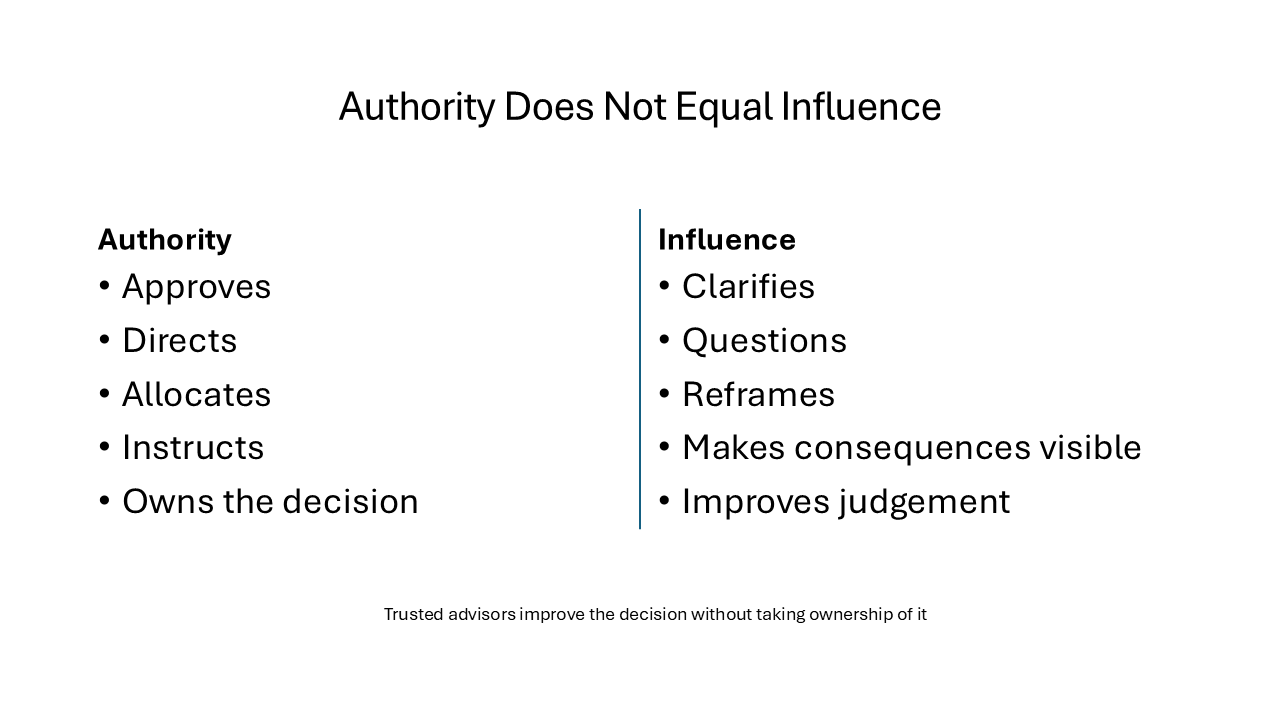
Authority does not equal influence
Questions create ownership
A recommendation can tell somebody what to do. A well-judged question can help somebody understand why the decision matters.
Questions such as the following can change the quality of a senior discussion:
What evidence would materially alter this decision?
What concern is preventing commitment?
What would need to be true for this option to succeed?
What happens if nothing changes?
Who will answer for the outcome once the decision is made?
These questions do not manipulate the decision-maker towards a predetermined conclusion. They expose the conditions required for a sound decision. When people articulate those conditions themselves, they are more likely to understand and own the resulting choice.
That ownership matters after the meeting. A decision accepted because somebody argued forcefully for it may weaken once that person leaves. A decision reached through clear reasoning is more likely to endure.
Restraint strengthens influence
Influence is easily weakened by over-explanation.
Once the decision, recommendation, and consequences are clear, additional words can begin to introduce doubt. Repeating an argument may suggest the adviser does not trust it to stand. Adding further evidence can reopen questions that were already sufficiently resolved.
This is particularly relevant when silence follows a recommendation.
The urge to keep speaking can be strong. Silence may feel like loss of control or lack of engagement.
Often it is simply the moment when the decision-maker is thinking. Experienced advisers allow that space to exist. They answer the question asked, state the judgement clearly, and stop. If more detail is required, it can be requested. If a concern remains, it can be explored directly.
Restraint shows confidence in both the advice and the client’s ability to consider it.
The adviser must not own the client’s decision
There is a boundary at the heart of trusted advice. The consultant contributes analysis, judgement, challenge, and clarity. The client owns the decision.
Crossing that boundary may appear helpful in the short term, particularly when stakeholders are reluctant to commit. But it creates dependency and weakens accountability.
A decision-maker who adopts a recommendation without understanding or owning it may later distance themselves when circumstances change. The adviser then becomes associated not only with the analysis, but with a decision that never properly belonged to the client. Strong advisers resist that temptation.
They make the decision clear enough to own. They do not take ownership on the client’s behalf.
The test
A simple test helps distinguish advisory influence from forceful persuasion:
If the adviser needs to win the argument, the advisory position has probably already weakened.
Trusted advice is not measured by whether the consultant dominates the conversation.
It is measured by whether the client reaches a clearer, better-owned decision.
Conclusion
The strongest advisers are rarely the loudest people in the room. They do not rely on authority they do not possess. They do not overwhelm challenge with information or treat every objection as opposition.
They clarify the decision. They listen for the concern beneath the question. They make consequences visible. They ask questions that improve judgement and then allow the decision-maker enough space to think. This is not passive consulting. It requires confidence, restraint, and the willingness to leave ownership where it belongs.
Good advisers bring expertise. Trusted advisers help other people use their own judgement more effectively. That is why the most persuasive advice often feels less like persuasion and more like clarity.