Why organisations are rarely surprised by failure

Image courtesy of Unsplash.com
Executive Summary
Organisational failure is often described as unexpected, but serious problems rarely arrive without warning. Falling performance, recurring exceptions, staff turnover, customer complaints, and increasing dependence on a small number of people usually appear well before failure becomes visible. The problem is not always that organisations fail to identify risk. More often, they recognise individual warning signs but tolerate the combined exposure for too long. Effective strategic-risk management means distinguishing current issues from future risks, understanding where the organisation is most vulnerable, and acting before repeated signals become accepted as normal.
Failure rarely begins with a single dramatic event
When an organisation experiences a serious failure, the event is often described as sudden.
A major customer leaves. A critical service breaks down. Costs rise sharply. Delivery becomes unreliable. Key employees resign, taking important knowledge with them. From the outside, this can look like an unexpected crisis. Inside the organisation, the story is often different.
Warning signs may have been visible for months. Staff turnover was increasing. Customer complaints were recurring. Exceptions were becoming routine. Managers were spending more time managing immediate problems and less time addressing their causes.
The final failure may be sudden. The conditions that created the failure usually are not.
Risk is not the same as an issue
One reason organisations struggle with strategic risk is that risks and issues are frequently treated as though they are the same thing.
An issue is happening now. A risk is an uncertain future event or consequence.
If staff turnover is already increasing, that is an issue. The associated risk may be that service resilience falls, remaining staff become overloaded, customer relationships weaken, or essential knowledge leaves the organisation.
The distinction matters because an organisation can manage a current issue without adequately addressing the future exposure it creates.
Recruitment may replace some departing staff. Temporary cover may protect service levels. Overtime may keep work moving. These actions may control the immediate issue.
They do not necessarily reduce the strategic risk.
Identifying a risk does not mean controlling it
Most organisations can identify risks.
Risks appear in reports, meeting papers, project documents, and risk registers. They are assigned ratings, owners, and review dates. This can create confidence that the risk is being managed.
But visibility is not control.
A risk can remain clearly documented while the organisation’s exposure continues to rise. The same concern may be reviewed repeatedly without a meaningful change in behaviour.
The language may become familiar:
Recruitment remains difficult.
Customer complaints continue to be monitored.
Operational pressure remains high.
Management capacity is constrained.
Mitigating actions are in progress.
Each statement may be accurate.
Together, they may describe an organisation moving steadily towards failure.
The danger is that familiarity reduces urgency. A risk discussed every month without becoming a crisis can begin to feel stable, even while the underlying position is deteriorating.
Failure is rarely unexpected. It is usually preceded by warning signs the organisation has learned to tolerate.
Exposure matters more than the risk description
A broadly worded risk tells leaders what might happen. Exposure tells leaders how badly the organisation could be affected and how little margin remains.
Consider a customer service function experiencing rising staff turnover. The immediate problem is clear, but the strategic exposure depends on several additional factors.
Is important knowledge concentrated among a small number of experienced employees? Are operating procedures sufficiently documented? Can other teams provide cover? How long does recruitment take? How quickly can new staff become effective?
Two organisations may appear to face the same risk while having very different levels of exposure.
One may have experienced staff, documented procedures, strong recruitment, and spare capacity.
The other may depend on a few individuals, have limited cover, and require several months to recruit and train replacements.
The headline risk is the same.
The vulnerability is not.
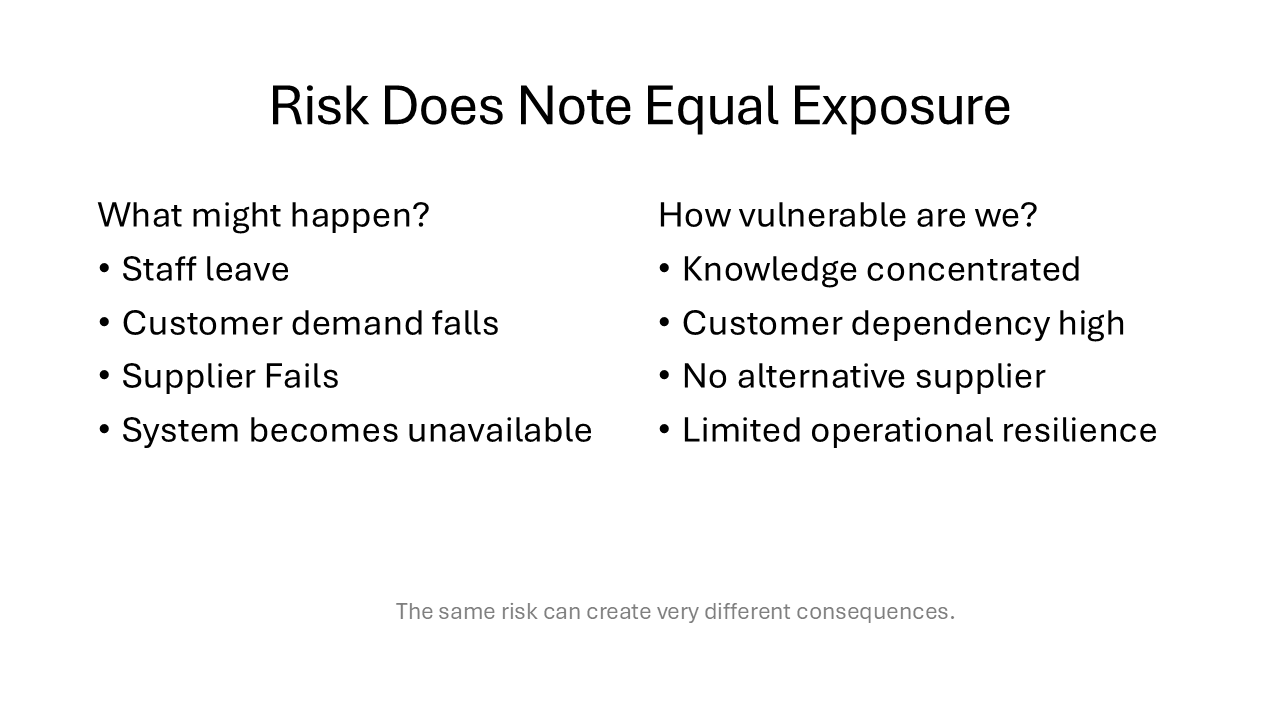
The same risk can create very different consequences
Concentration makes ordinary problems dangerous
Many strategic failures begin with excessive concentration.
Knowledge may be concentrated in one person. Revenue may be concentrated among a small number of customers. A service may depend on one supplier, one system, or one operational site.
Concentration can make an organisation efficient when conditions are stable. It can also make ordinary disruption disproportionately damaging.
The departure of one employee should not threaten an important service. The loss of one customer should not destabilise the entire business. The failure of one supplier should not stop all delivery.
Where that is possible, the organisation has more than a routine operational risk. It has a strategic exposure.
The absence of previous failure does not prove resilience. It may simply mean the concentration has not yet been tested.
Repeated exceptions are warning signs
Weak signals often appear as exceptions.
A deadline is missed because of unusual demand. A customer complaint is attributed to an isolated mistake. Overtime is approved to cover temporary absence. A workaround is introduced until the underlying problem can be addressed.
Each decision may be reasonable in isolation.
The strategic risk appears when exceptions repeat.
Repeated exceptions indicate that the system is no longer coping within its normal design. The temporary workaround becomes routine. Managers spend increasing amounts of time holding performance together manually.
At this point, the organisation may still appear functional. But resilience is declining.
Why organisations wait
Leaders rarely ignore warning signs deliberately.
More often, immediate demands take priority. Intervention carries cost, disruption, or political difficulty. The organisation hopes that recruitment will improve, demand will settle, or the next reporting period will show recovery.
Waiting can feel proportionate when no single signal appears decisive.
The problem is that strategic vulnerability develops through accumulation.
Staff turnover alone may be manageable. Rising complaints alone may be manageable. Increasing overtime alone may be manageable.
Together, they may be evidence of a system approaching its limit.
This is where principal judgement matters. The question is not whether any individual symptom proves failure is imminent. The question is whether the combined pattern has changed the organisation’s exposure.
Strategic risk requires intervention triggers
A risk should not remain a subject of indefinite observation.
There must be a point at which the organisation acts differently.
That point might be reached when complaints exceed an agreed tolerance, when turnover continues for successive periods, when essential knowledge becomes concentrated among too few people, or when temporary arrangements become routine.
Without an intervention trigger, risk management becomes passive reporting.
The organisation remains informed but not protected.
A useful test is:
If the same risk is discussed repeatedly but behaviour never changes, the organisation is monitoring exposure rather than managing it.
Conclusion
Organisations are rarely surprised by failure because no warning signs existed.
They are surprised because the warning signs were considered individually, explained away, or tolerated for too long.
Strategic risk is not controlled simply because it appears in a register or is reviewed regularly. Control begins when leaders understand the organisation’s exposure, recognise concentration and dependency, and define the point at which observation must become intervention.
The final failure may arrive suddenly. The path towards it usually does not.
Strong organisations do not wait for one decisive warning. They recognise when several smaller signals are telling the same story.
That is the difference between knowing a risk exists and acting before it becomes a crisis.