pressure reveals judgement

Lighthouse in a storm. Image courtesy of Unsplash
Executive Summary
Many organisations believe they understand their decision-making processes. Policies are documented, governance structures are established, and leadership teams are experienced. Yet the true quality of judgement is rarely revealed during stable conditions. It emerges when uncertainty rises, options narrow, time becomes limited, and the consequences of error increase. Pressure does not create character, capability, or culture. It reveals them. The decisions made under pressure often expose strengths and weaknesses that remained hidden when conditions were comfortable. The most effective organisations recognise this and prepare accordingly.
Why Pressure Reveals Judgement
Most organisational decisions are made under less-than-perfect conditions. Information is incomplete. Time is limited. Stakeholders disagree. Risks are uncertain. Resources are constrained. Despite this, many organisations assume that pressure is the primary cause of poor decision-making.
In reality, pressure often does something different. It reveals the strengths and weaknesses that already existed. A weak governance process may appear effective while circumstances are favourable. A poorly aligned leadership team may seem cohesive when difficult choices are unnecessary. A fragile culture may remain hidden while performance is strong.
Pressure changes that
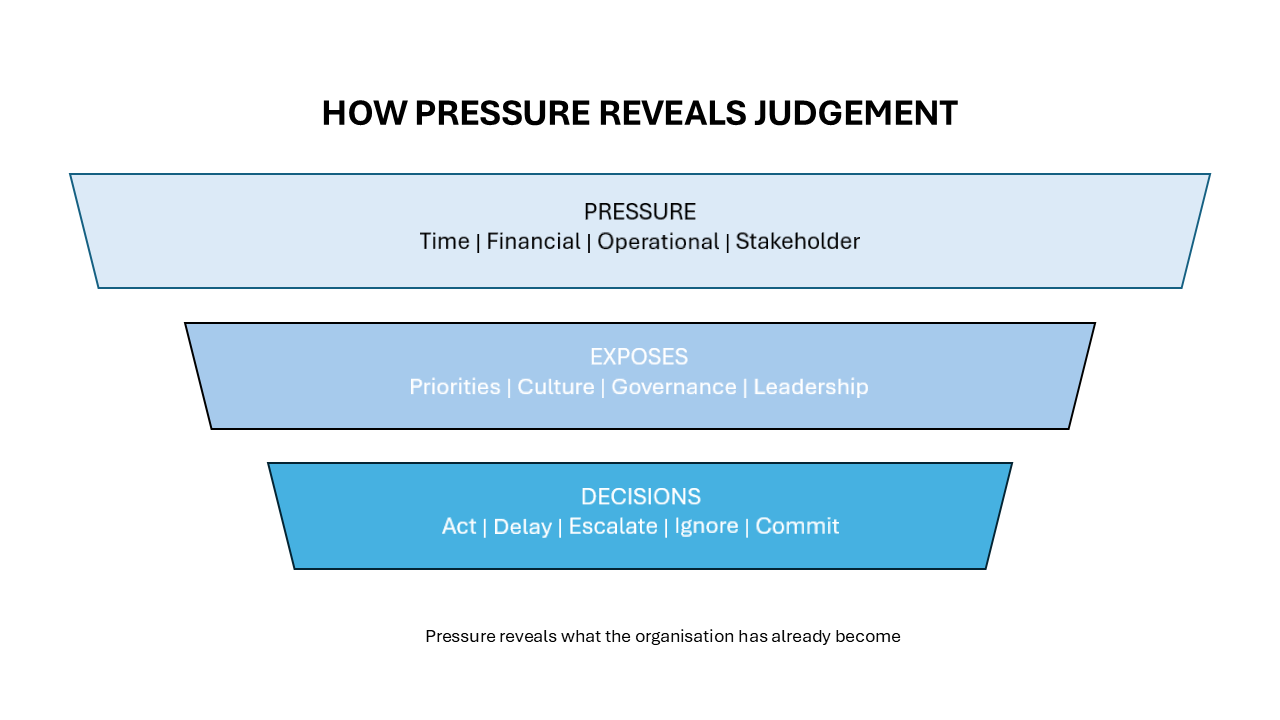
It removes comfort, exposes assumptions and forces priorities into the open. That is why pressure is such an effective test of organisational judgement. Pressure does not create behaviour. People often say that pressure causes individuals or organisations to behave differently. There is some truth in this. However, pressure frequently reveals existing tendencies rather than creating entirely new ones.
A leader who communicates openly under normal conditions may continue to do so when circumstances become difficult. A leader who avoids difficult conversations may find that avoidance becomes more visible under pressure.
The same principle applies to organisations.
Pressure exposes:
existing decision-making habits;
existing cultural norms;
existing levels of trust;
existing governance weaknesses;
existing strengths.
In other words, pressure magnifies what is already present.
Uncertainty changes the decision environment
Good judgement becomes more difficult when certainty disappears.
Unfortunately, the most important decisions are often made under exactly those circumstances.
Organisations may need to decide:
whether to invest;
whether to reduce costs;
whether to change direction;
whether to intervene;
whether to wait.
At these moments, complete information is rarely available. The challenge is not finding certainty. The challenge is making a proportionate decision despite uncertainty. This is where many organisations struggle. The search for certainty can delay action until options become limited. Equally, excessive confidence can lead to premature commitment. Judgement sits between those extremes.
Pressure exposes priorities
When resources are constrained, priorities become easier to identify. An organisation may claim that several objectives are equally important. Pressure often reveals otherwise. A difficult financial period may demonstrate whether customer service truly matters when costs must be reduced. A staffing shortage may reveal whether employee wellbeing remains a genuine priority when operational demands increase. The decisions made during these periods tell people what the organisation values most.
That is why pressure can have a lasting impact on culture. People pay attention to what leaders do when difficult trade-offs become unavoidable. Those choices often carry more weight than previous statements or commitments.
“Pressure does not create judgement. It reveals the quality of judgement that already exists.”
The danger of decision avoidance
Not all poor decisions involve taking the wrong action. Some involve avoiding a decision altogether. Under pressure, leaders may delay difficult choices in the hope that additional information will emerge or circumstances will improve. Occasionally, this is sensible. Frequently, it creates additional exposure. Problems rarely become easier simply because time passes. Costs can increase. Options can narrow. Risks can accumulate. A delayed decision is still a decision. The organisation has chosen not to act. Strong judgement requires recognising when further analysis is valuable and when it merely postpones commitment.
Teams reveal their quality under pressure
Pressure also exposes the quality of leadership teams. Some teams become defensive. Information becomes restricted. Debate becomes personal. Accountability weakens. Other teams become clearer and more disciplined. Important information is shared openly. Difficult questions are welcomed. Assumptions are challenged constructively. Decisions remain connected to evidence rather than hierarchy. The difference is rarely the absence of pressure. The difference is how the team responds to it. The strongest teams do not eliminate pressure. They create conditions in which sound judgement can survive despite it.
Preparation matters more than reaction
Organisations sometimes treat decision-making under pressure as a special situation requiring extraordinary leadership. A more useful perspective is that pressure tests routines developed long before the pressure arrived. Governance structures, reporting processes, leadership behaviours, organisational trust and cultural norms are all developed during relatively stable periods.
When pressure arrives, those foundations are tested. This is why resilient organisations often appear calm during challenging situations. They are not necessarily experiencing less pressure than others. They simply prepared more effectively before it arrived.
The test
A simple test helps evaluate organisational judgement:
What happens when certainty disappears and the decision cannot be postponed? The answer often reveals more about leadership, governance and culture than any formal assessment.
Conclusion
Pressure has a reputation for causing poor decisions. More often, it reveals weaknesses that already existed. It exposes whether priorities are genuine, whether governance is effective, and whether leaders can operate with incomplete information. Strong organisations do not wait for pressure before developing judgement. They create habits, processes and behaviours that remain effective when conditions become difficult. Because pressure is not merely an operational challenge. It is a test of everything the organisation has already become. And that is why pressure reveals judgement.