Why Culture usually wins

Image courtesy of Unsplash
Executive Summary
Organisations often describe culture through values, policies, and leadership statements. Those things can express worthwhile intentions, but they do not determine how people behave. Culture is formed through the conduct that is rewarded, repeated, challenged, or tolerated. It becomes particularly visible when pressure rises and declared principles compete with immediate results. Strategy may set direction and policy may define expectations, but culture determines what people believe will really happen. Sustainable improvement therefore requires more than communication. It requires leaders to align their decisions, responses, and consequences with the behaviour they claim to value.
Why Culture Usually Wins
Most organisations can explain the culture they would like to have. Their websites refer to integrity, collaboration, customer focus, accountability, and continuous improvement. Values appear in induction materials, internal communications, and leadership presentations. Policies explain how people should behave and how decisions should be made. These statements can be sincere and useful. They are not necessarily culture.
Culture is revealed through everyday experience. It develops from what leaders notice, what managers reward, what colleagues repeat, what the organisation challenges and what it quietly allows to continue. That is why culture usually wins.
A strategy can set a new direction. A policy can introduce a new expectation. A project can create a new system. But if established behaviour remains stronger than the formal change, people will usually return to what the organisation has taught them is normal.
Culture is not the values statement
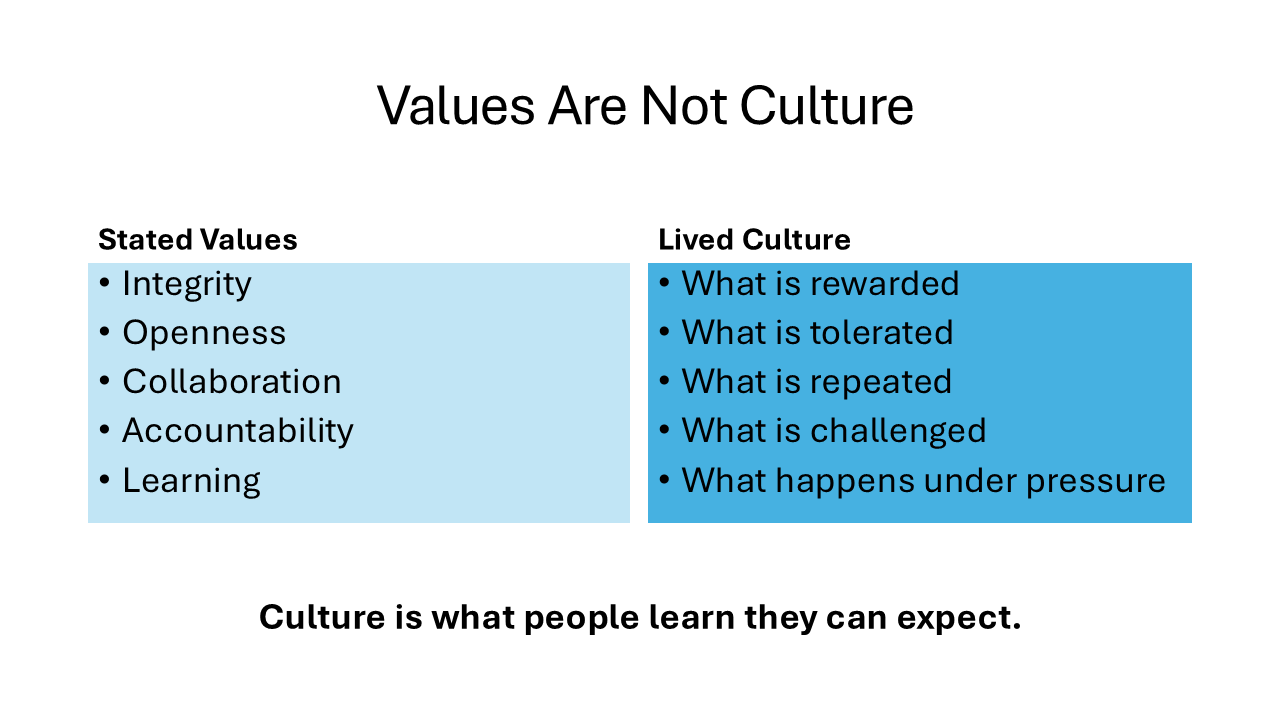
Values statements describe intention. Culture describes expectation. An organisation may say that it values openness, but employees will judge openness by what happens when somebody raises an uncomfortable concern. It may declare accountability, but people will judge accountability by whether commitments carry consequences. It may promote learning, but employees will notice whether mistakes lead to reflection or blame. The distinction matters because employees learn culture through observation.
They watch which behaviours attract recognition. They notice which concerns receive attention. They see whether rules apply consistently and whether senior people are held to the same standards as everybody else. Over time, these observations create a practical understanding of how the organisation works. That understanding is often more influential than anything written in a handbook.
What is rewarded becomes repeated
Every organisation has a reward system. Some rewards are formal. They include pay, promotion, performance ratings, and access to development opportunities. Others are informal. Attention is a reward. Access to senior leaders is a reward. Being protected from criticism can be a reward. Receiving praise for resolving a crisis, even when the same person helped create it, can reinforce a particular pattern of behaviour. These signals matter because people adapt to them.
If an organisation says that collaboration matters but promotes people solely for individual results, individual competition is likely to survive. If leaders say that risk should be raised early but react badly to unwelcome information, people will learn to delay unwelcome news. If short-term performance is rewarded regardless of how it is achieved, conduct will gradually adjust to that expectation. The written value remains. The rewarded behaviour becomes the culture.
What is tolerated becomes permitted
Culture is shaped not only by what organisations reward, but also by what they tolerate. A missed commitment may appear minor. An exception may seem reasonable. A recurring behaviour may be accepted because the person involved delivers strong results or possesses valuable knowledge. Each decision can be justified in isolation. Together, they create a standard. When poor behaviour carries no meaningful consequence, the organisation quietly communicates that the behaviour is permitted. When responsibility is repeatedly avoided, others learn that accountability is optional. When one team is allowed to ignore a process, the process becomes negotiable for everyone. Tolerance can be particularly damaging because it is rarely announced.
No leadership team formally declares that commitments do not matter. Few organisations intentionally decide that their policies should apply inconsistently. Instead, inconsistency develops through individual moments when challenge feels inconvenient. Culture records those moments even when the official record does not.
““If declared values and rewarded behaviour conflict, rewarded behaviour wins.””
Pressure reveals the real culture
Culture is often easiest to discuss when conditions are calm. The true test arrives when something goes wrong. What happens when a target is missed? What happens when costs rise unexpectedly?
What happens when an employee challenges a senior decision? What happens when somebody admits a mistake? Under pressure, organisations reveal what they value most. Collaboration may disappear as departments protect themselves. Openness may weaken as difficult information is softened. Long-term principles may give way to short-term performance. This does not necessarily mean that the organisation’s values were dishonest. It may mean that those values were never reinforced strongly enough to survive pressure. A value that applies only when convenient is not yet part of the culture. A principle becomes cultural when people expect it to hold even when ignoring it would be easier.
Culture explains why good changes fail
Many organisational improvements fail despite sound design. A new process is introduced, but teams continue using old workarounds. Accountability is clarified, but decisions remain delayed. Leaders ask for greater openness, but employees continue withholding difficult information. These failures may be described as communication problems or resistance to change.
Culture is often the missing explanation. People do not judge a new initiative only by what they are told. They judge it against what they have previously experienced. If earlier initiatives disappeared once leadership attention moved elsewhere, scepticism is rational. If people were previously criticised for raising concerns, a new invitation to speak openly may not immediately feel safe. If deadlines have historically mattered less than relationships or hierarchy, a revised process will not change behaviour on its own. Culture carries organisational memory. It tells people whether the latest message represents a durable change or another temporary priority.
Leadership behaviour carries more weight than leadership language
Leaders influence culture through visible decisions. People notice who receives attention, how conflict is handled, whether difficult news is welcomed and whether leaders admit their own mistakes. They notice whether pressure changes the standards that leaders previously described as non-negotiable. This does not mean leaders must behave perfectly. It means that leadership behaviour should be credible and consistent enough to reinforce the organisation’s stated expectations.
A leader who acknowledges an error can strengthen a culture of openness. A leader who challenges powerful performance achieved through poor conduct can reinforce standards. A leader who asks for unwelcome news early and responds constructively can make early escalation safer. These moments often influence culture more than a formal communications campaign. Leadership messages describe the desired culture. Leadership behaviour demonstrates whether it is real.
Culture cannot be changed through communication alone
Communication is necessary when an organisation wants culture to change. People need to understand what is expected, why it matters and what the organisation is trying to improve. But communication cannot carry the full burden. Posters, presentations, and values workshops do not change culture if the organisation’s decisions continue rewarding the old behaviour. A culture programme may create useful language, but the language will lose credibility if everyday experience contradicts it. Cultural change requires alignment.
The organisation must align:
what leaders say
what leaders do
what managers reinforce
what systems reward
what poor behaviour triggers
what happens when pressure rises.
Without that alignment, the existing culture will absorb the new language and continue unchanged.
Culture is maintained locally
Senior leaders influence culture, but culture is experienced locally. For most employees, the immediate manager, team, and working environment provide the strongest daily signals. Culture becomes real through meetings, workload decisions, performance conversations, responses to mistakes and the way colleagues treat one another. This explains why one organisation can contain several distinct cultures. The formal values may be identical across every department, while local expectations vary significantly. One team may raise concerns early. Another may conceal problems until they become unavoidable. One manager may encourage challenge. Another may treat questions as disloyalty.
Culture therefore needs attention at the level where work occurs. Organisation-wide statements matter. Local behaviour determines whether those statements become normal practice.
The test
A simple test helps reveal an organisation’s real culture:
What behaviour is repeatedly rewarded, protected, or tolerated, particularly when pressure is high?
The answer is likely to describe the culture more accurately than the published values. This is not an argument for abandoning values statements or formal policies. Those tools can provide direction and establish expectations. But they are only credible when everyday behaviour supports them.
Conclusion
Culture is sometimes described as an intangible feature of organisational life. Its consequences are anything but intangible. Culture affects what information reaches leaders, how quickly risks are raised, whether people accept accountability, how customers are treated and whether change becomes established. It influences decisions long after the meeting has ended. That is why culture usually wins. It does not win because strategy, structure or policy are unimportant. It wins because culture shapes how people interpret and apply them in practice. Organisations create stronger cultures when they align words with behaviour, recognition with values and consequences with expectations. They pay attention not only to the conduct they encourage, but also to the conduct they allow. Culture is not what an organisation says about itself. It is what people learn, through repeated experience, they can expect.