Why Good Decisions Still Fail

Image courtesy of Unsplash
Executive Summary
Organisations devote considerable time and effort to making decisions. Strategies are developed, plans are approved, projects are launched, and priorities are established. Yet many organisations still fail to achieve the outcomes they expect.
The challenge is rarely the quality of the decision itself. More often, it is the ability to execute effectively. Successful implementation requires clarity, focus, and commitment to a single overriding priority. While good decisions create the opportunity for success, execution is what converts intention into measurable results.
Too often, organisations mistake alignment for progress, assuming agreement alone will deliver outcomes. Sustained success depends on disciplined execution, consistent follow-through, and the ability to maintain focus over time. The organisations that succeed are not simply those that make the right decisions, but those that consistently act on them.
Why good decisions still fail
Organisations devote considerable effort to making decisions. Meetings are held, options are discussed and evaluated. Recommendations are reviewed, following a discussion around risk and mitigation decisions are approved. This activity is an important part of the process, as solid decisions are crucial to the stability of the organisation.
Yet many organisations experience a frustrating reality. The decision appears sound, but the outcome disappoints. A strategy that seemed convincing produces only limited improvement. A recovery plan gains widespread support but fails to deliver meaningful and sustainable change. A new initiative launches successfully and then gradually loses momentum, on a personal level just reflect on all those new gym memberships in January that are not used beyond March. The immediate temptation is to question the decision itself, sometimes that is appropriate. Often it is not.
Many good decisions fail because execution fails long before the decision does.
A decision creates potential
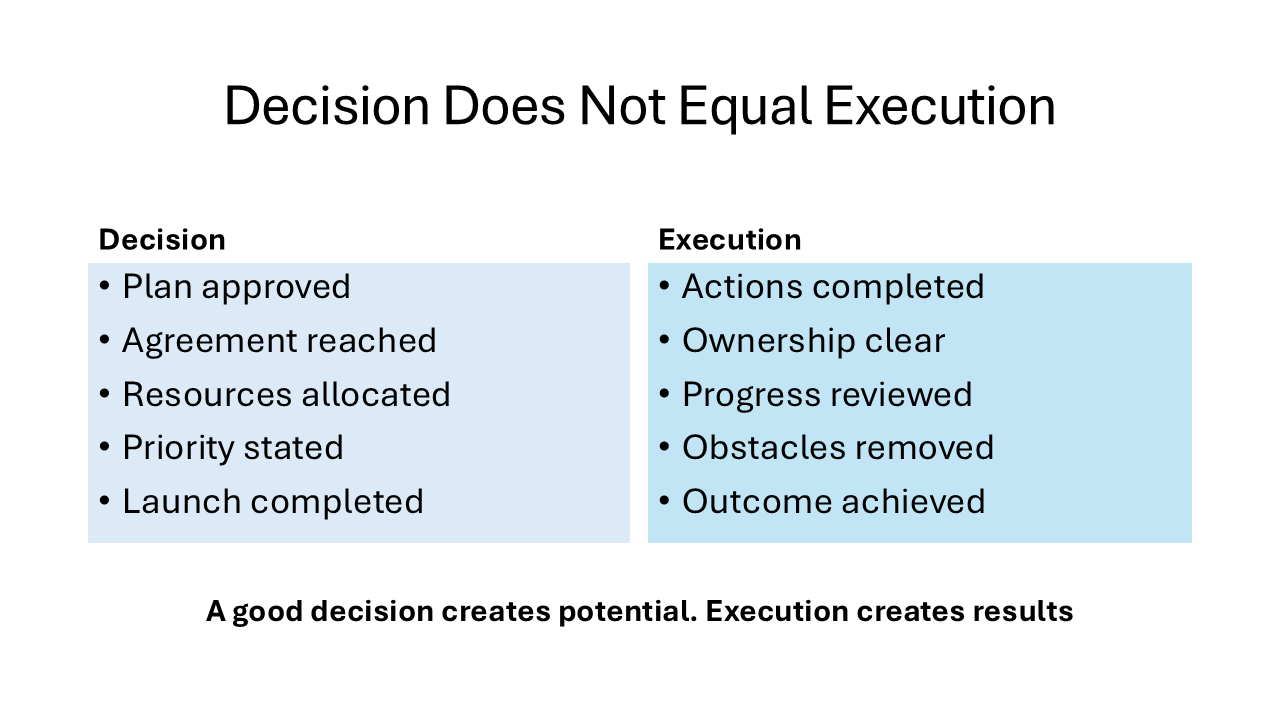
A useful distinction is separating decisions from outcomes. Organisations often treat them as though they are closely linked. In practice, they are only connected by execution. A decision approves a direction. It allocates resources, establishes priorities, and creates the possibility of improvement. What it cannot do is guarantee results. The gap between decision and outcome is where most organisational effort occurs. This gap is frequently underestimated.
A leadership team may spend weeks discussing a decision and then assume implementation will naturally follow. Unfortunately, reality is rarely that the impact of a decision can only be assessed once implementation is complete.
Agreement is not delivery
One of the most common execution traps is confusing agreement with progress. A decision receives support. Stakeholders are aligned behind it, the meeting ends with apparent consensus, everything, and everyone, feels positive. Yet nothing has changed. No customer has received a better service. No risk has reduced. No efficiency has improved. Only agreement has been achieved. Agreement is valuable because it creates a platform for action. It is not action. Many initiatives begin with strong consensus and gradually fade because the organisation mistakes support for delivery.
Why momentum disappears
Most execution failures do not occur at the beginning. They occur after the initial energy fades. Remember those gym memberships? At the start of a new initiative there is often enthusiasm. People are engaged, attention is focused, leadership interest is visible. Then other priorities emerge. New demands appear. Operational pressures return. What was once a visible priority now competes with everything else. The organisation becomes busy again. Momentum weakens as progress slows, which weakens the momentum further, and progress slows. Eventually the initiative survives more as a stated intention than an operational reality. This pattern is remarkably common. It explains why many organisations are better at launching improvements than sustaining them.
“Most execution failures begin after the initial enthusiasm fades.”
Ownership matters more than activity
Strong execution requires ownership. Not a committee, not a discussion group., not a shared aspiration. Ownership. Someone must be accountable for moving the work forward. Someone must remove obstacles, someone must ensure that progress remains visible after attention shifts elsewhere. Without ownership, activities continue but outcomes become uncertain. Tasks may be completed, meetings may occur, reports may be produced. Yet the desired outcome remains no closer. Execution requires accountability linked directly to results rather than simply activity.
Review keeps priorities alive
Another common reason execution weakens is the absence of meaningful review. Organisations often review activity instead of progress. They discuss:
meetings held
work completed
milestones achieved
documents produced.
These measures can be useful. But they do not necessarily indicate movement towards the desired outcome. The stronger question is:
What has improved?
Regular review helps prevent initiatives from becoming background noise. It keeps leadership attention focused on outcomes rather than effort. Most importantly, it creates opportunities to identify obstacles before momentum is lost completely.
Execution depends on consistency
Many organisations search for breakthrough solutions. Execution is usually less dramatic. It depends on consistency. Small actions repeated over time often create greater results than short bursts of intense activity. This is true in organisations and in personal development.
Progress is rarely created by one exceptional week. It is created by sustained follow-through. The same principle applies to strategy, governance, change, learning, and growth. Improvement depends on continued execution long after the original excitement has passed.
The hidden cost of weak execution
Poor execution creates more than disappointing outcomes. It damages confidence. People begin to doubt future initiatives. Scepticism grows. Stakeholders remember previous promises that produced limited results. Future change becomes harder because organisational memory now contains evidence that commitments do not reliably become outcomes. This creates a difficult cycle. Weak execution reduces trust. Reduced trust weakens future execution. Breaking that cycle requires visible delivery rather than additional promises.
The test
A simple test helps distinguish good intentions from execution:
If nobody owns the outcome, the decision has not been executed.
Ownership does not guarantee success, however, the absence of ownership makes success even less likely.
Conclusion
Many organisations assume that success follows naturally from making good decisions. It does not. Good decisions create direction. Only good execution creates results. The gap between the two is where priorities compete, momentum is tested, and accountability matters most. Agreement is valuable planning is essential, strategy is important. But none of them create outcomes on their own. The organisations that succeed consistently are not necessarily those that make the best decisions. They are often the organisations that execute good decisions more reliably than others. Because execution is not what happens after a decision is made. Execution is how the decision becomes real.