Why organisations confuse activity with progress

Why organisations confuse activity with progress
Executive Summary
Many organisations are extremely busy. Meetings are held, projects are launched, reports are produced, and initiatives are announced. Yet despite all this activity, meaningful progress remains elusive. Activity creates the appearance of movement, but movement alone does not guarantee improvement. The most effective organisations understand the difference. They focus less on how much is happening and more on whether what is happening is advancing a clear objective. Progress requires direction. Activity alone does not.
Why organisations confuse activity with progress
Most organisations are not short of activity. Calendars are full. Meetings are well attended. Projects are underway. Reports are produced. Action plans are updated. Emails circulate. Dashboards are reviewed. New initiatives are regularly launched.
From the outside, this often looks impressive. The organisation appears energetic, engaged, and productive. Yet a simple question frequently exposes a different reality:
What has actually improved?
The answer is often less clear than expected. This is because activity and progress are not the same thing. Many organisations generate large amounts of the first while achieving surprisingly little of the second.
Activity is visible
One reason activity is so attractive is that it is easy to see. People can point to:
meetings held
reports completed
projects started
workshops delivered
actions assigned
These things create evidence that work is happening. They provide reassurance. They create momentum. They allow people to feel as though something is being done.
None of this is inherently bad. The problem begins when activity becomes a substitute for progress. It is entirely possible for an organisation to be extremely busy while remaining largely stationary.
Movement is not direction
Imagine somebody walking quickly around in circles. There is movement. There is effort. There may even be urgency. What there is not necessarily is progress. Progress requires direction.
Organisations experience exactly the same problem. Teams can work extremely hard while moving in different directions. Departments can pursue competing priorities. Projects can consume resources without advancing the organisation's most important objectives. The organisation appears busy because many things are happening.
What becomes less clear is whether those things are collectively moving the organisation towards a better position.
This distinction sits at the heart of effective leadership.
The comfort of activity
Activity often feels safer than judgement. Starting a new initiative feels productive. Creating another report feels responsible. Holding another meeting feels engaged. As a result, organisations naturally drift towards things that can be counted, scheduled, and demonstrated. The risk is that effort becomes the measure of success. When that happens, a subtle shift occurs. People begin asking:
"What are we doing?"
instead of:
"What difference is it making?"
Those questions sound similar. They are not. One measures effort. The other measures outcome.
“If nothing has been excluded, there is probably no strategy”
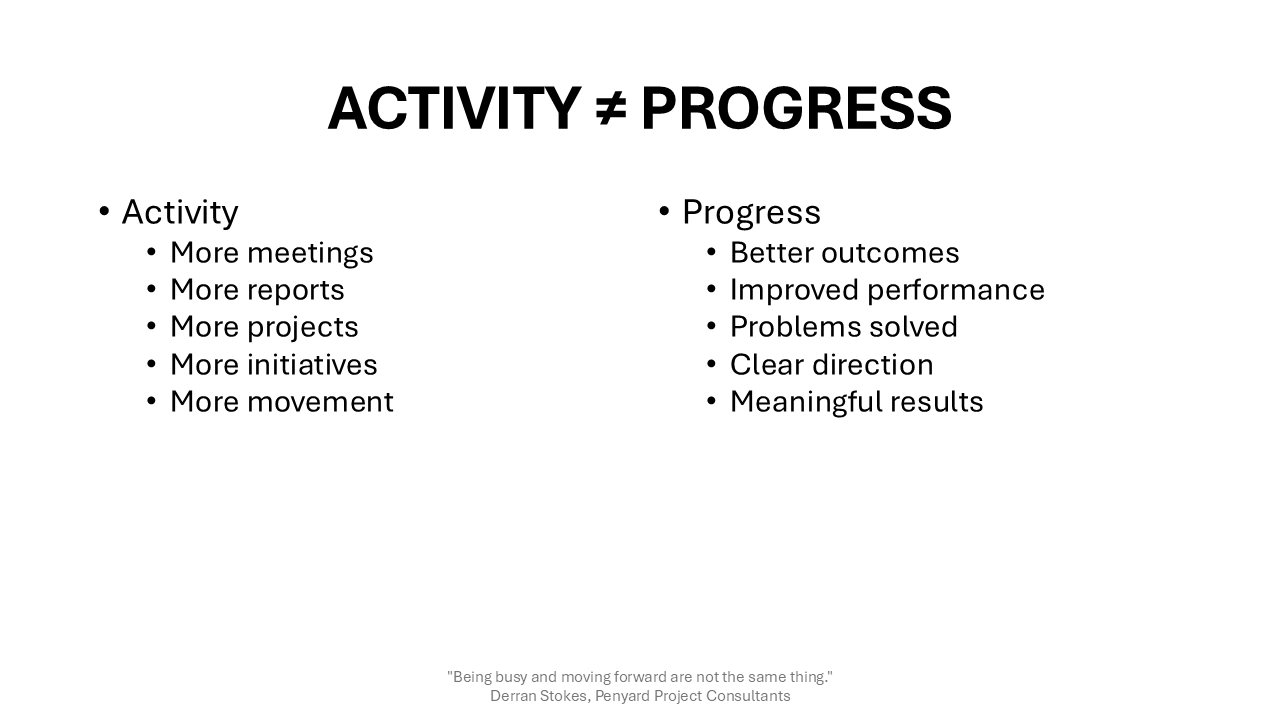
Comparison showing the difference between activity and progress
Why priorities become diluted
A common cause of excessive activity is the belief that everything matters. A new customer initiative appears important. A new compliance requirement appears important.
A technology improvement appears important. A recruitment challenge appears important. A process review appears important. Individually, they may all be justified. Collectively, they often overwhelm the organisation.
When everything becomes a priority, nothing receives the focus required to make meaningful progress. The result is predictable:
more meetings
more reporting
more projects
more pressure
but not necessarily better outcomes. The organisation becomes occupied rather than effective.
Progress requires choice
One of the least glamorous aspects of leadership is deciding what will not receive attention. Many organisations spend significant energy deciding what to start. Far fewer spend equal energy deciding what to stop. Yet stopping activities is often where progress begins. Every meeting consumes time. Every initiative consumes attention. Every project consumes resources. The question is not whether these activities have value.
The question is whether they contribute sufficiently to justify the resources consumed.
Effective leaders are willing to ask uncomfortable questions:
Why are we doing this?
What happens if we stop?
What outcome is this intended to achieve?
How will we know if it has worked?
These questions often reveal that some activity survives largely because it has always existed.
Progress is usually quieter than activity
Activity attracts attention. Progress often does not.
Progress can look like:
fewer customer complaints
shorter turnaround times
reduced rework
better decision-making
improved staff retention
stronger financial performance
These outcomes are often less visible than the work that created them. Because of this, organisations sometimes celebrate activity and overlook progress. The dashboard fills with indicators of effort while the underlying outcomes receive less attention.
Over time this creates a strange situation:
The organisation becomes highly informed about what it is doing while remaining less certain about whether it is succeeding.
The Principal Question
One question cuts through much of this confusion:
If we stopped doing this tomorrow, would anybody notice a meaningful difference?
Not because an activity disappeared. Because an outcome deteriorated. That distinction matters. If nobody notices a difference, the activity may not be contributing as much value as assumed. If outcomes immediately worsen, the activity is probably serving a genuine purpose. This is often a more useful test than discussing effort, commitment, or historical practice.
Conclusion
Most organisations do not struggle because people are lazy. They struggle because people are busy. There is a difference.
Activity creates movement, visibility, and reassurance. Progress creates improvement.
The challenge for leaders is recognising that the two are not interchangeable. A full calendar is not a strategy. A long action list is not progress. A growing number of initiatives is not evidence of success. Real progress occurs when activity is connected to a clear direction and produces measurable improvement.
That requires focus. It requires judgement.
And sometimes it requires the courage to stop doing things that create movement without creating value.
A useful test remains:
If activity disappeared tomorrow, what outcome would change?
Because organisations do not become successful by doing more things. They become successful by doing the right things, consistently, for long enough to matter.