What Clients really buy from trusted advisers

Image courtesy of Unsplash
Executive Summary
Clients may initially appoint advisers because of their knowledge, experience, or technical expertise. Those qualities matter, but they are rarely what creates a lasting advisory relationship. Trusted advisers provide something more valuable: clarity when choices are difficult, perspective when the client is too close to the issue, constructive challenge when comfortable assumptions need testing, and judgement when evidence remains incomplete. The strongest advisers do not take decisions away from their clients or create dependency. They help clients understand their choices, consequences, and uncertainties clearly enough to exercise their own judgement with confidence.
Clients rarely need more information
Most organisations are not short of information. Reports are available. Data is collected. Opinions are offered. Internal teams understand the history, personalities, and operational detail surrounding an issue. Yet important decisions can remain unresolved. This is because information and understanding are not the same thing.
A client may possess extensive knowledge of a problem while still being uncertain about what to do next. Several options may appear credible. Different stakeholders may interpret the same evidence differently. The consequences of acting may be visible, while the consequences of delay remain hidden. At moments like these, adding further information does not necessarily help. The client needs clarity. That is where trusted advice begins.
Expertise opens the door
Clients rightly expect advisers to understand their subject. Expertise provides credibility. It allows an adviser to recognise patterns, evaluate evidence, identify risks, and distinguish important details from background noise. Without expertise, advice lacks a sound foundation. But expertise alone does not create trust.
A knowledgeable adviser can still overwhelm a client with detail, make recommendations that ignore practical reality, or become more interested in demonstrating understanding than improving the decision. Technical accuracy is necessary. It is not sufficient.
Clients may appoint an adviser because of expertise. They continue working with that adviser because expertise has been converted into useful judgement.
Trusted advisers create clarity
The central value of trusted advice is often the ability to make a difficult decision easier to understand. That does not mean making the decision itself easy. Some choices remain uncomfortable, uncertain, or expensive even after they have been framed properly. Clarity means that the client understands:
what is actually being decided
which options genuinely deserve consideration
what consequences follow from each choice
what remains uncertain
what must happen next.
This clarity reduces the amount of noise surrounding the decision. Adjacent issues can be separated from immediate ones. Premature options can be deferred. Assumptions can be made explicit. Information that does not alter the judgement can remain available without dominating the discussion. The problem becomes smaller without being oversimplified.
Clients may initially buy expertise. They retain trusted advisers for judgement.
Perspective is difficult to create internally
Clients often understand their organisations better than any external adviser ever could. They know the history, culture, working relationships, previous decisions, and practical constraints. That knowledge is valuable, but it can also make issues harder to see clearly. People inside an organisation may have become accustomed to recurring problems. Temporary workarounds may have become normal practice. Longstanding assumptions may no longer be questioned. Political or personal considerations may make certain conclusions uncomfortable to express.
An external adviser can provide distance. That distance allows familiar circumstances to be viewed afresh. It can reveal that an accepted constraint is actually a choice, that an apparently new problem has developed gradually, or that a discussion about cost is concealing uncertainty about value. The adviser does not possess better organisational knowledge. The adviser provides a different angle from which that knowledge can be examined.
Constructive challenge is part of trust
Trusted advice is not constant agreement. An adviser who supports every proposal, confirms every assumption, and avoids every difficult conversation may be pleasant to work with, but is unlikely to be valuable when decisions become serious. Trust sometimes requires challenge.
That challenge might involve saying:
the evidence does not support the preferred conclusion;
the decision is being taken too early;
an attractive opportunity does not fit the strategy;
apparent savings create greater long-term cost;
ownership remains unclear;
the organisation is monitoring risk rather than controlling it.
This does not require confrontation. Challenge becomes constructive when it focuses on the decision rather than the person making it. The strongest advisers test assumptions calmly, explain consequences plainly, and resist the temptation to dramatise disagreement. The objective is not to prove the client wrong. It is to ensure that the decision is strong enough to survive reality.
Judgement matters most when evidence is incomplete
If every relevant fact were known, many senior decisions would be considerably easier. In practice, leaders often choose while evidence remains incomplete, conditions are changing, and several outcomes are possible. Analysis can reduce uncertainty. It cannot remove it entirely.
This is where judgement becomes valuable. Judgement recognises when the evidence is sufficient to proceed. It distinguishes uncertainty that matters from uncertainty that can be tolerated. It identifies when further analysis will materially improve the decision and when it will merely delay commitment. Trusted advisers do not pretend to know what cannot be known. They express uncertainty honestly, while still helping the client decide. That balance matters. Excessive certainty undermines credibility when events change. Excessive caution leaves the client no clearer than before. Experienced advice sits between the two.
It says, in effect:
This is what the evidence currently indicates, these are the principal uncertainties, and this is the most proportionate decision available.
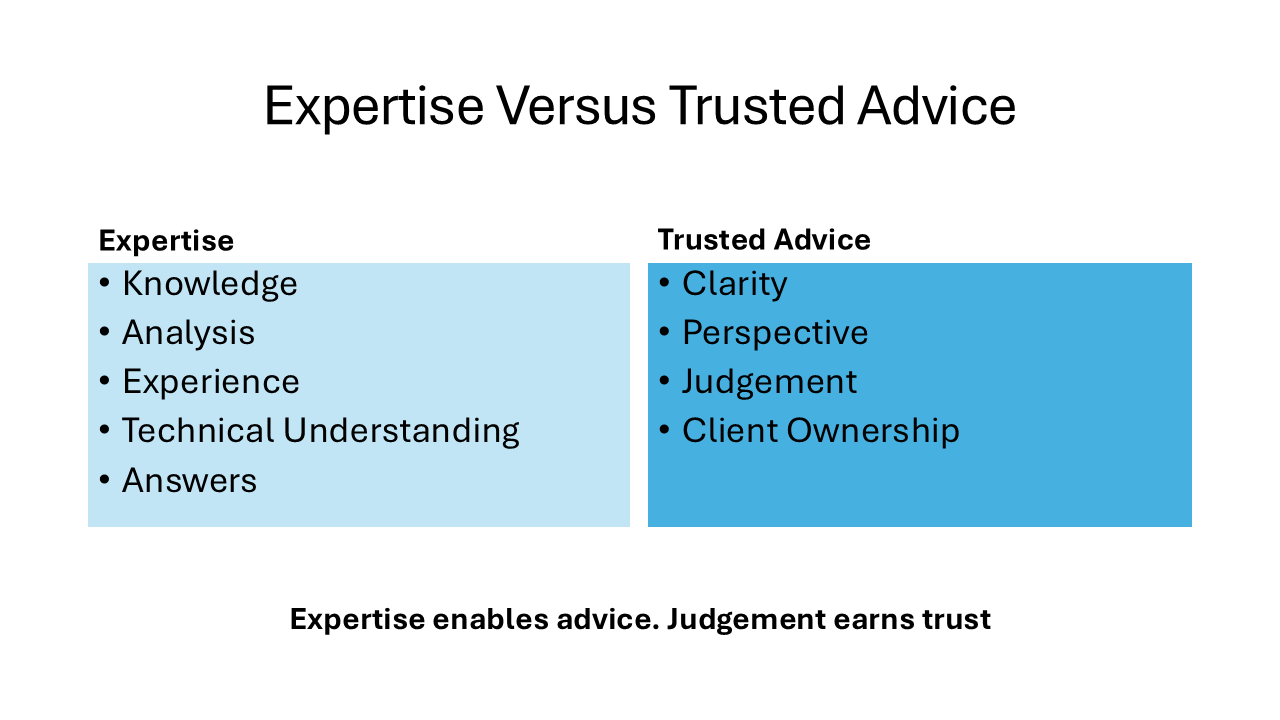
Expertise versus Trusted Advice
Trusted advisers make consequences visible
Senior decisions often become distorted because attention concentrates on the immediate and visible consequences of acting. The financial cost is clear. The disruption is clear. The resources required are clear. The consequences of doing nothing may receive far less attention. A trusted adviser helps the client see both sides.
What happens if action is taken?
What continues if nothing changes?
What risk accumulates during delay?
Which opportunity is lost when resources are committed elsewhere?
What future decision becomes harder if this one is avoided?
This is not persuasion through fear. It is balanced decision-making. A choice cannot be evaluated properly if only the visible cost of action is considered. The cost of inaction, the opportunity cost, and the strategic exposure must also be understood. Making those consequences visible often contributes more value than another round of analysis.
The client must retain ownership
There is an important boundary at the heart of trusted advice. The adviser contributes expertise, analysis, challenge, perspective, and judgement. The client owns the decision. When a client is uncertain, an adviser may be tempted to assume more responsibility. Recommending a course of action can gradually become making the choice on the client’s behalf.
That may feel helpful. It creates a fragile decision. If the client does not understand and own the reasoning, commitment may weaken when circumstances become difficult. The recommendation remains associated with the adviser rather than becoming part of the client’s own judgement. Strong advisers avoid creating this dependency. They help the client reach a decision that can be explained, defended, and implemented without the adviser remaining permanently present. The purpose of advice is not to make the adviser indispensable. It is to make the client’s judgement stronger.
Restraint builds credibility
Trusted advisers also know when to stop. Once the decision, recommendation, evidence, consequences, and uncertainties are clear, additional explanation can reduce rather than increase confidence.
More slides may introduce new distractions. More analysis may reopen settled questions. More talking may imply that the recommendation cannot stand without constant defence. Restraint is therefore part of advisory judgement. It means answering the question asked, making the relevant point, and allowing the client space to consider it.
Silence does not indicate that the adviser has run out of expertise. It can indicate confidence that the necessary judgement has been expressed.
The test
A simple test reveals whether advice is strengthening the client:
If the client becomes dependent on the adviser’s judgement, the adviser has not strengthened the client’s own.
Trusted advice should leave something behind. Not merely a report or recommendation, but a clearer understanding of the decision and a stronger ability to act on it.
Conclusion
Clients may begin by looking for expertise. What they ultimately value is clarity. They value an adviser who can distinguish the important from the merely available. They value perspective that reveals what proximity has hidden. They value constructive challenge that improves decisions without becoming personal. They value judgement that can operate honestly when information remains incomplete. Most importantly, they value advice that helps them make a decision they understand and can own. Trusted advisers do not dominate the room, manufacture certainty, or create dependence.
They clarify. They question. They challenge. They make consequences visible. Then they leave the decision with the person accountable for it. That is the difference between providing information and providing trusted advice.
Expertise may earn the first conversation. Judgement earns the next one.