Why growing a business is easier than strengthening one

Image courtesy of Jake Bluckner on Unsplash.com
Executive Summary
Growth is often treated as an unquestioned sign of success. More customers, more revenue, and more activity can certainly be positive developments. However, growth does not automatically make an organisation stronger. Many businesses become busier, more complex, and more dependent on key individuals without becoming more resilient or sustainable. The most effective organisations focus not only on growth itself, but also on whether that growth strengthens capability, improves resilience, and creates a foundation for long-term success.
Why growing a business is easier than strengthening one
Growth is one of the most celebrated words in business. Businesses aim for growth. Investors look for growth. Leadership teams discuss growth. Success stories are often measured by how quickly an organisation expands. There is good reason for this. Growth can create opportunities, resources, influence, and resilience. A growing organisation may be serving more customers, generating more revenue, and creating more value than before.
The problem is that growth and strength are not the same thing.
Many organisations become larger without becoming stronger. That distinction matters more than most people realise.
Growth is easy to recognise
One reason growth attracts so much attention is that it is visible.
Growth often appears as:
higher revenue
larger teams
additional customers
new products
new services
larger premises
These changes are easy to identify and easy to celebrate. They provide evidence that the organisation is moving forward. At least on the surface.
The difficulty is that visible growth can hide emerging weaknesses. A business may be generating more revenue while becoming increasingly dependent on a small number of people. A team may be growing while communication becomes more difficult. A consultancy may be winning more work while finding less time to improve how it operates. The organisation is growing.
However, the organisation is not necessarily becoming stronger.
Busy is not the same as successful
One of the most common mistakes in growing organisations is confusing demand with strength. More enquiries arrive. More projects begin. More work enters the system. The immediate response is often positive. The organisation appears successful because it is busy. But busy can be misleading.
Many businesses reach a point where every new opportunity creates additional pressure. Leadership attention becomes stretched. Systems struggle to keep pace. Priorities become less clear. Delivery starts relying on personal effort rather than repeatable processes. The organisation remains busy.
Yet the experience of running it becomes harder rather than easier. This is not necessarily a sign of success.
It may be a warning sign.
Growth can create fragility
Growth introduces complexity. New customers create new expectations. Additional services create new delivery requirements. Larger teams create new communication needs. More projects require more coordination.
Complexity itself is not a problem. Every successful organisation becomes more complex over time. The challenge arises when complexity grows faster than capability. Processes that worked for five customers may struggle at fifty. Informal communication that worked for a small team may fail in a larger one. Founder oversight that once ensured quality may become impossible to maintain.
At that point, growth begins to expose weaknesses rather than reinforce strengths. The organisation becomes larger, but also more vulnerable.
“Growth becomes dangerous when complexity grows faster than capability.”
The strongest businesses are selective
A common assumption is that growing businesses should accept every opportunity available to them. In reality, many strong businesses become more selective as they grow. They understand that every new client, service, or project consumes time, attention, and capacity. They recognise that growth carries an opportunity cost. Not every piece of revenue improves the business. Not every customer moves the organisation in the right direction. Not every opportunity is aligned with the chosen direction.
This can feel uncomfortable, particularly for smaller organisations where declining work appears counterintuitive. Yet sustainable growth often depends on choosing what not to pursue. Focus strengthens capability. Constant expansion can weaken it.
Repeatability creates resilience
One characteristic of durable growth is repeatability. Strong organisations develop systems, methods, and ways of working that can be used consistently across multiple situations. This does not eliminate the need for expertise or judgement. It simply reduces the extent to which success depends on constant improvisation.
When growth is built on repeatability:
onboarding becomes easier;
quality becomes more consistent;
improvement becomes possible;
capacity becomes more predictable.
Without repeatability, growth often relies on increasingly heroic effort from increasingly busy people. That approach can succeed for a time. It rarely remains sustainable indefinitely.
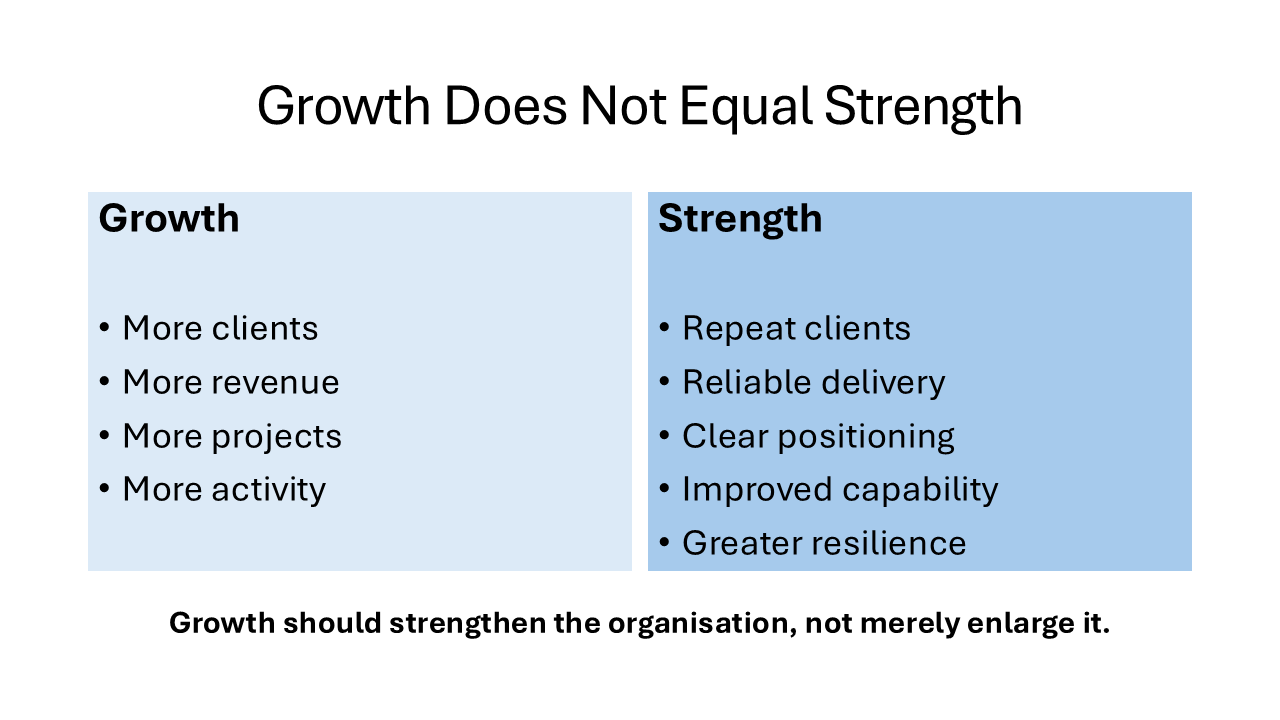
Graphic comparing growth and strength
Revenue is not the only measure
Revenue matters. Without revenue, organisations cannot survive. However, revenue should not be treated as the only indicator of progress.
Other signs often reveal whether growth is strengthening the business:
repeat clients
referral business
delivery consistency
staff retention
operational resilience
customer trust
These signals are less visible than headline revenue figures. They are often better indicators of long-term success. A business that steadily strengthens capability may be building a more valuable future than one that pursues rapid expansion at the expense of stability.
The test
A simple test helps identify the difference between growth and strength:
If growth makes delivery harder every month, the organisation may be becoming larger rather than stronger.
Growth should eventually make future success easier, not more difficult. When every additional customer increases fragility, the organisation is accumulating pressure rather than capability.
Conclusion
Growth is valuable. But growth alone is not enough. The organisations that endure are rarely those that simply become larger. They are the organisations that become stronger as they grow.
That means investing in capability, protecting focus, improving repeatability, and building resilience alongside revenue. Anyone can become busy. Sustainable success comes from becoming stronger. The most effective organisations understand that growth is not the destination. It is the by-product of a business that continues to strengthen over time.