Why Organisations struggle with change

Image Courtesy of Unsplash
Executive Summary
Most organisations understand how to announce change. Far fewer understand how to make change stick. New structures, systems, processes, and initiatives are often introduced with good intentions, yet many fail to deliver the expected benefits. The reason is simple: organisations frequently focus on implementing change rather than achieving the behavioural shifts needed to realise value. Successful change is not measured by what has been launched. It is measured by what people do differently once the launch is over.
Why organisations struggle with change
Change has become a permanent feature of organisational life. New systems are introduced. Processes are redesigned. Teams are restructured. Strategies are refreshed. Improvement programmes are launched. For many organisations, change is no longer an occasional event. It has become part of normal operations.
Yet despite the amount of effort invested in change, many organisations continue to experience a similar problem. The change happens, the benefits do not.
This raises an uncomfortable question:
Why is organisational change so often more difficult than expected?
The answer usually has less to do with the quality of the solution and more to do with the way people experience change.
Organisations change quickly. People do not.
A leadership team can approve a change in a meeting. A project team can implement a system in a few months. A process can be redesigned within weeks. Formal change can happen surprisingly quickly. Behavioural change rarely follows the same timetable.
People need time to understand new expectations. Existing habits need to be replaced. New ways of working need to become familiar. Confidence needs to develop. This creates a gap.
The organisation may believe the change is complete because the initiative has been delivered. The people affected by it may still be adapting. This is one reason so many change programmes appear successful on paper while producing disappointing outcomes in practice.
Change is not the objective
One of the most common mistakes is treating change as the goal. It is not.
Few organisations introduce a new process because they enjoy changing processes. Few leadership teams replace systems because they enjoy disruption.
The real objective is always something else:
· Better service
· Greater efficiency
· Lower risk
· Higher quality
· Faster delivery
· Stronger performance
The change is simply the mechanism. When organisations become overly focused on implementation, they can lose sight of the outcome the change was intended to create. As a result, success becomes defined by delivery rather than improvement. The initiative finishes. The desired result remains uncertain.
People experience consequences, not programmes
Leaders often describe change through organisational language. They talk about transformation, operating models, restructuring, technology, efficiency, and strategic priorities. Most employees experience something much simpler. What does this mean for me?
“People rarely resist change itself. They resist uncertainty, loss, or consequences they do not yet understand.”
That question sits at the heart of many change challenges.
People want to understand:
· What will change?
· What remains the same?
· What becomes easier?
· What becomes harder?
· What support will be available?
· How will success be measured?
When these questions remain unanswered, uncertainty grows. Uncertainty often looks like resistance. It is usually a request for clarity.
Resistance is frequently misunderstood
Resistance is commonly described as opposition. A more useful interpretation is that resistance often signals an unresolved concern.
For example:
· The purpose may be unclear.
· The benefit may not be visible.
· The impact may feel one-sided.
· Previous initiatives may have disappointed.
· Accountability may be uncertain.
Treating resistance as a problem to overcome can create conflict. Understanding resistance as information often creates progress. The question becomes:
What concern is preventing commitment?
That question tends to produce much better answers.
Communication is necessary but not sufficient
Communication is often treated as the solution to change resistance. Effective communication matters. Poor communication almost always makes change harder.
However, communication alone does not create commitment. An organisation can communicate frequently and still fail to change behaviour.
No amount of presentation, documentation, or email distribution will replace practical experience.
People begin to believe in change when they see:
· decisions changing
· leaders behaving differently
· processes being used consistently
· benefits becoming visible.
Communication introduces change. Behaviour demonstrates it.
Adoption matters more than launch
Many organisations celebrate launches. A new system goes live. A revised process is introduced. A programme reaches completion. These milestones deserve recognition. The difficulty is that adoption often begins where the project ends. A system only creates value when people use it.
A process only improves performance when it becomes normal practice. A new structure only works when people understand how to operate within it.
This is why implementation and adoption should never be confused. Implementation creates capability. Adoption creates value.
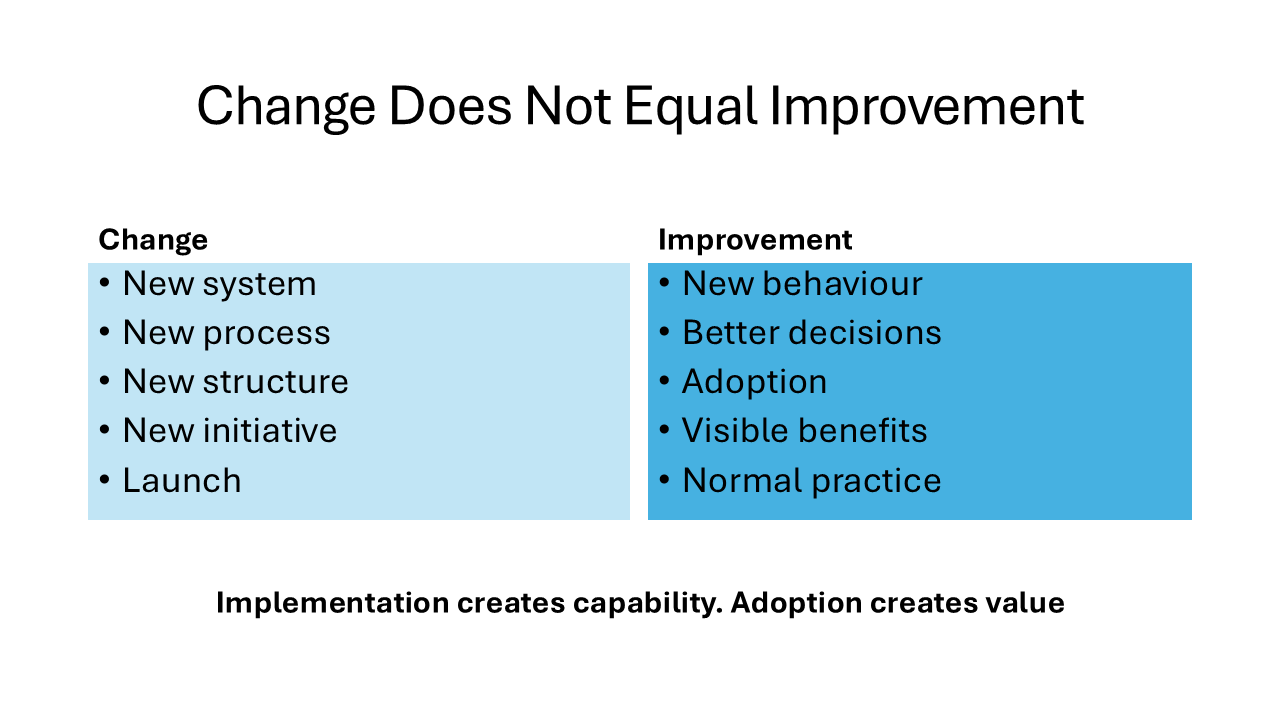
Change Does Not Equal Improvement - Derran Stokes
Behaviour is the real measure
The most reliable indicator of successful change is behavioural evidence. Not whether the initiative was launched. Not whether training was completed. Not whether the programme closed successfully.
The question is:
What are people doing differently?
If decision-making remains unchanged, the change is incomplete. If old workarounds remain dominant, the change is incomplete. If new processes exist but are rarely followed, the change is incomplete. The evidence of successful change appears in practice long before it appears in reports.
The test
A simple test helps distinguish change activity from genuine change:
If behaviour never changes, the change never happened.
Organisations sometimes find this uncomfortable because behavioural change is harder to measure than delivery activity. Nevertheless, it remains the most reliable indicator.
Conclusion
Most organisations can implement change. The greater challenge is ensuring that change becomes part of normal behaviour. This requires more than communication, programme management, or implementation plans. It requires people to understand the purpose of the change, believe the intended outcome is worthwhile, and adjust the way they work as a result.
Change should not be measured by what has been launched. It should be measured by what has become normal.
Because change is not complete when the announcement is made. It is complete when the new behaviour no longer feels new.