Why some organisations improve faster than others

Image Courtesy of Unsplash
Executive Summary
Every organisation encounters problems, setbacks, mistakes, and unexpected challenges. The difference between high-performing organisations and struggling organisations is rarely the absence of problems. More often, it is the speed and consistency with which lessons are turned into action. Many organisations gather feedback, conduct reviews, and identify lessons learned. Far fewer change behaviour as a result. Sustainable improvement comes not from collecting knowledge but from applying it. Organisational learning is not measured by what has been documented. It is measured by what has become normal practice.
Why some organisations improve faster than others
Every organisation wants to improve. Leaders want better performance. Teams want fewer frustrations. Customers want better service. Owners want stronger results. Despite this shared ambition, organisations improve at very different rates.
Some appear to learn quickly. Once problems are identified, changes are made, and performance improves. Others seem trapped in a cycle of recurring issues. The same concerns reappear. The same recommendations resurface. The same surprises continue to cause disruption. This raises an important question:
Why do some organisations improve faster than others?
The answer often lies in the difference between experience and learning.
Experience alone is not enough
Experience is frequently described as a valuable teacher.
In many respects, that is true. Experience exposes weaknesses. It reveals gaps in capability. It creates opportunities to reflect and improve. However, experience does not automatically create learning. An organisation may experience customer complaints, delivery failures, project delays, staff turnover, or governance issues. Those events provide information. They create the opportunity for learning.
The learning itself only occurs if something changes. Without that change, the organisation has merely accumulated a record of the experience. This distinction is important because organisations often assume that awareness and learning are the same thing. They are not. Knowing that a problem exists is different from doing something about it.
Lessons identified are not lessons learned
Many organisations conduct reviews after significant events. Projects hold lessons-learned workshops. Teams discuss what went well and what could improve. Reports are written. Recommendations are captured. All of these activities are worthwhile.
The difficulty is that identifying a lesson and learning a lesson are not the same thing. A lesson is only truly learned when behaviour changes.
If a project identifies the importance of stakeholder engagement but future projects behave in exactly the same way, the lesson was recorded but not learned. If a risk review highlights concentrated dependency on a small number of individuals but no action follows, knowledge has been created without improvement. The lesson exists, but the learning does not.
“A lesson is only truly learned when behaviour changes.”
- Derran Stokes Penyard Project Consultants
Knowledge does not create capability on its own
This challenge becomes more obvious when organisations invest heavily in training. Training can increase knowledge and understanding. It can introduce new tools, concepts, and ways of thinking. But knowledge alone does not guarantee capability. People often know what they should do. Consistent implementation of what should be done is the recurring difficulty.
An organisation may understand the principles of project governance, customer service, operational resilience, or financial management. Yet those principles may still fail to influence everyday decisions. Capability emerges when knowledge becomes routine behaviour. The gap between knowing and doing is where many improvement efforts lose momentum.
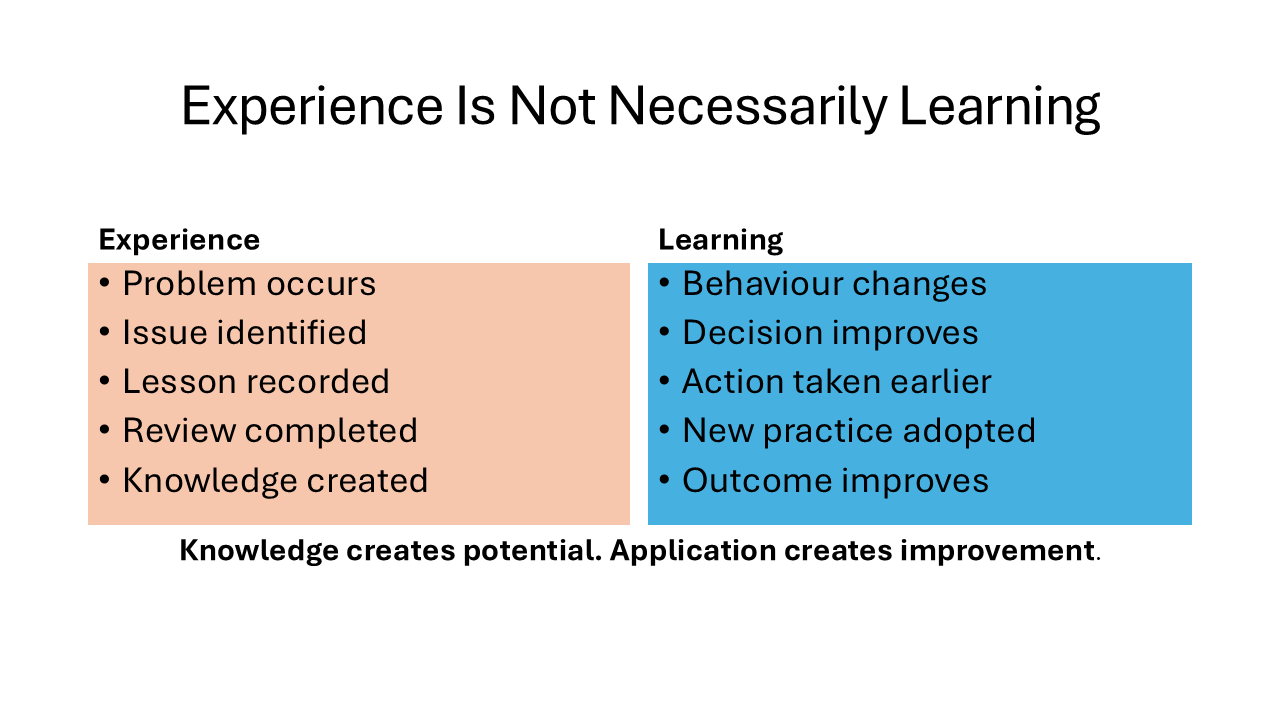
Experience alone does not create learning. Learning happens when behaviour changes
Learning changes decisions
One of the strongest signs that learning is taking place is improved decision-making. A learning organisation does not simply collect insights. It uses them. Leaders ask better questions. Teams recognise problems earlier. Risks are identified before they become issues. Mistakes become less frequent because previous mistakes have altered behaviour. The result is not perfection. Problems still occur. The difference is that organisations become better at responding because prior experience influences current judgement. Learning therefore appears less in documents and more in decisions.
Repeated surprises are warning signs
A useful signal of organisational learning is how often the same surprise occurs. Unexpected events will always happen. Markets change. Circumstances shift. New challenges emerge. The concern arises when familiar events continue to produce the same reaction. A recurring problem should become progressively less surprising. If the same issue creates the same level of disruption year after year, there is a reasonable chance that learning has not been translated into action. Repeated surprise often indicates one of three things:
the lesson was never identified;
the lesson was identified but not applied;
the lesson was applied inconsistently.
In each case, the challenge is not knowledge. The challenge is adoption.
Learning must become normal practice
The most successful organisations are not necessarily those with the best training programmes, the largest knowledge bases, or the most detailed process documentation. They are often the organisations that make learning part of normal practice. When lessons become embedded:
people share knowledge more freely
problems are addressed earlier
improvements become easier to sustain
capability becomes less dependent on individuals.
Learning becomes part of the culture rather than an occasional activity. This creates compounding benefits over time. Each improvement makes future improvement easier.
Why organisations stop learning
Ironically, success can sometimes become a barrier to learning. When performance is acceptable, there is less pressure to challenge assumptions. Existing methods become comfortable. Improvement begins to feel optional. The organisation continues operating successfully, but its ability to adapt gradually weakens. This is one reason why some organisations struggle when circumstances change. Their previous success reduced the urgency to learn. Learning requires curiosity. It also requires the humility to accept that current practice can be improved.
The test
A simple test helps determine whether genuine learning has occurred:
If the same problem creates the same surprise, the learning has not occurred.
This is not a criticism. It is a signal. The organisation may know what happened. The question is whether that knowledge has changed behaviour.
Conclusion
The organisations that improve fastest are not those that avoid mistakes. They are the organisations that convert experience into action more effectively than others. They identify lessons, apply them consistently, and reinforce them until new behaviours become normal practice. Knowledge matters. Training matters. Reviews matter. But none of them create improvement on their own. Improvement occurs when lessons influence behaviour, decisions, and outcomes. Because organisational learning is not measured by what has been documented. It is measured by what people do differently because of it.