Why senior leaders prefer fewer words

Courtesy of Unsplash.com
Executive Summary
Senior leaders do not usually need less information because they are uninterested in detail. They need information to be selected, ordered and expressed so that the decision becomes clear quickly. Long papers, crowded presentations and extended explanations can obscure sound analysis rather than demonstrate rigour. Effective executive communication begins with the decision, recommendation and consequence, while keeping supporting evidence available for challenge. The objective is not to say the least possible. It is to communicate everything necessary, and nothing that makes the important point harder to see.
Senior attention is a scarce resource
Senior leaders operate in environments where information is abundant and attention is limited.
A typical working day may involve operational performance, financial results, staffing concerns, customer issues, regulatory matters and strategic decisions. Each subject may be important. Each may arrive with reports, presentations, emails and requests for approval. The difficulty is rarely gaining access to information. The difficulty is identifying what matters.
This is where executive communication becomes valuable. Its purpose is not merely to transfer information from one person to another. It is to organise information so that judgement can be exercised efficiently. Yet many papers and presentations do the opposite.
They begin with history, move through context, describe the analysis and explain the methodology. Assumptions and caveats follow. The recommendation may not appear until the final page. The author may believe this demonstrates thoroughness. The reader experiences a search.
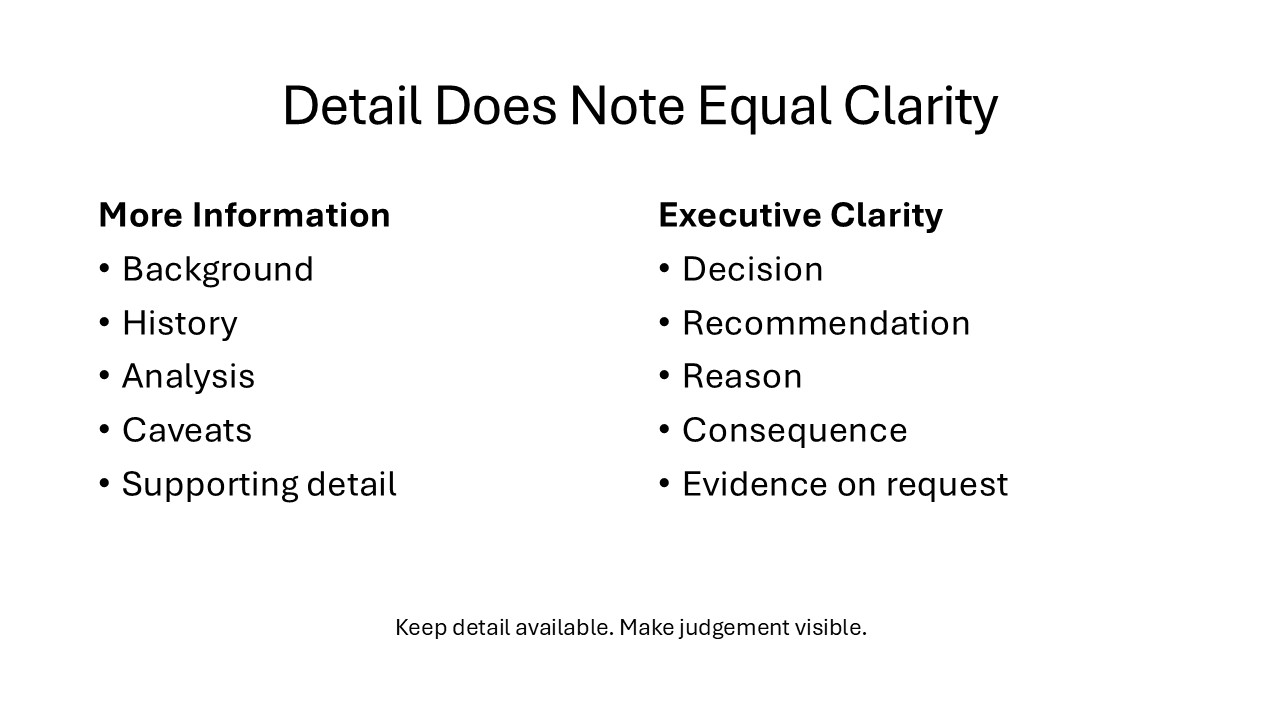
Detail is not the same as clarity
Detailed work has an important place. Senior decisions should be supported by sound analysis, credible evidence and clear assumptions. But detail and clarity are not the same thing.
A document can be comprehensive and still leave the reader uncertain about what is required. A presentation can contain accurate information and still fail to communicate its central point. A lengthy explanation can demonstrate effort while obscuring judgement. This happens because writers often organise information in the order in which they discovered it.
They reproduce the analytical journey:
the background;
the investigation;
the evidence;
the alternatives;
the conclusion.
The executive reader usually needs a different sequence:
the decision;
the recommendation;
the reason;
the consequences;
the evidence, where required.
The analysis remains important. Its position changes.
“Clarity is created by making the important thing impossible to miss.”
Why people over-explain
Over-explanation is rarely caused by a lack of knowledge. It is more commonly caused by a lack of confidence in what can safely be omitted. Writers worry that a short document will appear superficial. Advisers fear that a brief answer will not demonstrate sufficient expertise. Teams add background so that nobody can accuse them of overlooking something.
The result is communication designed to defend the author rather than serve the reader. Every additional paragraph may be individually reasonable. Collectively, those paragraphs make the decision harder to identify.
This is especially common when the subject is uncertain. More qualifiers are added. More alternatives remain visible. More analysis is offered in anticipation of every conceivable question. The communication becomes longer, but the underlying judgement does not become stronger.
Brevity does not mean oversimplification
There is a difference between reducing complexity and pretending complexity does not exist. Oversimplification removes something essential. Brevity removes what is not currently necessary.
An executive summary that states the decision, recommendation and principal consequences is not denying the supporting detail. It is placing that detail at the appropriate level.
A concise presentation can still be grounded in substantial work. A one-page brief may sit above days of analysis. A one-sentence recommendation may reflect years of experience.
The reader does not need to see every part of the process to trust the result. The reader needs confidence that the necessary work has been done and that the conclusion can withstand challenge. This is why good executive communicators keep detail available without making all of it visible.
The decision should appear first
The simplest improvement to executive communication is often to state what is being asked for at the beginning.
Consider a leadership team facing deteriorating operational performance, increasing work-in-progress and rising pressure across a service.
A conventional paper might begin by describing the history of the service, recent performance, stakeholder interviews, data limitations and possible causes.
Several pages later, the paper recommends focused discovery. A decision-first opening would instead say:
Approve focused discovery to identify the causes of declining performance before committing to intervention.
The leader immediately knows:
what is being requested;
why the paper exists;
what the proposed next step is.
The supporting information can then explain why that recommendation is reasonable. The difference is not cosmetic. It changes how the document is read.
Once the reader understands the decision, every subsequent point can be interpreted in relation to it. Without that anchor, information competes for attention.
Good communication makes consequences visible
A recommendation rarely stands on its own. Senior leaders also need to understand the consequences of acting and not acting. That does not require an exhaustive catalogue. It requires the few consequences that materially affect the decision.
For example:
performance is continuing to deteriorate;
work-in-progress is increasing;
further delay will reduce available options;
discovery will reduce uncertainty before significant investment.
These points give the decision shape. They explain why it matters now, rather than merely describing why the subject is interesting.
The most effective executive communication connects information to consequence. Facts become relevant because the reader can see what those facts mean for the choice being made.
Headings should carry the argument
Many readers skim before they read carefully. This is not poor behaviour. It is a rational response to information volume. Good headings therefore do more than label sections.
A heading entitled Risks tells the reader the subject.
A heading stating Further delay will increase cost and reduce available options tells the reader the judgement.
If the headings alone communicate the argument, the document is easier to understand. Readers who need more evidence can enter the detail. Readers who need only the senior message can still follow the logic.
This principle applies equally to PowerPoint titles. A slide called Options Analysis identifies its contents. A slide called Focused discovery offers the best balance of speed and certainty communicates its conclusion.
This is not presentational polish. It is decision architecture.
Silence is part of executive communication
The same discipline applies in conversation.
An adviser may give a clear recommendation and then continue speaking because silence feels uncomfortable. Further context is added. Caveats are introduced. The answer becomes less certain as it becomes longer. A concise answer followed by a pause gives the decision-maker space to think and ask for the detail that matters most.
That pause is not disengagement.
It reflects confidence that the answer can stand without immediate defence. Trusted advisers do not conceal detail. They allow demand to determine when detail becomes visible.
The test
A simple test helps distinguish executive communication from information transfer:
If the audience must search for the conclusion, the communication has failed.
The problem may not be weak analysis. The problem may simply be that the analysis has not been converted into a form that supports senior judgement.
Conclusion
Senior leaders do not prefer fewer words merely because they are busy. They prefer communication that respects the purpose of their attention.
They need to understand what is being decided, what is recommended, why it matters and what consequences follow. Supporting evidence remains essential, but it should strengthen the decision rather than hide it. Good executive communication is not the art of making everything short. Some subjects require depth, nuance and extensive examination.
The discipline lies in separating what the reader needs now from what the reader may need later.
State the decision. Make the recommendation clear. Explain the consequence. Keep the evidence ready. The aim is not to say as little as possible. It is to ensure that nothing unnecessary stands between the reader and the judgement required.